

GOAT Network CEO Kevin Liu sits down with Biteye at KBW 2026: the road from 160 million downloads to Bitcoin infrastructure, why "Bitcoin Layer 2" was never enough on its own, and the booth that gave his team its first real glimpse of product-market fit.
Minutes after walking off the Stable Stage at @KBWofficial, GOAT Network co-founder and CEO @KevinLiu sat down with @BiteyeCN to tell the longer story: how a founder who had already seen 160 million downloads ended up betting on Bitcoin, and what happened at the booth downstairs that made the bet feel close to paying off.
Biteye's Amelia caught Kevin at KBW 2026 in Seoul, fresh from his main-stage talk, for the second of two interviews he gave at the conference. The first, with Bitcoin News, covered the live agent demo and the architecture underneath it; you can read it here. The Biteye conversation went somewhere else: backwards, through two decades of building, and inwards, to the most candid assessment Kevin has given of what worked, what did not, and why GOAT Flow exists.
Kevin's answers below are translated from the original Chinese and lightly edited for length and clarity. The full interview is on Biteye's YouTube channel, linked at the end.

CEO Kevin Liu with Biteye's Amelia at KBW
From 160 million downloads to Bitcoin
Kevin did not arrive in crypto through crypto.
"I actually entered Web3 around 2018, 2019. Before that I was building mobile internet startups. We built a mobile live-streaming app that was later acquired by China Radio International, with around 160 million cumulative downloads. So our team has seen real users and real traffic."
That line frames everything that follows. Kevin measures infrastructure by whether people actually use it, and it is the standard he has applied to every project since. After leaving the app behind and moving to Canada, he went looking for a new direction, found friends who had entered Web3 early, and saw an industry whose infrastructure was still barely built. The team started researching Ethereum scaling in 2019 and launched Metis, one of Ethereum's early Layer 2s, in 2021.
"When we built @MetisL2, we brought early investors close to a 300x return. With GOAT, the market has not been great recently, so we are still working at it."
GOAT started in 2023, built on the view that there was still plenty worth constructing beyond Ethereum Layer 2: zero-knowledge proofs, Bitcoin's scalability, and whatever new use cases could emerge around Bitcoin itself. Underneath it sat one question.
"We kept thinking about how to make the Bitcoin network more prosperous, genuinely busy. If the users of a network only hold the asset and nobody actually uses the network, the foundation of its value is not solid. If miners do not have enough incentive, the security of the Bitcoin network suffers too, and in the end the value of the assets everyone holds loses its support."
"Bitcoin Layer 2, by itself, is not enough"
From 2024, with the Bitcoin-based scalability stack built, the search turned to a product scenario with real product-market fit. Kevin is unusually direct about how that search went.
"We tried DeFi on Bitcoin Layer 2, and we tried BTCFi, but to be honest, it was not particularly successful."
The reflection that followed is the most clear-eyed diagnosis you will hear from anyone building in the category.
"Most projects have no need to rebuild on a new Layer 2. If a project on Ethereum has plenty of capital, strong community consensus, and a good product experience, why would it have to move to another chain? Which tells you that relying on the concept of 'Bitcoin Layer 2' by itself is not enough."
So the team kept searching, and the direction it found reshaped the product.
"That is why we integrated x402 and MPP, and fiat payments as well. The idea is that no matter which chain your assets sit on, the agent only needs to complete the payment on a chain it can pay on to get the service. It does not have to think about cross-chain problems itself. Our infrastructure underneath handles the whole cross-chain process for it."
For context, x402 is the open agent-payment protocol Coinbase introduced, and MPP is Stripe's Machine Payments Protocol.
"From the direction of agent payments, in the process of looking for product-market fit, we felt this could be the opportunity."
The merchants agents cannot find
The other half of the opportunity sits with merchants.
"Agents are already very powerful, but for a lot of merchants there are still a lot of missing pieces. Say you ask an agent to buy you a pair of tennis shoes. It will not necessarily find all the products that really suit you. It will probably find the top-ranking websites first, or the platforms it has partnerships with. But small and mid-sized merchants, who might have big discounts or really distinctive products, are very hard for an agent to discover."
Closing that gap is the product Kevin had announced from the stage an hour earlier.
"I just came off stage at KBW, and this time we officially launched a new product called GOAT Flow. The goal of GOAT Flow is to help merchants make their products understood by machines, discovered by machines, and ultimately bought by machines. No matter how local a merchant is, even in a very remote place, GOAT Flow can plug their products into the agent ecosystem."
GOAT Flow had been live since late August, and KBW was its official launch moment. Kevin's description of getting started matches what merchants find in the portal.
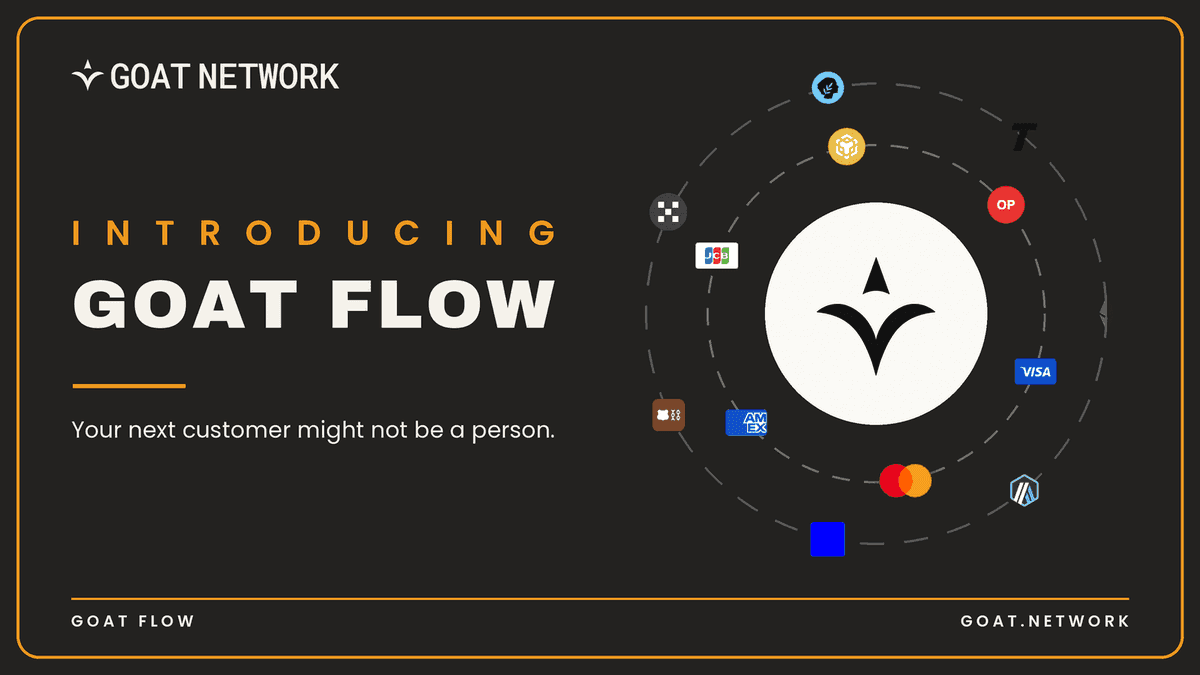
GOAT Flow launched in August 2026.
"The whole onboarding process is very simple. Think of it like registering an email address. The merchant fills in some product information, and a payment-ready page is generated automatically. That page carries the complete product information, the payment methods, and machine language an agent can read directly."
What comes next is distribution.
"The next thing we need to do is build the traffic, so that when a user expresses a purchase intent to an agent, the agent can discover these products and complete the purchase for them."
Merchants who want to be on the shelf when that traffic arrives can start with How to Start Selling to AI Agents.
The direction changed. The logic did not.
A company that moves from BTCFi to agent payments invites the question of what, if anything, stayed constant. Kevin's answer is settlement.
"Our product direction has shifted, but the underlying logic has not changed. We believe that whether you ultimately use crypto or fiat, it should settle on the most secure network. Fiat has the traditional banking system, but for crypto, we believe final settlement should come back to the Bitcoin network."
That conviction is the thesis GOAT has published in full in Why Bitcoin should be the settlement layer.
It is also a conviction with a track record behind it.
"Decentralization is something we genuinely pursue, and we have our own ideas about it. Metis, for example, was and still is one of the few Ethereum Layer 2s that truly runs a multi-sequencer node model. In a sense it is a bit like starting a revolution against yourself, because you are sharing the sequencer revenue with all the node participants instead of one company keeping control of it. But the benefit is that the network achieves a genuinely higher degree of decentralization. Its resistance to attack, its resistance to censorship, and its overall security all step up to a completely different level. And from that angle, we recognize the value Bitcoin represents all the more."
The uncomfortable truth about Web3 in Silicon Valley
Asked about AI and crypto, Kevin opened with an observation most founders would keep to themselves.
"There are some uncomfortable truths right now. When we were at events in Silicon Valley, a lot of Web3 people did not even dare to introduce themselves as working in Web3. Sometimes when you say you are from Web3, the AI people wonder whether you have come to ride the AI wave again."
He does not think the dismissal will survive contact with reality.
"From the perspective of building platforms, technology and products, I think AI and blockchain are certain to combine very deeply. If AI could one day handle payments entirely on its own, that would be a different story. But the reality is that without blockchain infrastructure, AI is going to run into a lot of problems at the payment layer. Especially as more and more machine-to-machine payments appear, with huge volumes of small, high-frequency transactions, the traditional financial system can hardly support that kind of demand. So I believe blockchain will carry an important part of AI's infrastructure."
And then the part that explains why the skepticism exists at all.
"Of course, a lot of Web3 projects in the past, ours included, never really found product-market fit and never produced good enough results. Being looked down on in that situation is natural. In the end it is on us, to prove it through real products and real results."
A glimmer at Booth 37
The proof Kevin had in mind was two floors down.
"KBW left a deep impression on us this time. We were attendees, and we also had our own booth. After officially launching GOAT Flow, we set up a small activity on site where people could buy GOAT plushies and Starbucks gift cards through an agent. The result completely exceeded our expectations. Yesterday the queue stretched all the way to the entrance."
The numbers from his count after day one:
"More than 300 items sold in total, over 100 GOAT plushies and over 200 Starbucks gift cards."
By the time the conference closed, more than 450 people had come through Booth 37 and agents had made over 310 purchases on their behalf; the full story of those two days is in the KBW 2026 recap.

Around 500 visitors showed up at the GOAT booth.
The mechanics were deliberately ordinary.
"The whole flow is that the user scans the code, or hands the QR code straight to their own agent, and the agent automatically calls our purchase flow. Whether the user ends up paying with crypto or a credit card, the full payment process completes."
For a founder who opened the interview by saying his team has seen real users and real traffic, the week in Seoul carried a particular weight.
"The response from the Korean market went far beyond what we imagined. For us, this might be the first time we have really seen a glimmer of light. We are starting to think that maybe we really are approaching product-market fit."
GOAT Flow is live at goat.network/flow.
The full interview with Kevin Liu, in Chinese, is on Biteye's YouTube channel: youtube.com/watch?v=7OUQaMA_yNo

