

Settlement is the point where a payment is final. The money has moved, the ledger everyone relies on says so, and nobody can take it back. Every payment system has a settlement layer somewhere underneath it. For a card payment it's a bank. For a bitcoin transaction it's Bitcoin.
Bitcoin has a fixed supply. It has no owner and no admin key. Nobody who can freeze a balance or reverse a transaction. Those aren't properties of the coin in your wallet. They're properties of the ledger it settles on.
Which means they don't travel. Move a bitcoin somewhere else to use it and you're not actually using it anymore.
What you're actually holding
A lot of the bitcoin that gets used, rather than just held, isn't settling on Bitcoin.
On an exchange, you hold a number in a database. The exchange owes you bitcoin.
Wrapped on another chain, you hold a token that says a custodian is keeping a bitcoin for you. The token is worth what that promise is worth.
On a federated sidechain or rollup, a group of named companies holds the bitcoin in a multisig. More signatures than one custodian. Still a promise.
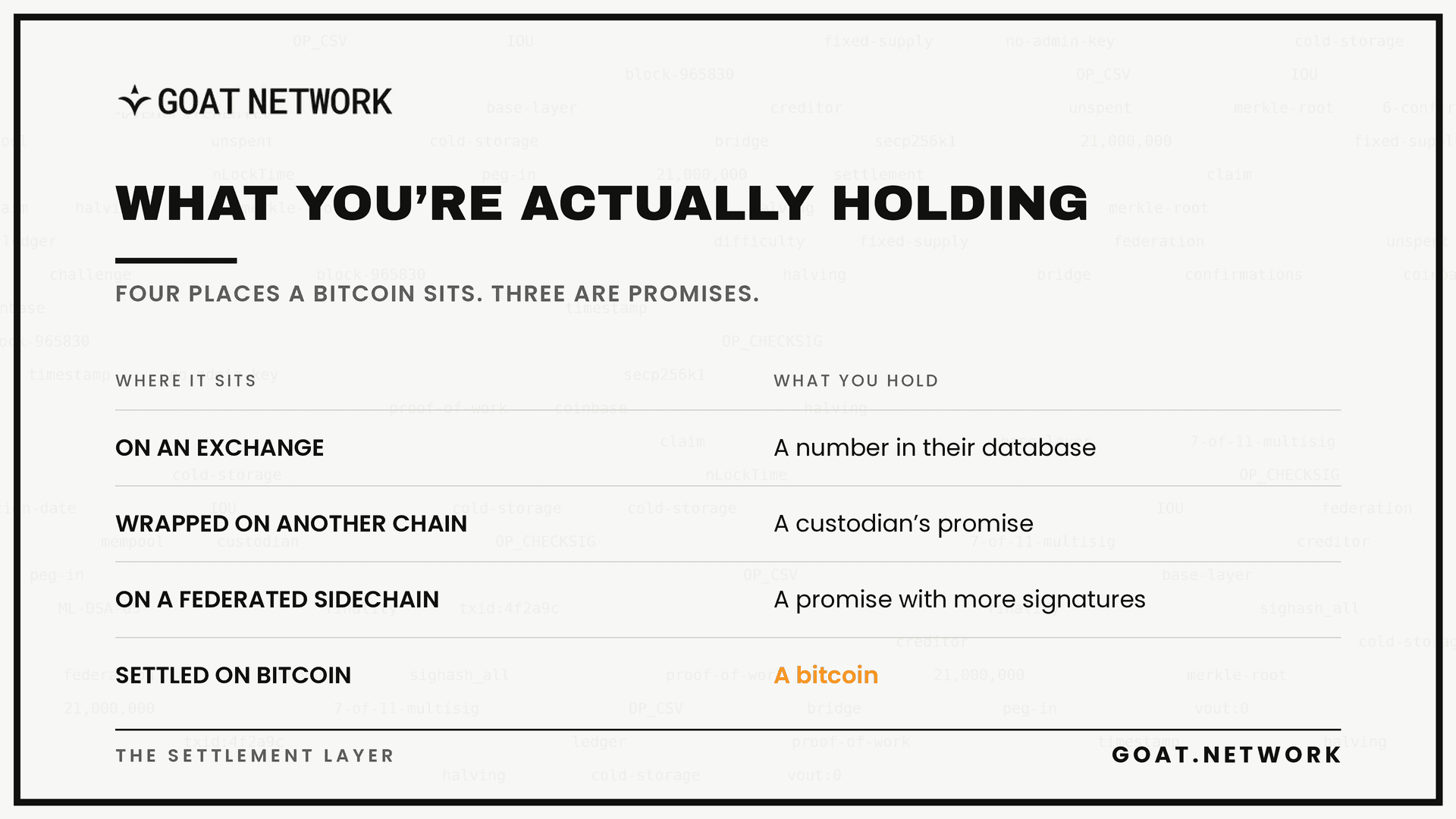
In every case you're holding a claim on someone. You're a creditor. That's fine right up until it isn't.
A promise is bad for us
The usual reply is that people have recourse. If the promise breaks, there's a court.
There is, and it doesn't fix it. When a custodian fails you become one creditor in a queue. Mt Gox failed in 2014. Repayments began a decade later, and some creditors are still waiting today. FTX creditors were paid in dollars at the price on the day it collapsed, not in the bitcoin they'd deposited. In between there are years of claim forms, lawyers, and waiting, and most people get back less than they lost, if they get anything at all.
Recourse exists on paper. In practice it's slow, partial, and exhausting, and nobody wants it. The promise isn't a good deal for us.
For lack of a better option, we've just been putting up with it.
It's worse for agents
An agent can't even put up with it.
An agent has no legal identity, so it can't be a creditor, file a claim, or sign a settlement. It has no jurisdiction, so there's no court to go to in the first place. It works on machine timescales, so a recovery process measured in years is the same as never. And it transacts constantly at small sizes. Nobody litigates a broken three-dollar promise, and an agent's entire economic life is three-dollar promises.
An agent also can't judge a counterparty the way a person does. It can't meet the founders or read the room. It can only check what's checkable. A promise isn't checkable. A transaction settled on Bitcoin is.
So for an agent, the settlement layer is the only recourse there is. If the guarantee isn't built into where the money settles, the guarantee doesn't exist. The protocol has to be the court, and it has to be a court that never needs to be asked.
Why Bitcoin
If the guarantee has to live in the settlement layer, the question is which one.
Bitcoin is the asset we and our agents will hold, so settling it anywhere else brings the promise straight back. It has no foundation, no owner, and no admin key, which makes it the most neutral ledger there is. It has been running since 2009, with more value at stake than any other network.
And it's built for long time horizons. Agents will hold and move value for years, and that value should settle on the ledger with the longest expected life. Think in years and decades, not weeks and months.
What that needs
Bitcoin's base layer can't do all of this on its own. It's slow, and it's not programmable enough for what agents will do. @Lightning already shows payments can move fast while still settling on Bitcoin, but agents will need more than payments: escrow, contracts, programs that hold and move money under rules. So we need infrastructure on top of Bitcoin, and the whole job of that infrastructure is to add speed and programmability without turning the bitcoin back into a promise.
That means Bitcoin-native infrastructure that is decentralized, trust-minimized, and quantum secure. Each of those words rules out a shortcut.
Bitcoin-native: because security borrowed from another chain is another promise.
Decentralized: because a single sequencer is a single company that can stop, censor, or reorder your transactions.
Trust-minimized: because a bridge run by a custodian or a federation is the exchange problem with more signatures. The bitcoin has to be held under rules that Bitcoin itself enforces.
Quantum secure: because these guarantees have to hold for decades, and the signatures securing bitcoin today won't survive a large enough quantum computer. Nobody knows the date. The infrastructure has to be ready before it.
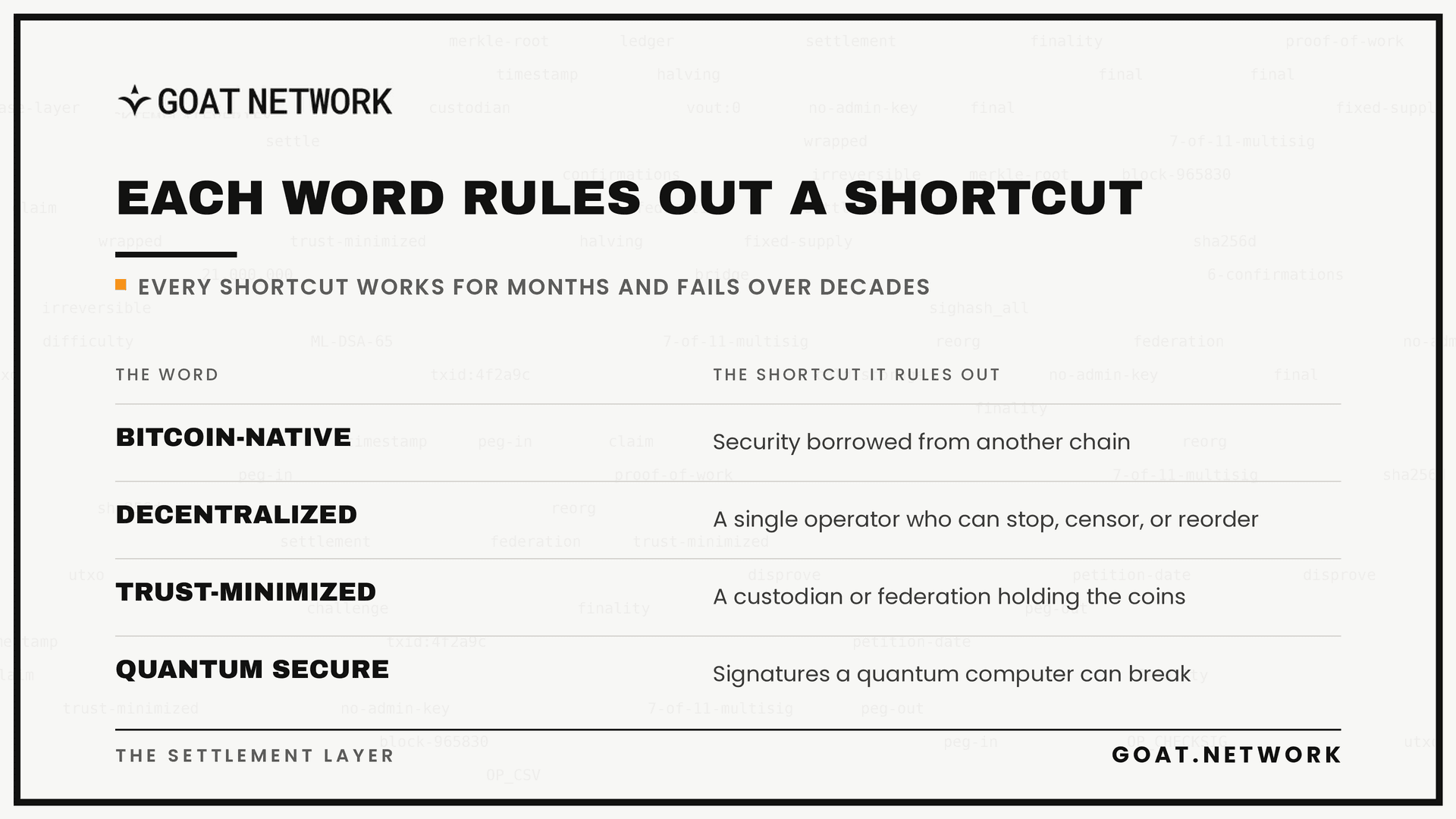
Every one of those shortcuts works for months and fails over decades. The next economy is going to run for decades.
Settlement is inherited
There's a further step to this argument, and it's the bigger one. The properties that don't travel off Bitcoin do extend to what settles onto it.
A rollup that settles on Bitcoin extends Bitcoin's settlement to everything that happens on it. Every transaction it processes, whatever the asset, is folded into a state that is proven and settled to Bitcoin. A stablecoin payment, a trade, an agent paying another agent for work. Each becomes final the way a bitcoin transaction becomes final, on the same ledger, under the same rules.
The routes in are already open. Through GOAT Flow, commerce arrives by card across @Visa, @Mastercard, @AmericanExpress, and @JCB_CARD, and onchain across ten networks: @Ethereum, @BNBChain, @Arbitrum, @Optimism, @Base, @Berachain, @XLayerOfficial, @MetisL2, @Tempo, and GOAT. Every onchain payment among them is verified on GOAT, and what settles on GOAT settles on Bitcoin.
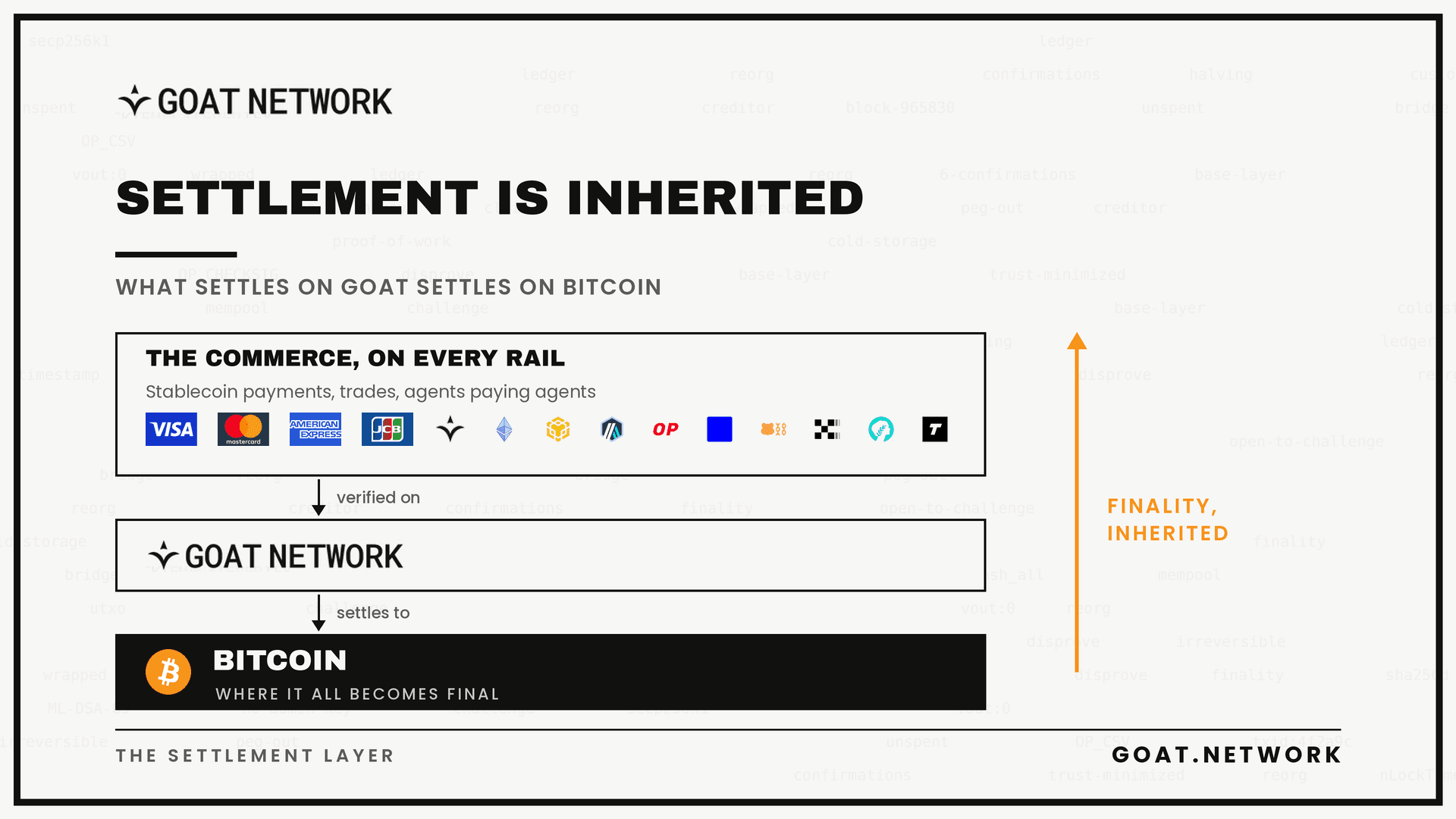
The assets keep their own risks. A stablecoin is its issuer's promise to redeem, wherever it lives. What's inherited is the settlement itself: that the payment happened, that it's final, that nobody can reverse, censor, or quietly rewrite it after the fact.
That's what makes Bitcoin the settlement layer for the next economy rather than for bitcoin alone. Most of the commerce we and our agents will do won't be denominated in bitcoin, and it doesn't have to be. If it settles on Bitcoin, it inherits the finality of the hardest ledger there is, whatever it's denominated in.
What we've been building
This is the standard GOAT Network has spent years building to. A zkEVM rollup that settles to Bitcoin, with exit validity proven and disputable on Bitcoin itself. A BitVM3 bridge, published as a Whitepaper and put through a public bug bounty, that holds every withdrawal open to challenge for at least a week. A decentralized sequencer, so no single company sits between a transaction and the chain. GOAT Flow and AgentKit, so agents can hold and move bitcoin under the same guarantees. And a published migration of validator consensus keys from secp256k1 to post-quantum ML-DSA-65, mapped in A Post-Quantum Map.
Bitcoin is the asset. It should also be the settlement layer, for us and for our agents. Think in years and decades, not weeks and months.
Nothing in this article constitutes as financial advice.

