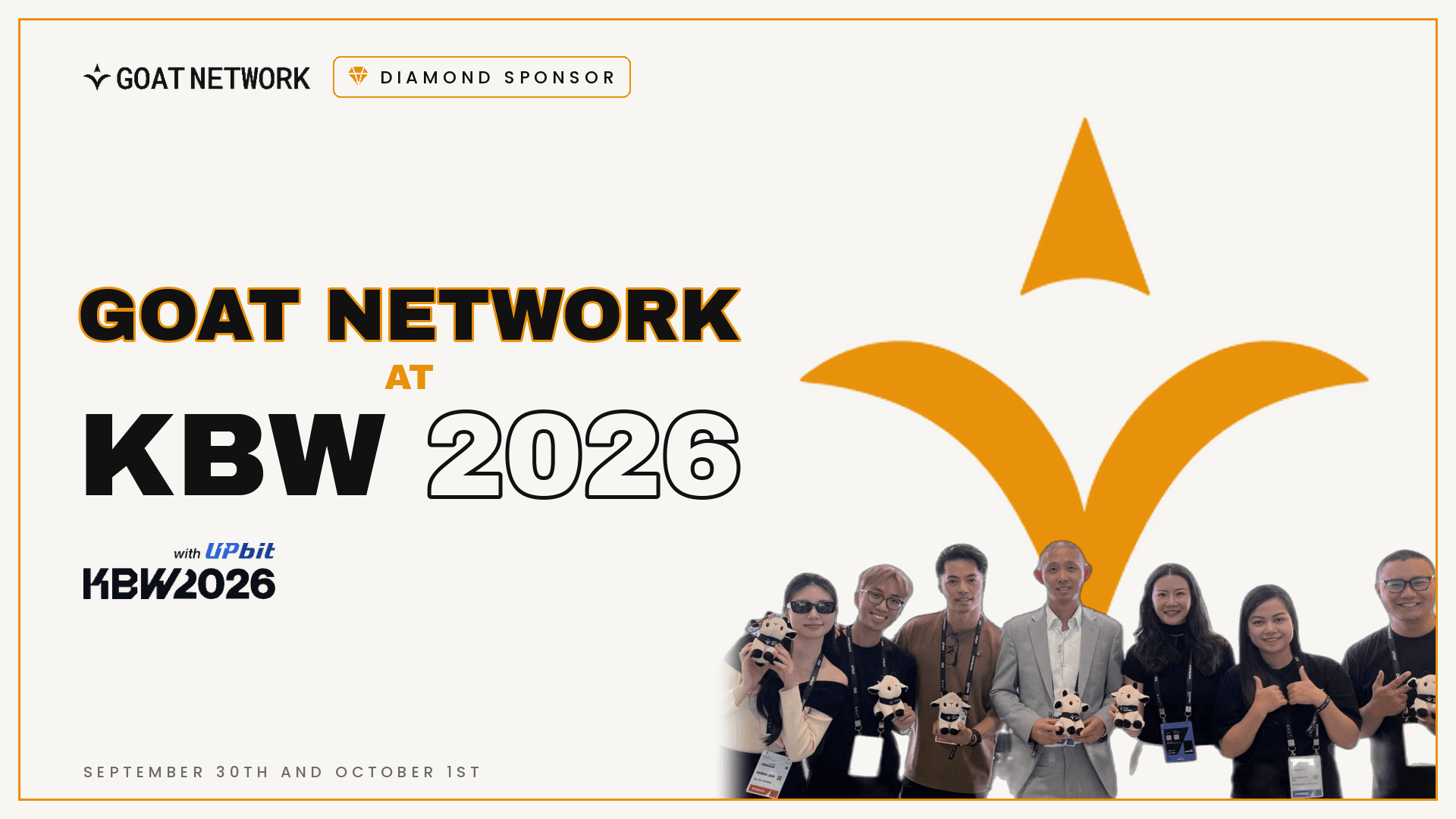
On the opening morning of Korea Blockchain Week, while a queue formed at the GOAT Booth to watch AI agents buy real products, GOAT Network co-founder and CEO Kevin Liu joined Bitcoin News live from the show floor.
Doors at KBW 2026 opened at 9:30. By 9:45, visitors to the GOAT Network booth had already bought eight goat plushies and nine Starbucks gift cards, and not one of those purchases was made at a till. Every one was carried out by an AI agent through GOAT Flow.
Between booth demos, Kevin sat down with Bitcoin News to explain what people were queuing for, why agent payments need Bitcoin underneath them, and how a team that started at the lowest level of Bitcoin infrastructure ended up at the front of agent commerce. GOAT was a Diamond Sponsor of this year's event, and the interview came a day before Kevin took the Stable Stage to explain why your next customer is an AI agent.

Kevin with Bitcoin.com Journalist Graham Stone.
The missing link in agent payments
The timing was no accident. Meta's Muse, launched in early September, crossed five million downloads faster than ChatGPT did, per Sensor Tower. Manus shipped 2.0 two days before KBW opened. Agents are reaching ordinary consumers at a pace nothing else in software can match right now.
"All these AI agents are getting more and more powerful", Kevin said. "It seems like they can do everything. But when you really ask them to do something, you find there are missing links in between, especially in payments. You ask one to buy some tennis shoes, it finds a website, and it turns out it cannot do the payment. It's not because the agent isn't powerful enough. It's because the merchant side isn't ready."
That gap is what GOAT Network is filling: Bitcoin-secured infrastructure that gets merchants ready for the agent era.
Why the foundation is Bitcoin
Asked why Bitcoin has to be involved at all, Kevin's answer came down to risk. "Anything related to payments, you cannot have any risk. In traditional finance, you go to the bank and rely on the bank system. In crypto, you rely on the network with the most security and the most consensus, and that's Bitcoin. Your agent can spend any asset, but it needs to settle on the most secure one.”
Settling directly on Bitcoin, though, is the hard part. "Bitcoin has no smart contracts, no mechanism to settle this today. So we built GOAT Network on top of Bitcoin to inherit its security, with smart contracts and a scalability layer. Transactions settle on GOAT, and GOAT settles on Bitcoin."
That connection runs through GOAT's BitVM3 bridge, secured by a purpose-built zkVM, and building it is what lets Bitcoin serve as the settlement foundation in the first place. "We don't want to touch users' bitcoin", Kevin said. "It stays locked on Bitcoin mainnet, and we use these mechanisms to make it liquid on the L2, so many more applications and use cases can use your bitcoin."
The full argument for this architecture is in Why Bitcoin should be the settlement layer.
Inside the Booth 37 demo
The demo Kevin described is the one hundreds of attendees ran over the two days of the conference. Scan a QR code and an agent opens on your phone, asking what you want to buy. Choose the plushie or the gift card - a $10 Starbucks card, offered at $1 for the show - and the agent brings up the payment sheet on your phone and completes the purchase. Most buyers at the booth paid by card: GOAT Flow integrates x402 and Stripe, so Visa, Mastercard, American Express and JCB run alongside the ten supported chains.

The GOAT booth was amongst the most popular at KBW 2026.
The booth used an embedded browser agent so nobody had to install anything, but the system is agent-agnostic. "In real life you can use Claude, ChatGPT, Manus, or Muse", Kevin said. "If your agent is already connected to your accounts, you give it the QR code and it does the rest."
He was clear about where the human sits in the loop. "Agents should do all of this by themselves - that's the automation - but of course they need your approval. After approval, they should move as fast as they can."
Making every merchant visible to agents
The deeper problem GOAT Flow solves is discovery. "We studied how ChatGPT and Claude search when you really want to buy something", Kevin said. "Usually they go to the top-ranking websites, the big ones, and they use the price feeds they have contracts with. For medium and small merchants, there's no way for an agent to find your product."
GOAT Flow, which went live at the end of August, makes a merchant's products "readable, understandable, searchable, and purchasable" by agents. Setup is three steps: register, fill in your merchant and product information, and you get an agent-ready page to drop into your own website or list in GOAT's marketplace, where GOAT handles the GEO and SEO.
The full walkthrough is here.
Payments the old rails cannot handle
A person asking an agent to buy something is only the first scenario. "If it's machine to machine and the payment is $0.01 or even less, I don't think the traditional finance system can handle that", Kevin said. "The service fee is much higher than the payment." A rail where sub-cent payments clear is not a cheaper version of an existing market. It is a new one, and the projections around it are large: McKinsey puts agentic commerce at $3 to 5 trillion by 2030.
Kevin's shorthand for all of this: "Your next customer is an agent."
The conversation turned to whether agents can be marketed to at all, since they do not care what a banner looks like. Kevin agreed, with a caveat. "Agents are going to be the main traffic in the future. You still need to find a way to get agents to notice you, understand you, and then buy from you. Give agents real usage and real incentives." That is the role being added to GOATED, the network's native token. It already secures the network through node operation and staking incentives, and the team plans to extend it into agent payments as an incentive layer, with points for the agents that transact through the network. Using the network does not require it.
Finding the niche
Kevin co-founded Metis, one of Ethereum's early layer 2s, and the lessons carried over. "Infrastructure is the first step for doing a lot of business on top, and the second part is timing", he said. Ethereum had community consensus and plenty of applications, but it was slow and expensive; when layer 2s made it cheap and fast, applications flooded in and DeFi summer followed. "We hoped to replicate that on Bitcoin, and to be honest, we failed. For DeFi, people don't need another Bitcoin layer 2. A Bitcoin layer 2 needs to find its own niche, its own product-market fit."
GOAT Network started in 2023 at the lowest level of Bitcoin infrastructure and kept building upward. "We kept building layers, hoping to find the last mile that really reaches users with a real use case. Now agents are coming on so strong, they need crypto payment rails, and crypto payment rails need to settle on something really secure. We found this niche."
Underneath the business case sits a conviction about Bitcoin itself. "If people just hold bitcoin and no one uses the network, the miners don't have incentives, and the network's security falls apart," Kevin said. Asked whether that makes him an ideological Bitcoiner, he picked a different word: "a doer", helping Bitcoin get more use cases. Then came the belief behind the word. "Bitcoin is the most beautiful design in all of cryptography. So many people hold the same belief, and if everyone contributes a little, it becomes something big."
The name fits the ambition. "It comes from the greatest of all time. But as a platform, we hope to enable you to become the greatest."

Kevin also gave a talk on the KBW stage.
Prepared for quantum, not afraid of it
The interview closed on quantum computing, a risk GOAT has been researching publicly. "People might overestimate or underestimate the threat from quantum computing", Kevin said. "Our understanding is that we cannot wait for that moment to come to be ready. We need to prepare in advance." GOAT has run audits, keeps a dedicated research team on where Bitcoin and Bitcoin layer 2s would be exposed, and is working to an 18 to 24 month implementation plan, with the intent of joining forces with other teams doing the same research.
On Bitcoin itself, he is relaxed. "For Bitcoin, I don't worry at all. The community is so strong, everyone will have the will to make it happen."
By the time KBW 2026 closed, more than 450 people had come through Booth 37 and agents had made over 310 purchases on their behalf. For most of those visitors, it was the first purchase an AI agent had ever made for them.
GOAT Flow is live at goat.network/flow.
The full interview with Kevin Liu by Bitcoin News can be found here: youtube.com/watch?v=nD36BNUEgO8&list=PLHuk8QiAxixo