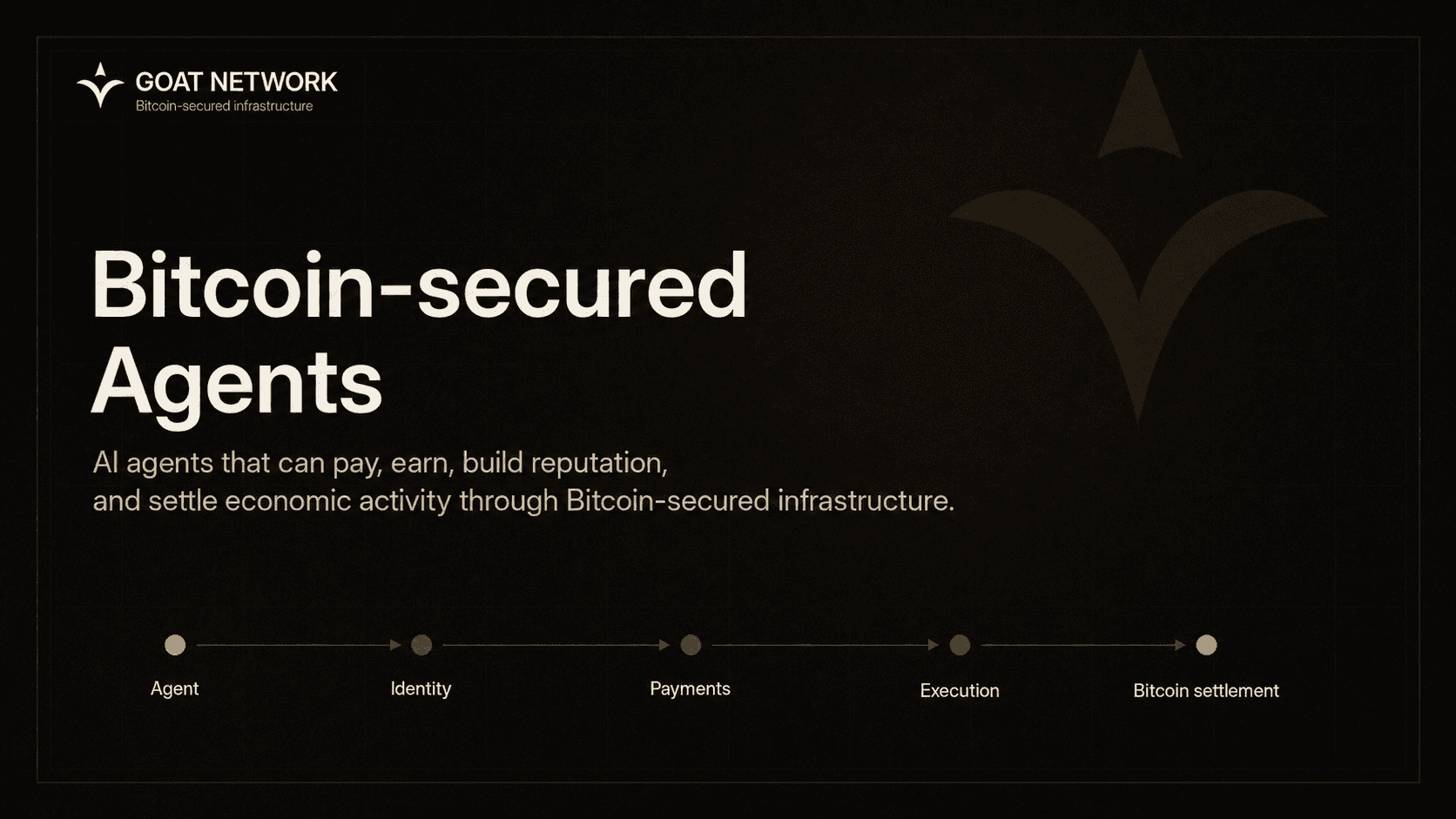

Not all agents are the same - and neither is all agent infrastructure.
Some agents can answer questions. Some can automate tasks. Some can hold a wallet and sign transactions. These are useful steps forward, but they are not the final form.
The highest type of agent is one that can operate independently: paying for services, earning revenue, building reputation, interacting with contracts, and settling value through infrastructure anchored to Bitcoin.
This is what we call a Bitcoin-secured Agent.
A Bitcoin-secured Agent is an autonomous or semi-autonomous software agent that can conduct economic activity through programmable infrastructure, with settlement ultimately anchored to Bitcoin.
It is not just an AI assistant. It is not just an onchain bot. It is an agent that can pay, earn, identify itself, build trust, access services, and operate on open, neutral rails secured by Bitcoin.
The three levels of agents
The easiest way to understand a Bitcoin-secured Agent is to compare it with the agent types that come before it.
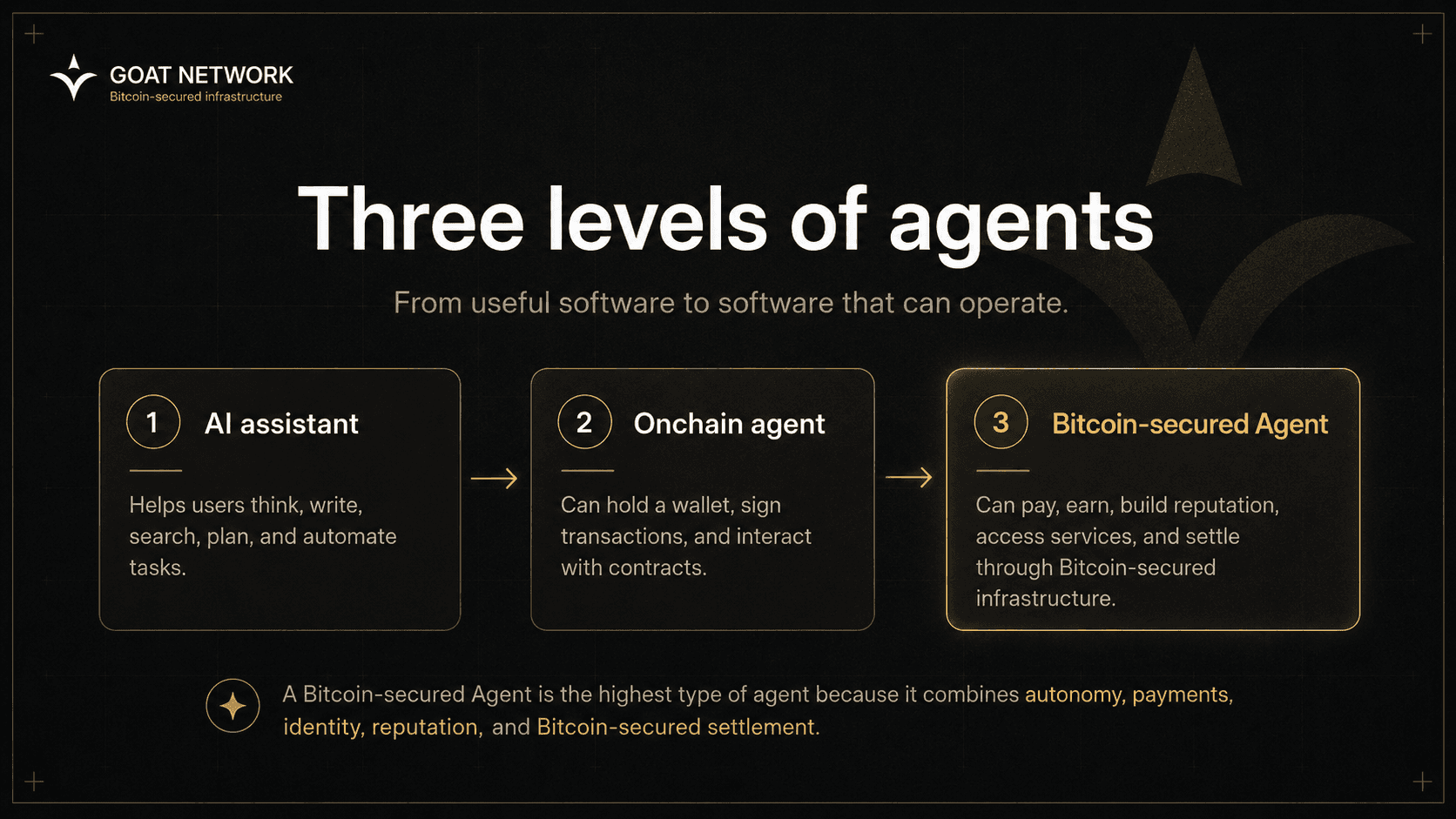
From useful software to software that can operate economically.
The first level is the AI assistant.
This is software that helps users think and work. It can search, write, summarize, plan, code, or automate parts of a workflow. It is useful, but it does not meaningfully participate in markets. It cannot pay for inputs, receive revenue, build financial reputation, or settle value.
The second level is the onchain agent.
This type of agent can hold a wallet, sign transactions, transfer tokens, and interact with smart contracts. This is a major improvement because the agent can now act onchain.
But an onchain agent is still incomplete if it depends on narrow or platform-controlled rails. It may have a wallet, but its identity, reputation, payment access, discovery, or settlement path may still be controlled by a single chain, hosted platform, bridge, application, or corporate stack.
In that case, the agent can transact, but it is not fully independent. It is still operating inside someone else’s economic environment.
The third level is the Bitcoin-secured Agent.
This is the complete form. A Bitcoin-secured Agent can act onchain, but it is also connected to the deeper infrastructure needed to operate independently: payments, identity, reputation, programmable execution, and Bitcoin-secured settlement.
The difference is not only what the agent can do. It is what the agent depends on.
A Bitcoin-secured Agent is not merely automated software running on a platform. It operates on open, neutral rails where its economic activity is anchored to Bitcoin-secured infrastructure. That gives it a stronger basis for independence, portability, and long-term validity.
Why Bitcoin-secured Agents matter
Agents are not valuable only because they can generate text or automate tasks. They become far more important when they can participate in economic activity directly.
An agent might pay for API access, buy data, rent compute, execute a contract action, coordinate with another agent, charge users for a service, or manage recurring workflows. Once agents start doing these things, the infrastructure underneath them becomes critical.
They need payments that work inside digital workflows.
They need identity so users and other agents know what they are interacting with.
They need reputation so the market can judge whether they are useful, reliable, or trustworthy.
They need programmable execution so they can interact with contracts and applications.
And they need settlement that is not dependent on a closed platform or single corporate operator.
This is why Bitcoin matters.
Bitcoin is the strongest settlement anchor in crypto. It is durable, neutral, scarce, and resistant to unilateral control. For agents that may handle real value, those properties matter.
But Bitcoin L1 is not designed for high-frequency agent activity. Agents need faster execution, richer programmability, identity standards, payment flows, and application-level coordination.
So the practical model is not to run every agent action directly on Bitcoin.
The practical model is:
Programmable execution for agent activity. Bitcoin-secured settlement for value.
That is the foundation of a Bitcoin-secured Agent
What makes an agent Bitcoin-secured
A Bitcoin-secured Agent needs five core capabilities.
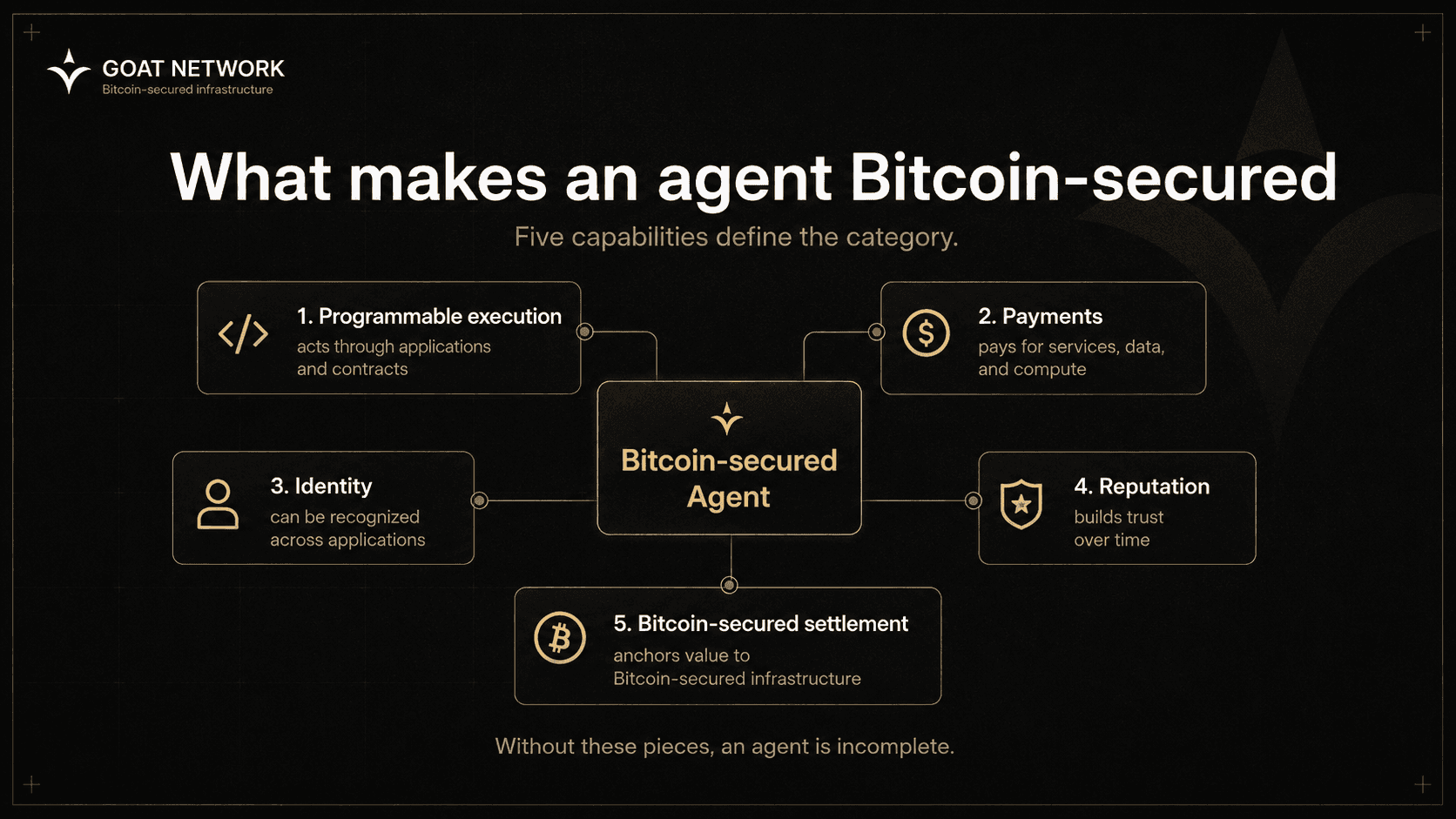
Five capabilities define a Bitcoin-secured Agent.
First, it needs programmable execution. It must be able to interact with applications, contracts, assets, and services.
Second, it needs payments. It must be able to pay for APIs, data, compute, content, tools, and other agents.
Third, it needs identity. It must be recognizable across applications and services, rather than existing only as a disposable wallet.
Fourth, it needs reputation. It must be able to build trust over time based on completed tasks, useful outputs, validations, and transaction history.
Fifth, it needs Bitcoin-secured settlement. Its economic activity should be anchored to infrastructure with credible neutrality, rather than trapped inside a closed platform.
When these pieces come together, the agent becomes more than a tool. It becomes a participant in an open digital economy.
Why GOAT Network is built for this category
GOAT Network is specifically designed to support Bitcoin-secured Agents.
The blockchain combines Bitcoin-secured settlement with a Type-1 zkEVM execution environment. That means builders can use familiar @Ethereum-compatible tools and standards while building inside infrastructure oriented around Bitcoin settlement.
This matters because developers should not have to choose between Bitcoin security and practical programmability.
Agents need expressive contracts, application logic, payment flows, and identity systems. Builders need familiar tooling. GOAT Network provides that execution environment while keeping Bitcoin as the settlement anchor.
The GOAT agent stack adds the other pieces needed for Bitcoin-secured Agents.
The complete Bitcoin-secured Agent stack.
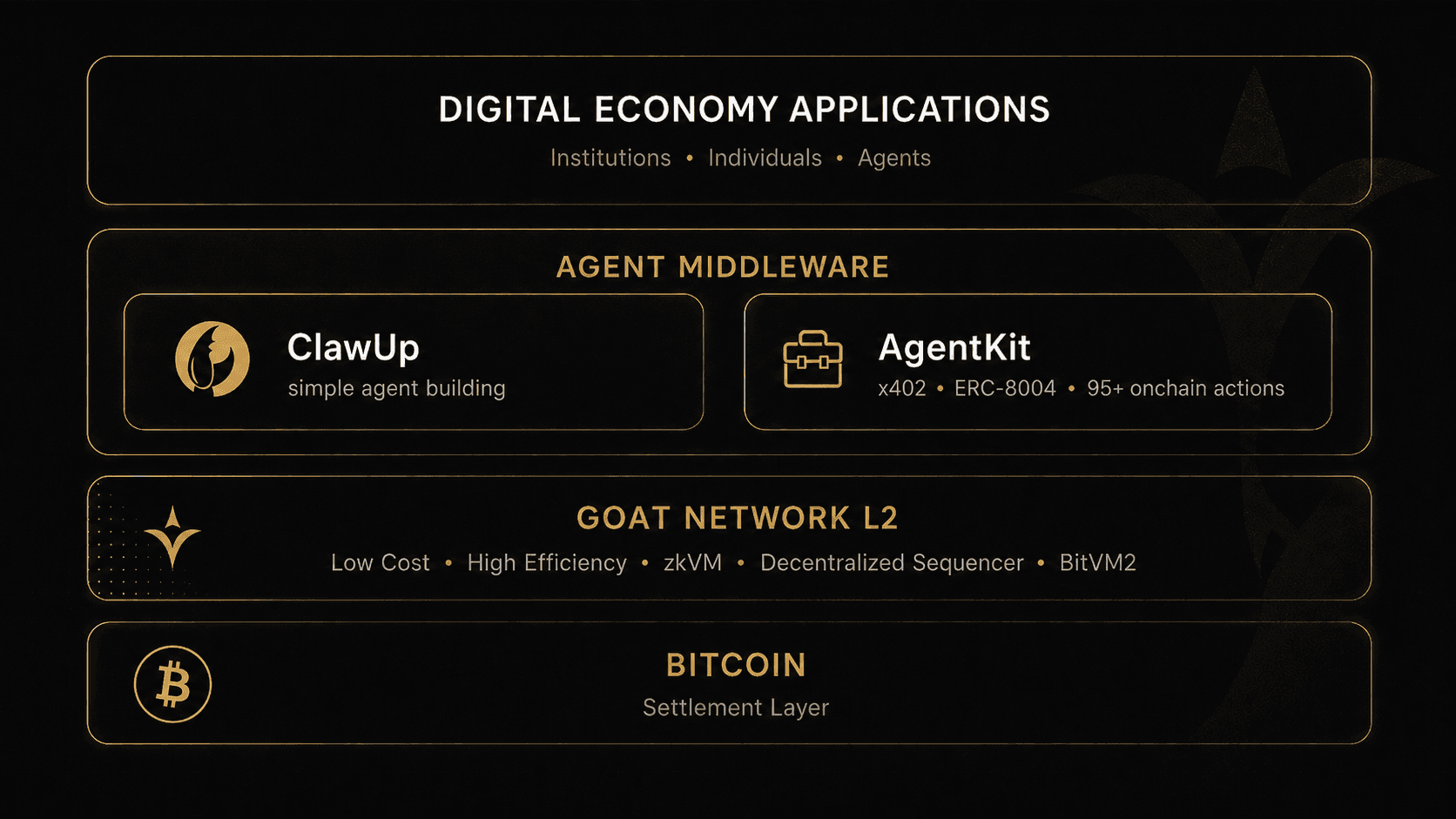
x402 gives agents internet-native payments, allowing them to pay for services, APIs, data, and workflows as part of normal digital interactions.
ERC-8004 gives agents identity and reputation, making them discoverable, accountable, and easier to evaluate.
AgentKit.goat.network incorporates both - in addition to almost 100 other ready-to-go onchain actions - quickly and effortlessly adding wallets, payments, identity, contract interactions, bridge actions, DEX actions, and merchant workflows to agents.
@ClawUpAI helps builders deploy agents more easily.
Together, these components create an environment where agents can move beyond simple automation and start participating in real economic loops.
Category-defining
The agent economy should settle value on open infrastructure.
A Bitcoin-secured Agent is not just an onchain wallet with automation. It is an agent with payments, identity, reputation, execution, and Bitcoin-secured settlement.
Most importantly, it is not an agent trapped inside centralized rails. It is an agent built on sovereign, neutral infrastructure, giving it a stronger basis to operate as an independent participant in the digital economy.
The strongest version of the agentic future is Bitcoin-secured. Built on GOAT.Network.