
Key considerations for preparing agents for real usage, monetization, and the GOAT AI Builder Grants Program.
A standard AI agent can talk, reason, call tools, and automate parts of a workflow, but far fewer can participate in economic activity directly.
A functioning economic agent needs a wallet, payment capability, identity, permissions, transaction logic, and a useful service loop. Without those pieces, the agent may be a helpful software tool, but it is far from being an independent economic actor.
GOAT Network’s agent stack is designed specifically to bridge this gap - and the GOAT AI Builder Grants Program is now live to support builders looking to build economic agents and monetize their services.
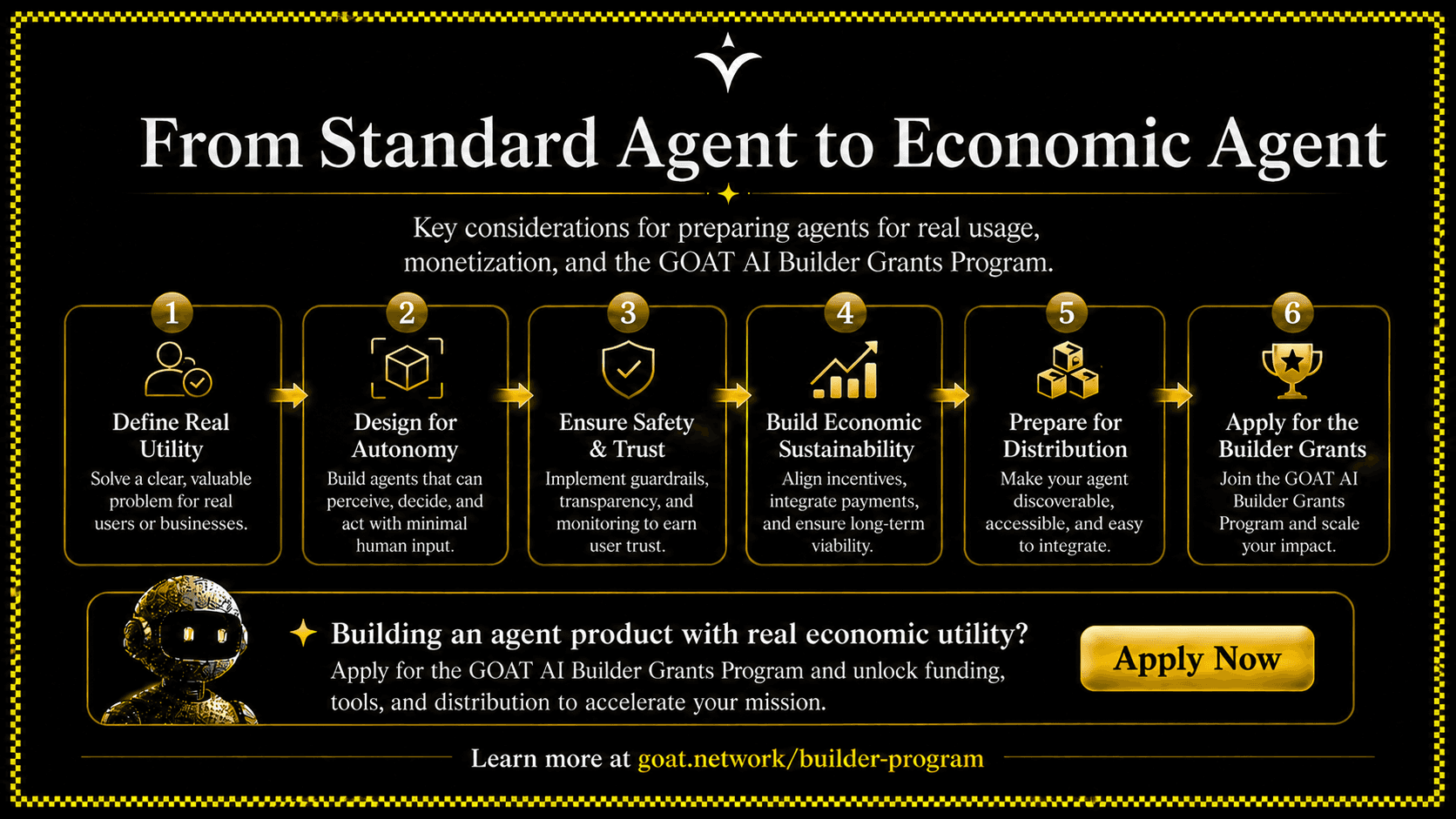
Below are some of the key steps and considerations when taking your agent from a standard agent to a functioning economic agent: one that can transact, identify itself, monetize useful services, and meet the real-usage standard expected of projects applying to the GOAT AI Builder Grants Program.
Start with the workflow
A standard agent can generate useful output, answer questions, or assist with tasks. But a functioning economic agent needs a workflow where value moves through the system. It should have a reason to transact, identify itself, coordinate with services, or settle value.
It might sell access to data, pay for APIs, automate a paid workflow, route tasks between users and service providers, manage an onchain operation, or interact with other agents.
If the goal is to build a product loop where the agent performs useful work and economic activity is part of that workflow, then GOAT becomes relevant. At that point, the agent may need to earn, spend, register identity, accept payments, interact with contracts, or build reputation over time.
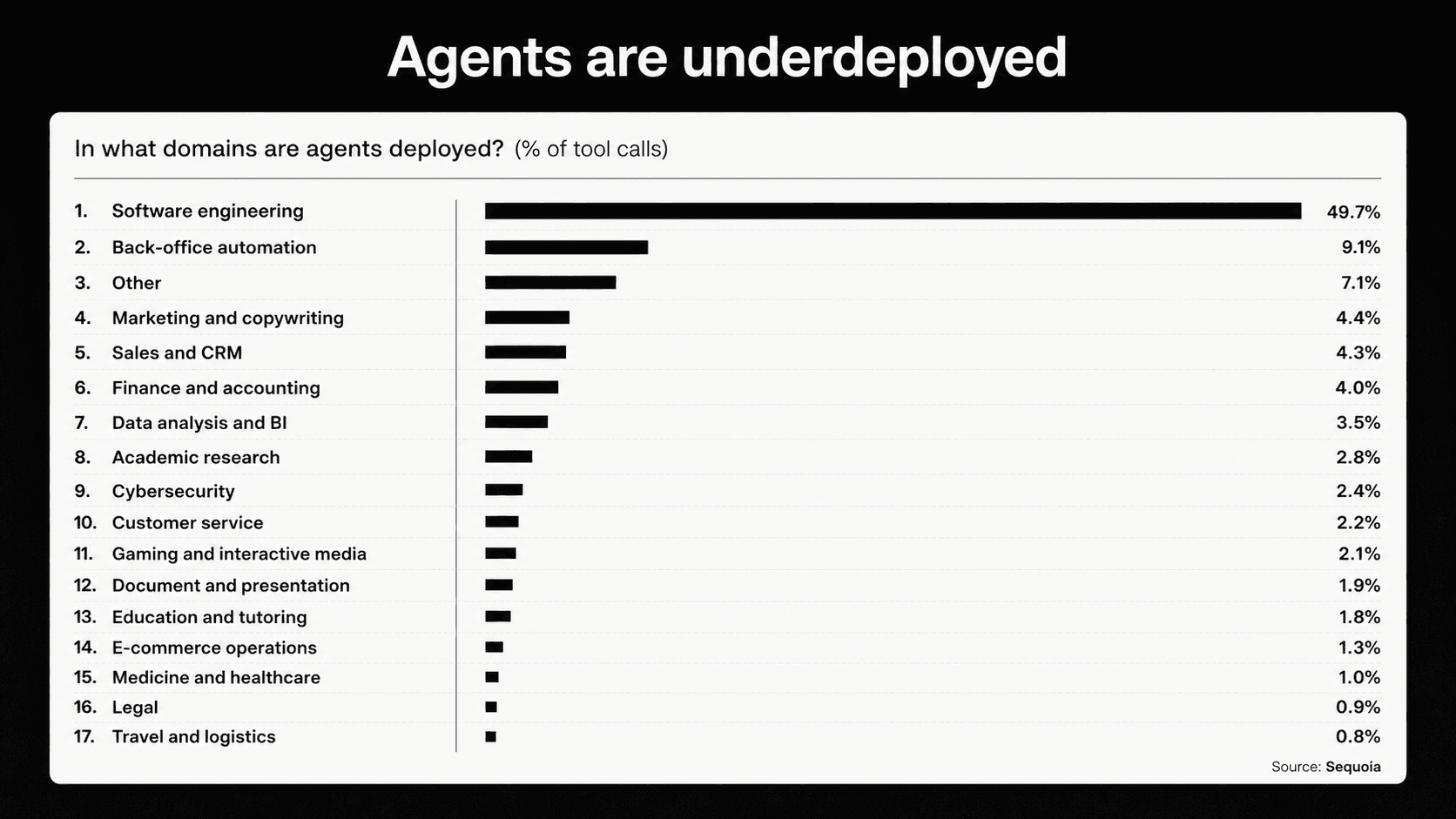
Agents are still concentrated in a narrow set of use cases. Software engineering has seen the clearest adoption so far, while many large areas of business activity remain underdeveloped. Customer service, finance, education, e-commerce, legal, healthcare, logistics, research, marketing, and internal operations all contain workflows that could benefit from more autonomous software, but most companies still do not have effective agents they can adopt off the shelf.
That gap is your opportunity.
For many companies, the complexity of building and integrating AI agents is a barrier in itself. Even when platforms like ClawUp.org make deployment easier and more tailored, businesses still need to know what to build, how to manage permissions, how to handle compliance, and how to trust the output.
Most just want a service that works, and this is where builders have an opening. The job is to identify workflows where companies or other agents need a specific agentic service, then package that service so it can be adopted without the customer having to solve the full stack themselves.
Some of the strongest opportunities will come from the places where intelligence alone is not enough. Agents may need access to gated data, specialized models, external compute, verified credentials, private integrations, user permissions, payment flows, identity, reputation, or settlement infrastructure before they become commercially useful.
This is also where the GOAT AI Builder Grants Program fits in. It supports builders who can identify underdeveloped workflows and turn them into agent products with real economic utility, through funding, technical support, and ecosystem backing.
Choose the agent runtime
The runtime is where the agent is created, hosted, and managed. It handles reasoning, prompts, memory, tool use, workflow logic, and user interaction.
Builders can use a managed deployment path such as ClawUp, agent runtime infrastructure directly such as OpenClaw or Hermes, or a custom stack. The runtime is responsible for deciding what the agent should do.
But the runtime alone does not make the agent economically functional. It may give the agent intelligence and tools, but it does not automatically give the agent wallet operations, payment flows, identity, reputation, or onchain execution.
That is where AgentKit comes in.
Add AgentKit
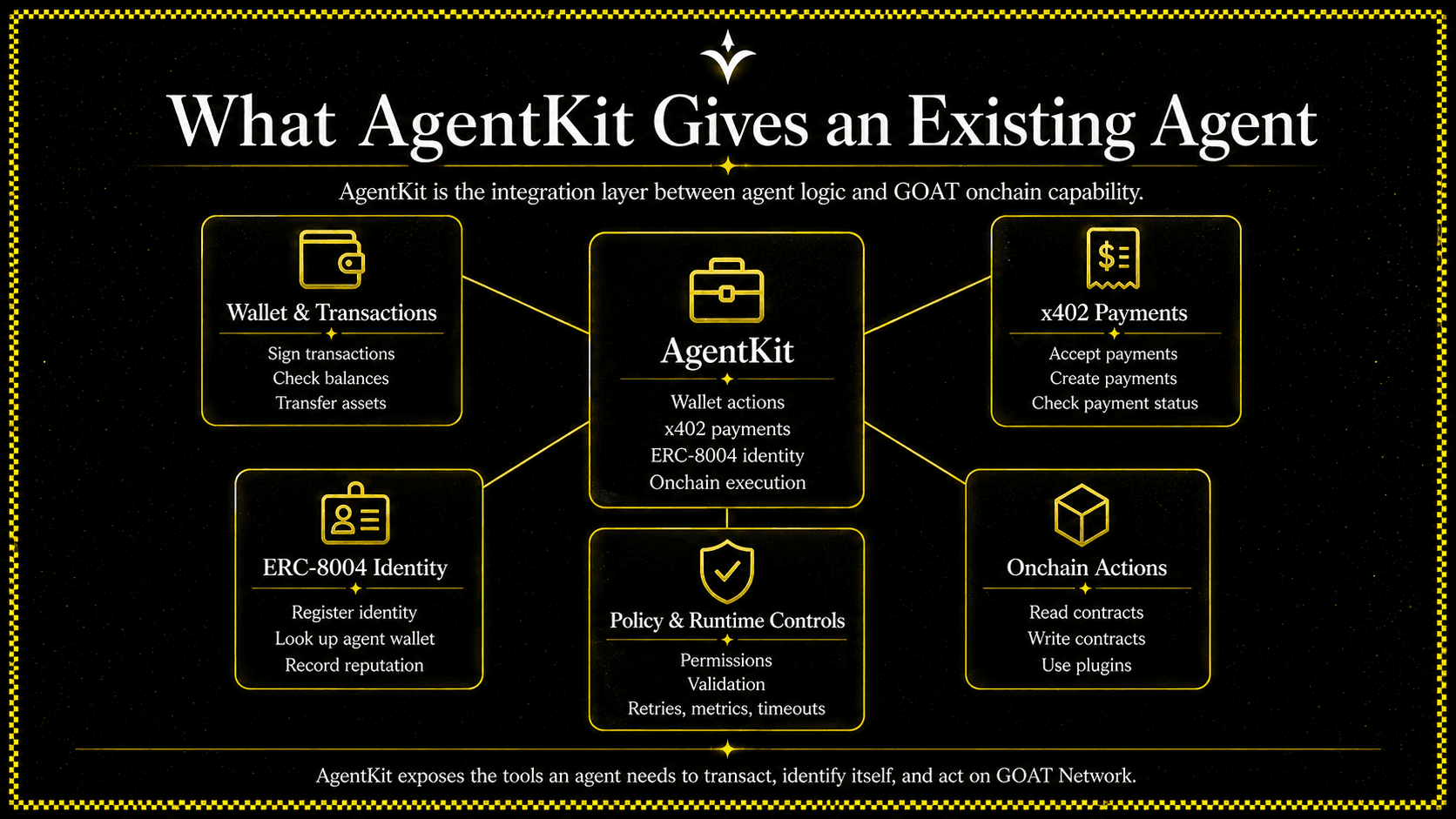
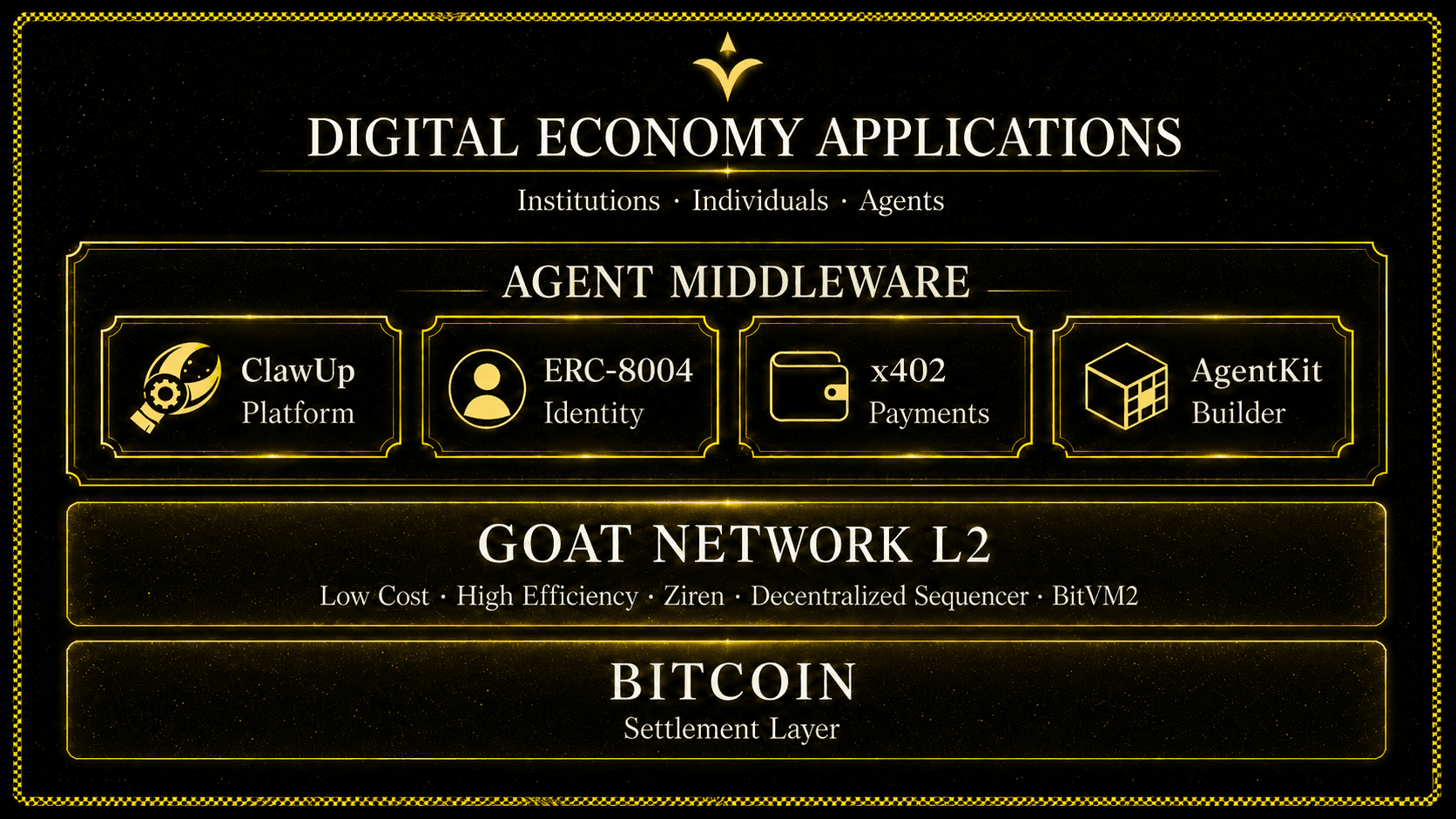
AgentKit is the main GOAT Network integration layer. It gives existing agents access to wallet operations, x402 payments, ERC-8004 identity, contract interactions, bridge actions, DEX actions, merchant operations, and other GOAT-native capabilities.
AgentKit includes core onchain actions such as ERC20 transfers, approvals, balances, contract reads and writes, deployments, bridge actions, DEX actions, and token resolution. It also includes x402 payment actions, x402 merchant operations, ERC-8004 identity and reputation actions, LayerZero actions, BitVM2 bridge and staking actions, NFT actions, GOAT token actions, faucet actions, and Bitcoin light client actions.
That makes AgentKit the correct developer entry point for agents that need payments, identity, and onchain actions on GOAT Network: agentkit.goat.network
Set permissions before autonomy
Once an agent can sign transactions or trigger payments, the builder needs policy controls.
AgentKit’s README describes a runtime engine with policy gating, schema validation, idempotency, retry logic, timeout handling, metrics, and execution hooks. It also shows a policy engine configuration with allowed networks, risk thresholds, and write permissions.
This should be treated as a core part of the build.
The goal is constrained autonomy: an agent that can act without requiring human approval for every small action, but still operates within defined limits.
For a real product, that means spending limits, approved networks, allowed contracts, risk-based confirmation rules, logging, monitoring, and clear failure handling. This is especially important because agentic commerce creates security risks across reasoning, authorization, trust, and settlement layers. A recent security survey on autonomous LLM agents argues that agentic commerce needs coordinated controls across LLM safety, protocol design, identity, market structure, and regulation.
Build a useful economic loop
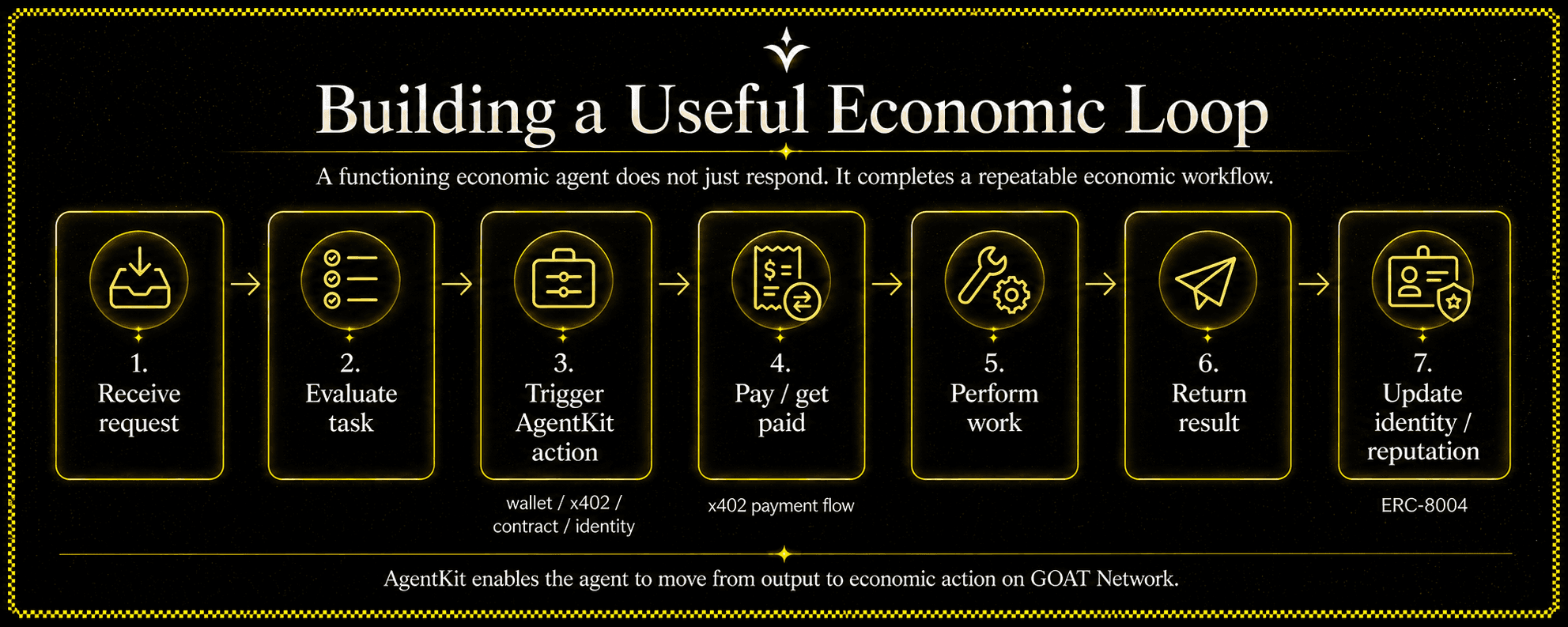
Once the agent runtime and AgentKit are connected, the useful work is the product loop.
A basic loop might look like this:
receive request → evaluate task → price or authorize action → accept or make payment → perform work → deliver result → update identity or reputation
For an API agent, this could mean accepting x402 payment before returning data. For a productivity agent, it could mean paying for external services while completing a user task. For an agent marketplace, it could mean using ERC-8004 identity and reputation so users or other agents can decide whether to trust the agent.
This is the difference between a demo and a product. The value here is that the agent can complete a repeatable workflow where payment, identity, and execution are built into the system.
Test the full path
A single transaction demo is not enough.
A functioning agent should be tested across the full workflow. It should receive a task, decide what to do, trigger the correct AgentKit action, handle payment, complete the service, record the result, and fail safely when something goes wrong.
The failure cases are where most of the product work lives. What happens if payment fails? What if the wallet has insufficient balance? What if the requested action exceeds the policy limit? What if a tool returns bad data? What if the transaction fails? What if the agent tries to act outside its permissions?
These are the questions that builders need to think about early.
Deploy and monitor it like production software
A functioning economic agent should be monitored like any other production system.
The important signals are uptime, wallet balance, failed transactions, payment success rate, task completion rate, blocked actions, unusual behavior, latency, user retention, and cost per completed task.
If the agent is supposed to generate revenue, the core question is whether the agent repeatedly performs useful work that users, services, or other agents are willing to pay for.
Why build this on GOAT Network?
When an agent needs economic capability, the chain matters.
Bitcoin-secured settlement. GOAT Network is a Bitcoin-Secured L2 anchored via BitVM2, powered by the Ziren zkVM and a decentralized sequencer set. Your agent’s transactions inherit Bitcoin’s security guarantees while you write standard EVM code.
x402 as a native payment rail. Most chains require building payment flows from scratch. GOAT treats x402 - an HTTP-native payment standard - as core infrastructure, with cross-chain routing so users can pay on one chain and you settle on another.
ERC-8004 as native identity. Agents aren’t just wallet addresses on GOAT. They have portable IDs, publishable capabilities, and a reputation surface other agents and users can verify.
Agents that need to earn, spend, identify themselves, coordinate with services, and settle value need infrastructure for those actions.
GOAT Network is that infrastructure. AgentKit is the way in.
Where the Builder Grants Program fits
The GOAT AI Builder Grants Program is about supporting teams building AI agents and agent-native applications with real economic utility through grants, technical support, ecosystem access, and potential follow-on investment.
The program is specifically looking for products that solve actual problems, fit into repeatable workflows, and have a credible path to sustained usage. It prioritizes transactional applications, where usage naturally leads to transactions, and productivity applications, where agents improve how work gets done.
If that sounds like what you’re building, apply here: goat.network/builder-program
Where to start:
AgentKit: agentkit.goat.network
Docs: docs.goat.network


