

Q1 2026 was perhaps the most pivotal quarter in GOAT Network history.
The vision of a digital economy built on Bitcoin was clearly outlined and the products are shipping fast.
Following the launch of the GOAT BitVM2 testnet, the team delivered foundational infrastructure across every layer of the AI agent stack - identity, payments, developer tooling, and protocol - giving agents, individuals, and institutions a Bitcoin-secured environment to operate in.
Bitcoin-Secured Infrastructure for the Digital Economy
GOAT Network has entered a new chapter with a sharper articulation of its vision: Bitcoin-secured infrastructure for the digital economy.
As individuals, institutions, and autonomous agents increasingly operate through programmable systems, the economy will need infrastructure that is secure, neutral, and built for machine-native coordination. Payments, identity, execution, and settlement can no longer be treated as separate problems. They are part of the same stack.
GOAT Network is building that stack on a Bitcoin-secured foundation.
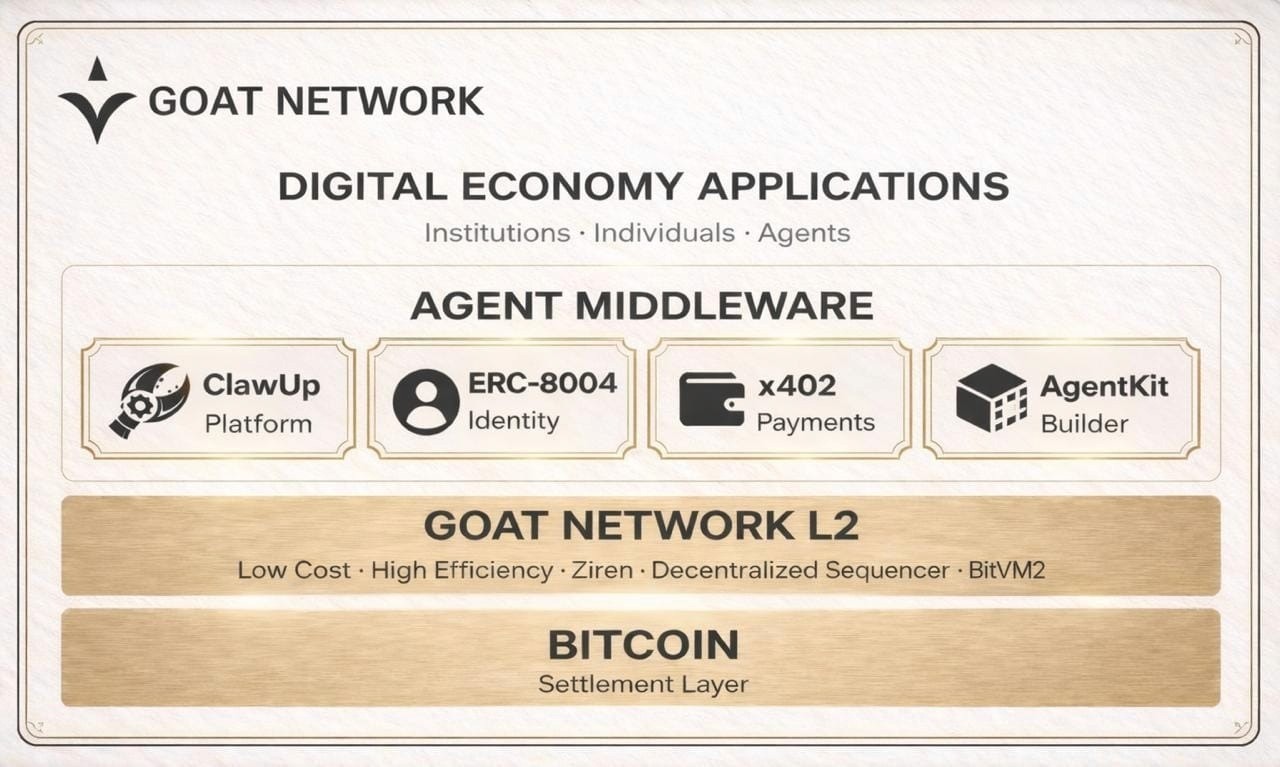
A Complete Stack for the New Digital Economy
This shift is also reflected in our new brand (and website), which draws from a much older infrastructural logic: economies scale when truth is verifiable, commitments are enforceable, rules are predictable, and participants retain the ability to exit. The visual identity is new, but the principles behind it are as old as civilization itself.
In that sense, the vision and the brand launch are saying the same thing: GOAT Network is building infrastructure designed for a much larger economic era - and designed to stand the test of time.
Read more: goat.network/news/bitcoin-secured-infrastructure-for-the-digital-economy
BitVM2 Testnet Launch
The GOAT BitVM2 Testnet went live in Q1, marking one of the most significant milestones in Bitcoin L2 development. For the first time on a decentralized network, users can bridge BTC in and out of a Layer 2 with an exit path enforced by Bitcoin’s own rules. Not a multisig. Not a federation. Bitcoin itself as the backstop.
The launch was covered by top media outlets including @Cointelegraph, Bitcoin.com, and @DecryptMedia, as the first public environment where Bitcoin-enforced bridging via BitVM2 can be tested end-to-end under real Bitcoin confirmation latency and fee conditions.
Since launch, the testnet has continued to progress from a public milestone into an active proving and bridge environment. The latest BitVM2 node release, bitvm2-node v0.4, adapts the system to our Ziren zkVM v1.2.5, improves how non-standard challenge and disprove transactions are mined, refactors key derivation and committee-key handling, and adds stronger operator reliability and monitoring.
The Ziren v1.2.5 upgrade is especially important for GOAT’s BitVM roadmap.
The release strengthens Ziren’s path toward larger Geth- and keeper-oriented proving workloads, hardens Linux ABI and syscall execution paths, adds malformed-input verifier protections, and improves correctness across arithmetic, curves, bitwise logic, and division handling. It also reduces upgrade friction for BitVM2 and BitVM3-style systems by keeping the Groth16 verification key unaffected by Ziren upgrades while adding historical VK bundling and public-input verification support.
In practice, this makes the proving layer more stable, maintainable, and better suited for long-term Bitcoin-enforced execution.
Read more: goat.network/blog/goat-bitvm2-testnet-native-bitcoin-finance-is-here
GOAT X402 + ERC-8004 - The Agent Infrastructure for the new Digital Economy Is Live
A big piece of the stack went live in February, when ERC-8004 and x402 launched on GOAT Mainnet.
ERC-8004 is an onchain identity and reputation standard for AI agents. The simple version: it gives agents a way to prove who they are and build a record of how they behave. If you want the mental model, it's somewhere between a passport and a credit score for machines. Under the hood, it has two parts: an Identity Registry and a Reputation Registry.
Agents can't really participate in an economy if they're just anonymous scripts spinning around the internet. If one agent is reliable, another is malicious, and a third is brand new, there needs to be a way to tell the difference. Our newly launched 8004 Registry gives both humans and agents a standard way to do that onchain instead of reinventing the same trust layer over and over again.
The payments side of the stack came shortly before with GOAT x402. Originally introduced by Coinbase and based on HTTP 402, x402 turns payments into a native part of internet requests. One way to think about it is as a toll booth built into the web: an agent hits a service, the service states the fee, and if the agent accepts, it pays within the same request - the service verifies the payment and the call completes. No invoice, no checkout flow, no payment page, no human intermediating.
GOAT Network's implementation currently supports six chains: Ethereum, Polygon, Arbitrum, BSC, GOAT, and Solana. That cross-chain support matters because agents are not going to live in one ecosystem. They'll move across tools, services, and networks, and the payment rails need to meet them where they are.
Put the two pieces together and the picture gets a lot clearer. ERC-8004 gives agents identity and reputation. x402 lets them pay and get paid. That's the minimum viable infrastructure for an agent economy to be more than a nice diagram in a deck.
This is also where our positioning starts to make sense. GOAT Network aims to be the natural home for building with x402. The protocol stays standards-compatible, while the network adds cross-chain support, native integration with ERC-8004, and a complete operating environment for agent commerce.
And perhaps most importantly, this new digital economy all settles on the most neutral, secure, and sovereign financial base in the world: Bitcoin.
Read our detailed comparison with Coinbase x402 here: goat.network/news/x402-two-approaches-to-agent-payments
The Birth of Eve
One of the more interesting internal developments this quarter was the GOAT Network team adopting our own agent infrastructure in day-to-day work.
Eve became part of regular team workflows across content creation, research, development support, and community management. This meant that the team had to ‘eat its own cooking’, which matters because using your own tools tends to surface the real problems fast.
Eve continues to be an integral part of team workflows. CEO Kevin Liu wrote about the experience here: x.com/kevinliu/status/2020881480214294767

AgentKit - The Full Stack in One SDK
The protocols are live, but how do developers actually build with them?
AgentKit is a TypeScript SDK with 95 on-chain actions across 13 plugins. It takes everything described above - x402 payments, ERC-8004 identity and reputation - and puts it alongside wallet operations, DEX trading, native bridging, BitVM2 bridging, cross-chain transfers, NFTs, and governance in a single package.
The x402 integration alone is substantial. On the payer side, agents create payments, sign EIP-712 authorizations, and settle with merchants - no human wallet needed. On the merchant side, there are 30 actions covering auth, dashboard, orders, balance, webhooks, API keys, callback contracts, and audit logs. An agent running AgentKit can operate a full merchant backend autonomously.
Underneath the actions is a production-grade runtime. Every call runs through a policy engine gating by risk level, schema validation, idempotency to prevent double-execution, automatic retries, per-action timeouts, Prometheus metrics, and execution hooks for observability. This isn't a demo-grade SDK - it's designed for agents that handle real money.
The individual pieces - identity, payments, DeFi, bridging, reputation - are useful on their own. But an agent economy doesn't run on individual pieces. It runs on a stack. AgentKit is the developer surface for that stack, and it's the most complete agent SDK shipping on any Bitcoin L2 today.
Start building: agentkit.goat.network
ClawUp Launch
@ClawUpAI is how non-developers start using GOAT Network’s agent infrastructure. It launched this quarter as an agent creation and hosting platform, designed to significantly lower the barrier to deploying and operating agents.
Most people don't want to think in terms of autonomous systems architecture. They want to know: can I create an agent that does useful work, can I run it reliably, and can it eventually earn money on its own? ClawUp is the product layer built around those questions.
0:03 / 1:29
The strategy has two phases. Phase 1 is the cold-start phase: help Web3 projects, developers, and DAOs create agents for real use cases and get them deployed. Phase 2 is where those agents start generating revenue and plugging into the upcoming Claw Market.
What makes ClawUp especially important inside the GOAT stack is that it's not standing alone. Agents created on ClawUp can be registered through ERC-8004 on GOAT Network, which gives them verifiable onchain identity. They can earn and pay through x402. And all of this happens on infrastructure secured by Bitcoin.
Try ClawUp for yourself: clawup.org
Global Hackathon
The GOAT Global Hackathon series has been one of the clearest early signs of what an agent-native builder ecosystem can look like in practice. Across San Francisco, Shenzhen, and Chennai, builders have been using GOAT Network to move beyond concept demos and toward agents that can actually act: earning, transacting, and participating in a shared onchain economy. Together, these events have offered an early glimpse of how the GOAT Agent ecosystem may evolve.
A big part of that energy has come from the quality of the teams and the incentive structure around them. Standout winners across the series have taken home Mac Minis and cash prizes, but more importantly, they have shown what happens when builders are given the right primitives early.
Some projects focused on practical agent workflows: connecting agents to services, enabling payments, coordinating tasks, or turning GOAT’s infrastructure into tools that could support real user or agent-to-agent activity. That is what has made the series valuable - it has helped reveal which kinds of products and behaviors start to emerge when agents are given access to execution, commerce, and identity in the same environment.
Next up is Toronto on May 26th: luma.com/2bntw4vd
GOAT User Journey - Season 1
The first season of the GOAT User Journey Program has officially wrapped, becoming one of the most engaging community initiatives GOAT Network has run so far.
Across the full program, more than 800 participants joined a four-stage journey designed to guide users from discovery to deeper ecosystem engagement, with over 50 users joining each event on average.
Through quizzes, game nights, BTCFi education, testnet exploration, and GOAT Mainnet interaction, the program gave users a structured way to experience the ecosystem firsthand. Along the way, $1,400 USDT in rewards were distributed, standout participants emerged as potential GOAT Ambassador nominees, and many users shared their first on-chain experiences with the help of @goatlightbot.
With Season 2 already live, the program will continue pushing users deeper into the growing AI ecosystem on GOAT Network: x.com/GOATNetwork/status/2045156430140133628?s=20
Research & Thought Leadership
Q1 wasn't just about shipping code. The GOAT team put out a series of long-form pieces that laid out the broader thinking behind our work - not marketing recaps, but actual arguments about why this infrastructure needs to exist and why it belongs on Bitcoin.
The GOAT Network Vision, and Why BTCFi Hasn't Even Started
This piece sets the foundation. The argument is direct: most of what gets called "Bitcoin L2" today is a sidechain with a bridge, or a custodial construct with better UX. That doesn't inherit Bitcoin's security properties in the way serious BTC capital requires. BTCFi hasn't started because the infrastructure hasn't been strict enough - unconditional exits, Bitcoin-enforceable disputes, non-custodial bridging. The GOAT Network architecture (zkVM + BitVM2 + decentralized sequencer) is designed to meet that bar. The yield model follows the same logic: revenue from real usage, payouts in BTC, scaling with demand rather than financial engineering.
Read it: https://www.goat.network/news/the-goat-network-vision-and-why-btcfi-hasnt-even-started
Why Bitcoin Needs Second Layers - A BitVM Story
This is the technical history piece. It starts with Hal Finney writing in 2010 that Bitcoin "cannot scale to have every single financial transaction in the world broadcast to everyone" and traces the path from there through BitVM (2023), BitVM2 (2024), and GOAT BitVM2 - which adds the practical engineering needed to make the theoretical design actually deployable: Bitcoin-anchored ordering, arbitrary-amount withdrawals, economically executable dispute paths, and explicit data availability.
If you want to understand the technical lineage behind GOAT Network's bridge design, this is the piece.
Read it: goat.network/news/why-bitcoin-needs-second-layers-a-bitvm-story
The Agent Standard - A Thesis on Sound Money for Autonomous Machines
The Agent Standard series put forth a simple but strong argument: just as “The Bitcoin Standard” argued that humans need money free from government control, “The Agent Standard” argues that machines need money free from human control.
If software agents are going to transact independently, the money they use can't depend on office hours, permissioned intermediaries, manual approvals, or systems that assume a human is always sitting nearby. The design requirements are different.
The framework defines six properties that agent-native money needs: Determinism, Finality, Sovereignty, Availability, Verifiability, and Composability. Put more plainly - machine money should be predictable, settle cleanly, be usable without permission, stay online, be easy to verify, and work well with other systems. That's not marketing language. It's a practical checklist.
Read it: goat.network/news/the-agent-standard-a-thesis-on-sound-money-for-autonomous-machines
AI Agents Will Push Bitcoin Further Than Humans Alone (BPI Research)
The Agent Standard argument was backed with original research from the Bitcoin Policy Institute. The study tested 36 AI models across 9,072 scenarios and looked at what kind of money those systems preferred under different conditions.
The headline result: Bitcoin was chosen 48.3% of the time. Zero models chose fiat. And Claude Opus 4.5 chose Bitcoin 91.3% of the time.
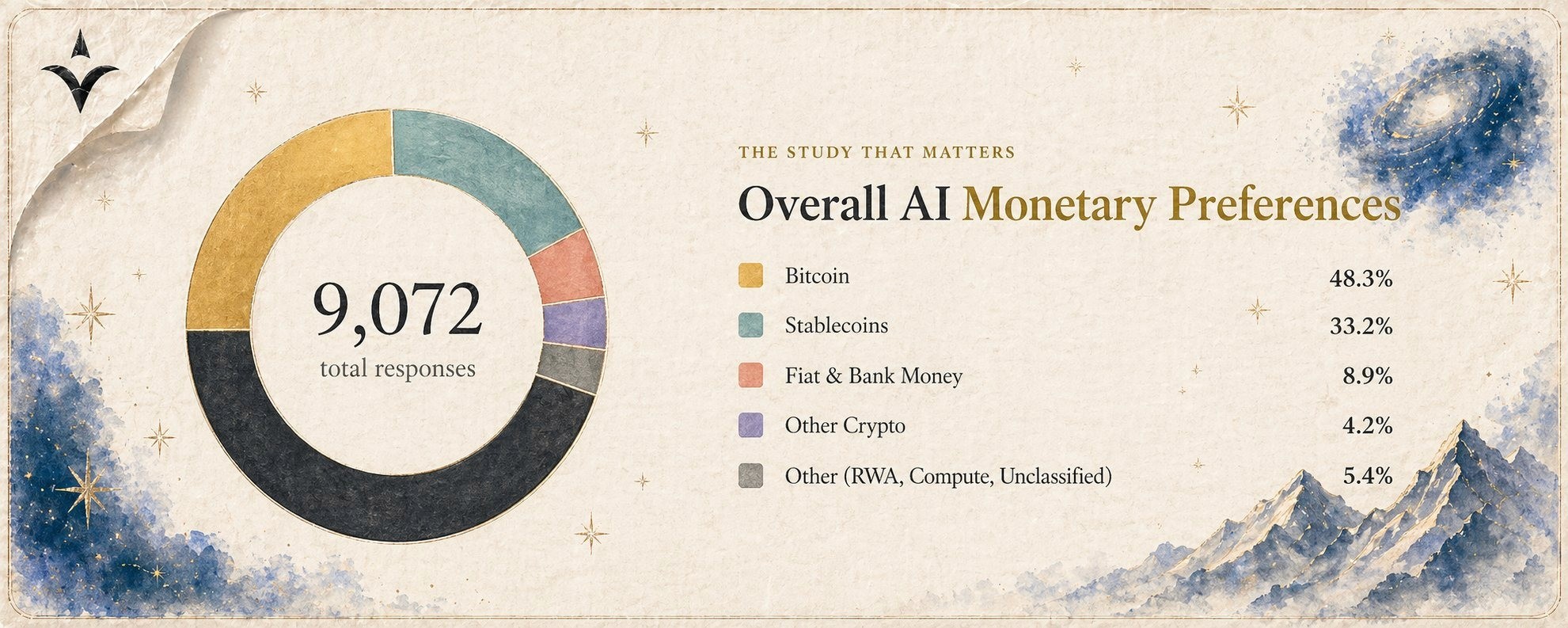
A recent study of AI Agent monetary preferences by the Bitcoin Policy Institute
That doesn't mean every model has become a Bitcoin maximalist. But it does suggest something worth paying attention to: when you evaluate money from the perspective of software agents instead of human institutions, Bitcoin starts to look unusually well suited to the job. This is one of the clearer examples of GOAT doing original thinking instead of recycling the same AI × crypto talking points.
Read it: goat.network/news/ai-agents-will-push-bitcoin-further-than-humans-alone
Key Partnerships
Canton
GOAT Network became a testnet validator operator on the @CantonNetwork this quarter - the privacy-enabled blockchain used by Goldman Sachs, DTCC, and 400+ financial institutions. It's a straightforward update, but an important one: Operating at the infrastructure level is the first step toward connecting GOAT Network's agent-native stack with Canton’s institutional blockchain rails.
Learn more: goat.network/news/goat-network-joins-the-canton-network-as-a-validator-operator
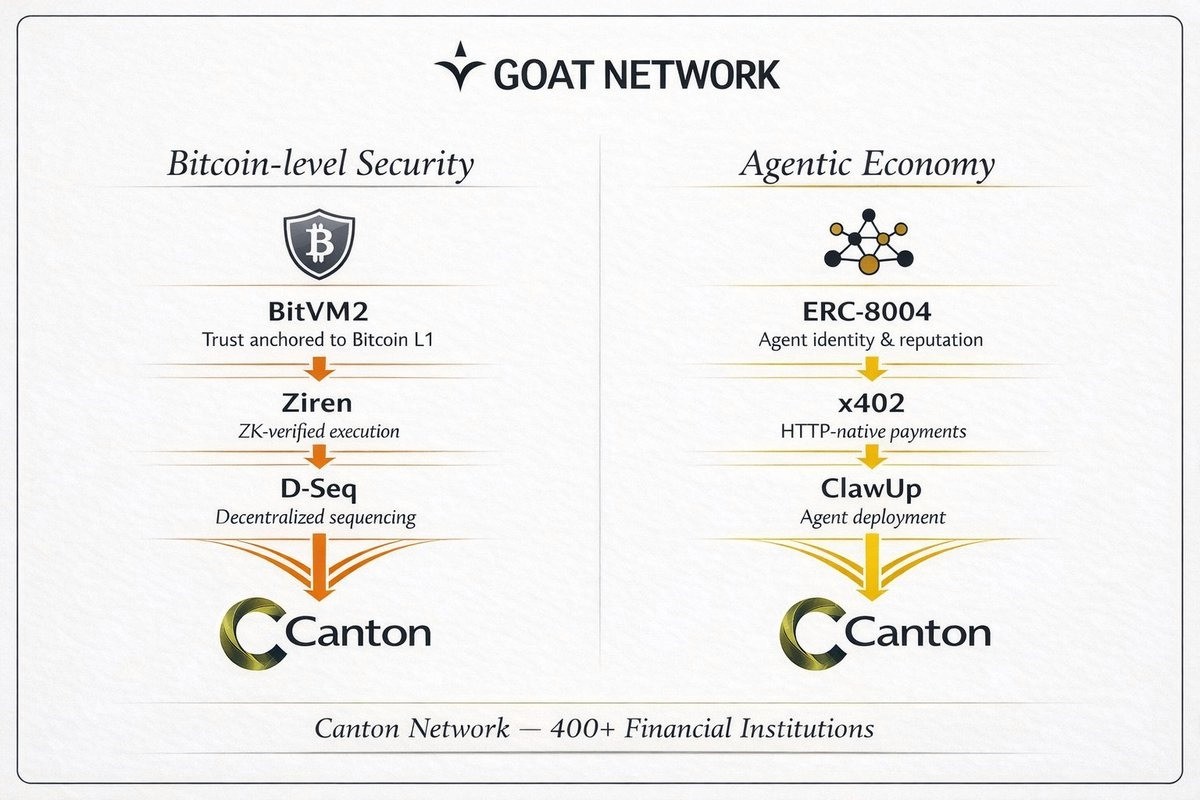
GOAT Network aims to bring AI infrastructure to Canton Network
Nexo
GOAT Network also partnered with @Nexo to give the GOAT community preferential access to Nexo’s award-winning Bitcoin-backed credit products. The partnership gives users a more capital-efficient way to access liquidity without selling BTC, while also extending dedicated white-glove support through a GOAT-specific access path.
It’s a useful example of what GOAT’s broader ecosystem strategy looks like in practice: not just building Bitcoin-secured infrastructure, but connecting users and builders to higher-quality financial rails around it.
Access here: nexo.com/goatnetwork
What’s Ahead for Q2 and beyond?
Q2 will be about turning the foundations we've put in place into broader, more visible activity across the ecosystem. That starts with expanding support for builders through an upcoming grants program designed to help more teams move from experimentation to deployment, while giving stronger projects a clearer path to long-term participation in the network.
At the protocol level, continued progress around BitVM3 points to the next phase of Bitcoin-secured scalability and functionality - part of our larger effort to make Bitcoin a more practical base layer for applications, commerce, and autonomous systems.
Just as importantly, more real-world use cases are beginning to take shape around agent payments. The direction is increasingly clear: payments can unlock new forms of access, coordination, and onchain utility across different products and user journeys. As that surface area expands, GOAT x402 increasingly becomes THE way for agents to interact with services, assets, and digital experiences with far less friction than traditional systems allow.
Q2 and beyond will be about bringing the various components of the GOAT Network stack into closer contact with actual users, builders, and markets, so that the network is judged less by its architecture alone and more by the economic activity and agent behavior it makes possible.


