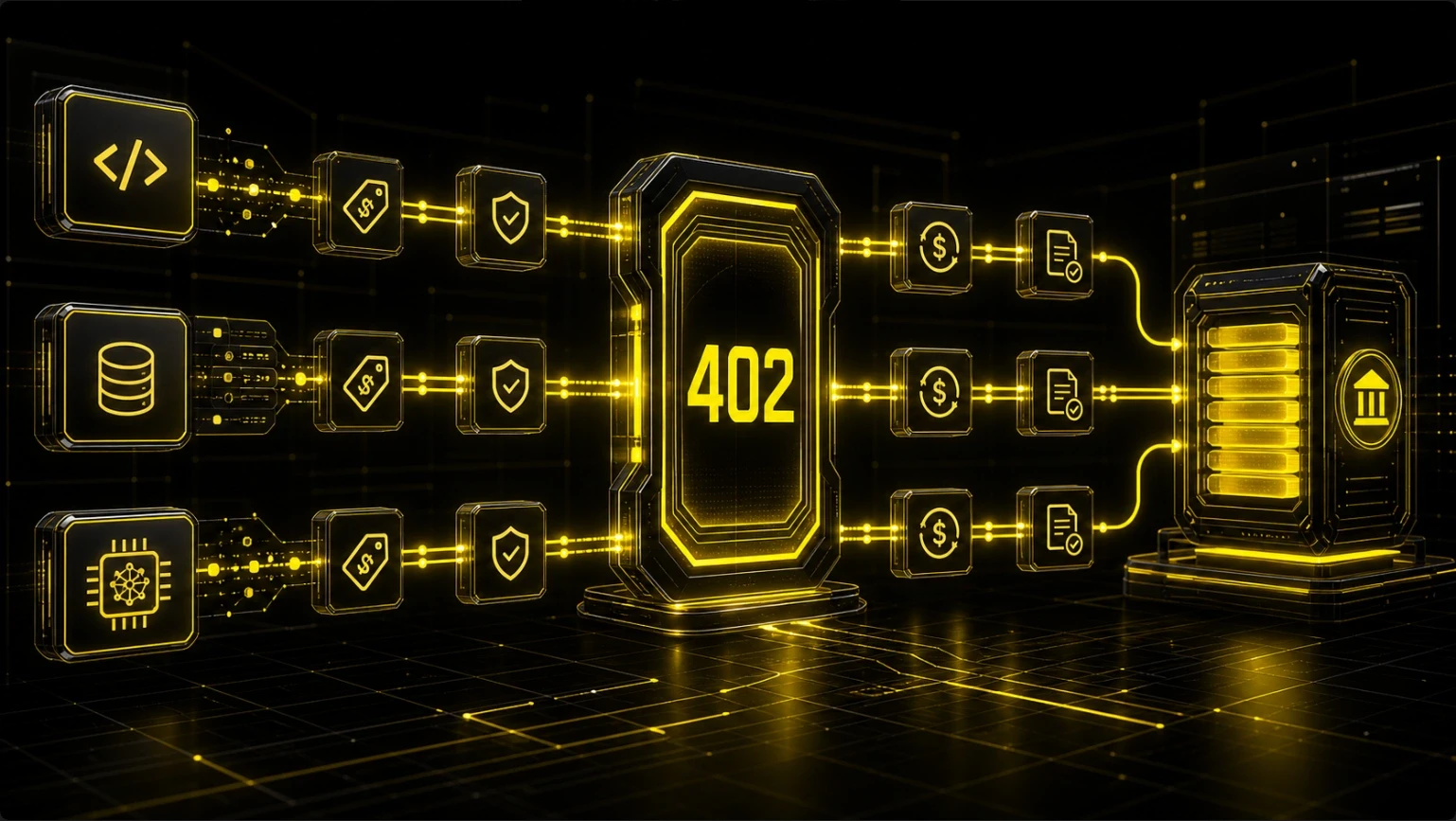

Developers can use a layered x402 infrastructure stack to monetize APIs, MCP tools, data services, AI models, and other resources consumed by AI agents. The stack typically includes server middleware, a facilitator for payment verification and settlement, an agent wallet, merchant operations, and service-delivery logic.
Available options include x402 reference SDKs, hosted facilitator services, edge runtimes such as Cloudflare, and full-stack agent infrastructure such as GOAT Network. The right choice depends less on which quickstart is shortest and more on who should own pricing, wallet compatibility, verification, transaction state, refunds, observability, and delivery failures.
The Stack Is A Responsibility Map, Not One Product
x402 defines a payment interaction at the HTTP layer. A client requests a protected resource, the server returns 402 Payment Required with supported payment terms, the client prepares payment, and the request is retried with payment evidence. A server or facilitator verifies the payment and processes the applicable settlement path before the service releases the resource under its own acceptance rule.
That flow requires several operational owners:
Responsibility | Typical component | Core question |
|---|---|---|
pricing and resource definition | merchant application | What is being sold, at what price, and for how long? |
HTTP payment enforcement | server middleware | When should the route return payment requirements or content? |
verification and settlement | facilitator or payment service | Does the payload satisfy the scheme, and what happened to settlement? |
payment authorization | agent wallet and policy engine | May this agent pay these terms? |
merchant operations | order, receipt, reporting, and support systems | Can the business find, reconcile, refund, and explain the purchase? |
fulfillment | API, MCP server, model service, or job system | Was the paid resource actually delivered? |
An SDK can implement the protocol exchange without owning all six responsibilities. A hosted facilitator can reduce verification and transaction-handling work without deciding how a failed model inference should be remedied. An edge runtime can move middleware close to the request without replacing the agent wallet.
Treat the architecture as a responsibility map. For each row, name the system of record, failure behavior, retry boundary, and team that operates it.
Define The Paid Resource Before Selecting Infrastructure
Infrastructure selection becomes easier after the billable resource is precise.
For a normal API route, the resource may be one successful response. For a data service, it may be a particular dataset version, query result, or time-bounded feed. For an AI model, it may be one inference, an input/output token allowance, or a completed generation. For an MCP tool, it may be a tool invocation that starts a job rather than returning the final result immediately.
Define:
resource identifier and version;
unit of sale;
fixed price, maximum price, or metering rule;
quote expiration;
conditions for successful delivery;
retry and idempotency behavior;
refund, credit, or rerun policy;
data retention and privacy boundaries.
This definition determines infrastructure requirements. A fixed-price, synchronous endpoint can use simple route middleware. A token-metered model may need preauthorization, usage measurement, and final reconciliation. An asynchronous MCP tool needs a job receipt and later retrieval flow. A data feed may require entitlements rather than a new transfer for every message.
Do not force every service into per-request payment merely because x402 operates at the request layer. The payment requirement can gate an entitlement, job, bundle, or funded usage balance when that better matches delivered value.
Path One: Reference SDKs And A Self-Managed Stack
The x402 reference SDKs are the clearest starting point for teams that want protocol-level control. The developer integrates seller middleware, configures payment requirements, connects a facilitator or settlement implementation, and adds payer support where needed.
This path provides strong control over:
route protection and framework integration;
payment schemes, networks, and assets supported by the implementation;
quote construction and resource binding;
verification and settlement policy;
logs, storage, and privacy;
deployment topology and release schedule.
The control comes with engineering responsibility. A self-managed path needs secure key handling where settlement submission requires it, reliable RPC or network access, status persistence, replay and duplicate protection, retries, monitoring, and upgrade management. The team must track protocol and SDK changes rather than assuming the initial integration remains compatible.
Self-managed does not necessarily mean writing a facilitator from scratch. A merchant can use reference server middleware while connecting a hosted facilitator. The useful distinction is which parts the team operates.
Choose this route when payment behavior is core product infrastructure, supported environments are unusual, data residency matters, or the team needs deep control over verification and settlement. Avoid it when the organization cannot operate payment state outside the happy path.
Path Two: A Hosted Facilitator
A facilitator acts as an independent verification and settlement layer in x402. It can help a resource server verify payment payloads and submit or coordinate transactions for supported schemes.
A hosted facilitator can reduce work involving:
scheme-specific payment verification;
network submission and transaction handling;
supported chain and asset integrations;
status endpoints and payment receipts;
operational availability of the verification layer.
It does not automatically own merchant pricing, tax or compliance decisions, wallet policy, resource delivery, refunds, or customer support. Those responsibilities may be available as separate provider features, but they are not implied by the facilitator role.
Evaluate a hosted facilitator on more than the demo response:
supported x402 version, schemes, networks, and assets;
authentication and merchant isolation;
verification and settlement semantics;
idempotency and replay handling;
query APIs after callbacks are lost;
fee, rate-limit, and availability model;
data collected from payment requirements and payloads;
incident, migration, and exit procedures;
refund or cancellation support, if offered.
Keep a provider-neutral purchase ID and retain the original payment requirement. If the facilitator changes, the merchant should still understand historical orders and resolve in-flight transactions through the original system.
This path fits teams that want to launch quickly and accept the provider's supported payment matrix. It becomes risky when the application treats the hosted success response as proof that the service was delivered.
Path Three: x402 At The Edge
Edge runtimes can enforce payment near the HTTP entry point. Cloudflare, for example, documents x402 support for Workers and its Agents SDK. This makes edge infrastructure a concrete option for APIs and agents already deployed in that environment.
An edge design can handle:
detecting unpaid requests;
returning payment requirements;
validating request structure;
calling the selected facilitator;
attaching verified payment context to the origin request;
rate limiting and basic abuse controls;
serving a small protected response directly.
The main advantage is architectural placement. Payment enforcement can stay close to routing, caching, and request policy rather than being copied into every origin service.
The limitation is state and fulfillment complexity. A short-lived edge handler should not become the only record of a payment. Asynchronous jobs, model queues, refunds, and long-running MCP tools need durable state elsewhere. Secrets, callback authentication, request-body limits, execution time, and regional data handling also matter.
Use signed internal context between the edge and origin so the backend does not trust arbitrary headers claiming payment was verified. Bind that context to the resource, payment attempt, expiry, and request identity. The origin still decides whether the paid operation completed successfully.
Edge deployment is strongest when the service already uses edge routing and the paid operation is synchronous or cleanly handed to a durable job system.
Path Four: Full-Stack Agent Infrastructure
A full-stack option combines x402 with more of the agent runtime around it. That may include wallet actions, spending policy, identity, merchant operations, framework adapters, onchain execution, and observability.
GOAT Network is relevant in this category. Its public agent infrastructure connects AgentKit, x402, ERC-8004 identity and reputation capabilities, merchant tooling, and programmable network actions. Developers can use AgentKit to expose controlled wallet and onchain actions while integrating x402 payment flows and agent identity into a broader workflow.
This can reduce integration work when the application needs both sides of agent commerce:
an agent that can discover or evaluate a service;
a policy-constrained wallet that can authorize payment;
an x402-capable merchant route;
payment and order operations;
identity or reputation context;
post-payment onchain or application actions.
The tradeoff is a broader dependency surface. Review package boundaries, supported frameworks, networks, assets, payment modes, wallet providers, merchant APIs, and runtime controls. Confirm current production availability rather than relying on an ecosystem diagram.
GOAT Network does not own x402, and x402 can be implemented without GOAT. GOAT's role is as one environment that combines payment with agent tooling and Bitcoin-secured infrastructure. That broader positioning should not be rewritten as a claim that every x402 payment settles directly on Bitcoin L1.
Choose a full-stack path when the agent wallet, identity, payment, merchant, and execution workflows benefit from shared tooling. Keep application-level pricing, delivery, and remedy rules portable even when the infrastructure is integrated.
MCP Tools Need A Payment-To-Job Contract
MCP tool monetization needs special care because a tool call may start work that finishes later. Payment verification is not the same as successful tool execution.
A useful contract separates these states:
The initial paid request should return a stable job or invocation ID when the result is asynchronous. That ID must bind the x402 payment, tool name, normalized inputs, quoted scope, expected output, expiry, and customer identity where appropriate.
For variable-cost tools, developers have several choices:
charge a fixed amount for a bounded task;
authorize a maximum and reconcile actual usage;
sell credits that tool calls consume;
divide the workflow into separately priced stages;
quote after inspecting non-sensitive request metadata.
Each model changes wallet behavior and refund logic. Maximum authorization is more complex than a fixed transfer. Credits create a merchant liability and account balance. Multi-stage payment can increase request overhead.
Do not expose private prompts, credentials, or sensitive tool arguments in public payment metadata. The payment needs a durable resource reference, not the complete customer payload.
Merchant Operations Determine Whether Revenue Is Supportable
A payment can settle correctly while the monetization system remains impossible to operate. Merchant tooling is what turns isolated transfers into supportable revenue records.
At minimum, operators need to search by purchase ID, payment ID, agent or payer reference, transaction reference, resource, time, and status. They need to see the original quote, verification result, settlement state, delivery state, and remedy history.
Merchant operations should cover:
order and payment status lookup;
settlement reconciliation;
duplicate and replay investigation;
expiry and cancellation handling;
paid-but-undelivered queues;
credits and refunds;
pricing and route configuration changes;
usage and revenue reporting;
access control and audit logs;
provider outage and migration procedures.
Hosted and full-stack platforms may provide some of this control plane. Reference and edge-first deployments may require the merchant to build more of it. Compare actual operational coverage rather than counting SDK methods.
Accounting also needs a stable interpretation of gross payment, fees, refunds, credits, and delivered revenue. A transaction receipt alone does not determine when the business should recognize a completed sale.
The Agent Wallet Is Part Of Server Compatibility
Seller infrastructure cannot be selected in isolation from buyer capabilities. The payment requirements returned by the server must intersect with what the agent wallet and its policy allow.
Compatibility includes:
network and asset support;
payment scheme and payload format;
balance and gas requirements;
quote expiry and signing latency;
maximum amount and cumulative budget;
merchant and destination allowlists;
human approval thresholds;
retry and idempotency behavior.
An agent should choose among supported payment requirements rather than accept arbitrary terms. Before signing, deterministic policy must compare amount, destination, network, asset, resource, and task budget. Automatic execution should remain bounded; x402 does not imply agents can spend without limits.
If the service targets external agent developers, publish machine-readable support and clear failure responses. An unsupported network should produce an actionable incompatibility, not an unexplained payment failure after the agent has already attempted signing.
Test with more than one wallet implementation. Provider-specific assumptions about headers, account identifiers, or transaction timing can quietly turn an open protocol integration into a closed client requirement.
Delivery Logic Remains The Merchant's Last Mile
No infrastructure option removes the need to define fulfillment.
For a synchronous API, middleware can release the response after the application's accepted payment state. For a model call, the service must decide whether errors consume the payment. For an MCP tool, a verified payment may create a job rather than complete it. For data access, delivery may mean an entitlement or signed download rather than returning bytes in the payment request.
Keep payment and delivery states separate. Common exceptions include:
payment verified but settlement later fails;
payment succeeds and the origin times out;
model execution fails after costly work begins;
the same paid request is retried;
delivery succeeds but the response is lost;
the merchant refunds after partial delivery.
For each case, define whether the system retries delivery, reruns the work, grants credit, refunds, or escalates. Make handlers idempotent so a network retry does not create a second charge or duplicate high-cost job.
The facilitator reports payment state. The merchant application remains authoritative for delivery. Revenue becomes complete only when those records can be reconciled under the product's terms.
Choose With An Ownership Matrix
Path | Best fit | Team owns most | Main constraint |
|---|---|---|---|
reference SDK and self-managed components | protocol control and custom environments | integration, operations, security, upgrades | highest engineering burden |
hosted facilitator | fast launch on a supported payment matrix | pricing, merchant records, delivery, remedies | provider scope and dependency |
edge runtime | services already using edge routing or agent runtimes | durable order state, origin fulfillment, recovery | runtime and state limits |
full-stack agent infrastructure | combined wallet, identity, payment, and onchain workflows | product rules, configuration, portability, delivery | broader platform dependency |
Teams can combine paths. A Cloudflare Worker can enforce x402 at the edge while using a hosted facilitator. A GOAT AgentKit-powered buyer can pay a seller built with reference middleware. A merchant can start hosted and later self-manage a component that requires more control.
The protocol boundary enables combination, but only if implementations preserve standard payment semantics and avoid leaking private provider assumptions into the resource contract.
Choose the path whose failure modes the team can operate. A self-hosted stack is not more independent if nobody can reconcile an unknown transaction. A hosted service is not lower risk if the team cannot export its order history or deliver during provider disruption.
Launch One Revenue Path End To End
Start with one resource and one payment configuration. A narrow launch should prove the full operating model, not only return a successful demo response.
Before expansion, verify:
The paid resource and successful delivery are precisely defined.
Payment requirements bind amount, asset, network, destination, resource, and expiry.
At least one target agent wallet can authorize the payment under policy.
Verification and settlement state can be queried after a lost callback.
Duplicate requests do not create duplicate charges or work.
Merchant support can find the purchase from every major reference.
Paid-but-failed delivery reaches a defined retry, credit, or refund path.
Sensitive request and payment metadata are minimized.
Current facilitator, network, asset, and service availability are verified.
The team can migrate or disable the payment path without losing in-flight records.
Only then add more endpoints, tools, pricing models, assets, or facilitators. Expansion multiplies operational states as well as revenue opportunities.
FAQ
What infrastructure is required to monetize an API with x402?
At minimum, developers need server middleware, payment requirements, a verification and settlement path, a compatible payer wallet, persistent payment records, and delivery logic. Production systems also need monitoring, reconciliation, refunds or credits, and support tooling.
What does an x402 facilitator do?
A facilitator verifies payment payloads and handles or coordinates settlement for supported schemes. It does not automatically define pricing, authorize the buyer's wallet, deliver the service, or resolve every refund and compliance requirement.
Can x402 monetize MCP tools and AI models?
Yes, but developers must define the billable unit and delivery contract. Asynchronous MCP tools need job receipts, while variable-cost model usage may need maximum authorization, credits, or usage reconciliation.
Should developers self-host or use a hosted facilitator?
Self-managed infrastructure offers more control but requires stronger payment operations and security capabilities. Hosted facilitators reduce implementation work but introduce provider scope, availability, data, and migration dependencies.
Can x402 run at the edge?
Yes. Edge environments such as Cloudflare Workers can enforce payment requirements and connect to facilitators. Durable order state, long-running jobs, refunds, and origin fulfillment still need appropriate backend systems.
How does GOAT Network relate to x402 infrastructure?
GOAT Network integrates x402 within a broader agent infrastructure context that includes AgentKit actions, wallet controls, ERC-8004 identity capabilities, merchant workflows, and programmable execution. x402 remains an open protocol and can also be implemented outside GOAT.
Select The Responsibilities Before The Provider
x402 infrastructure can turn APIs, MCP tools, data, models, and digital resources into machine-payable services. The protocol supplies a common payment interaction, but monetization depends on the systems around it.
Decide who owns middleware, verification, settlement, wallet compatibility, merchant operations, and delivery recovery. Then choose reference SDKs, a hosted facilitator, an edge runtime, a full-stack platform, or a deliberate combination.
GOAT Network is relevant when developers want x402 alongside agent wallet actions, runtime controls, identity, merchant tooling, and onchain execution. Its value is the broader integration context, not exclusive control of x402 or a substitute for merchant product logic.


