

When the BitVM3 Bug Bounty opened on August 18th, the request was to approach our trust-minimized Bitcoin bridge as an adversary would. The first batch of submissions has now completed full engineering review, and here are the results.
The numbers
Engineering review of the first batch produced 86 classified findings, spanning the breadth of the BitVM3 stack: node and P2P behaviour, verifier and challenge logic, bridge and contract logic, transaction validation, proof and circuit-level analysis, and API behaviour.
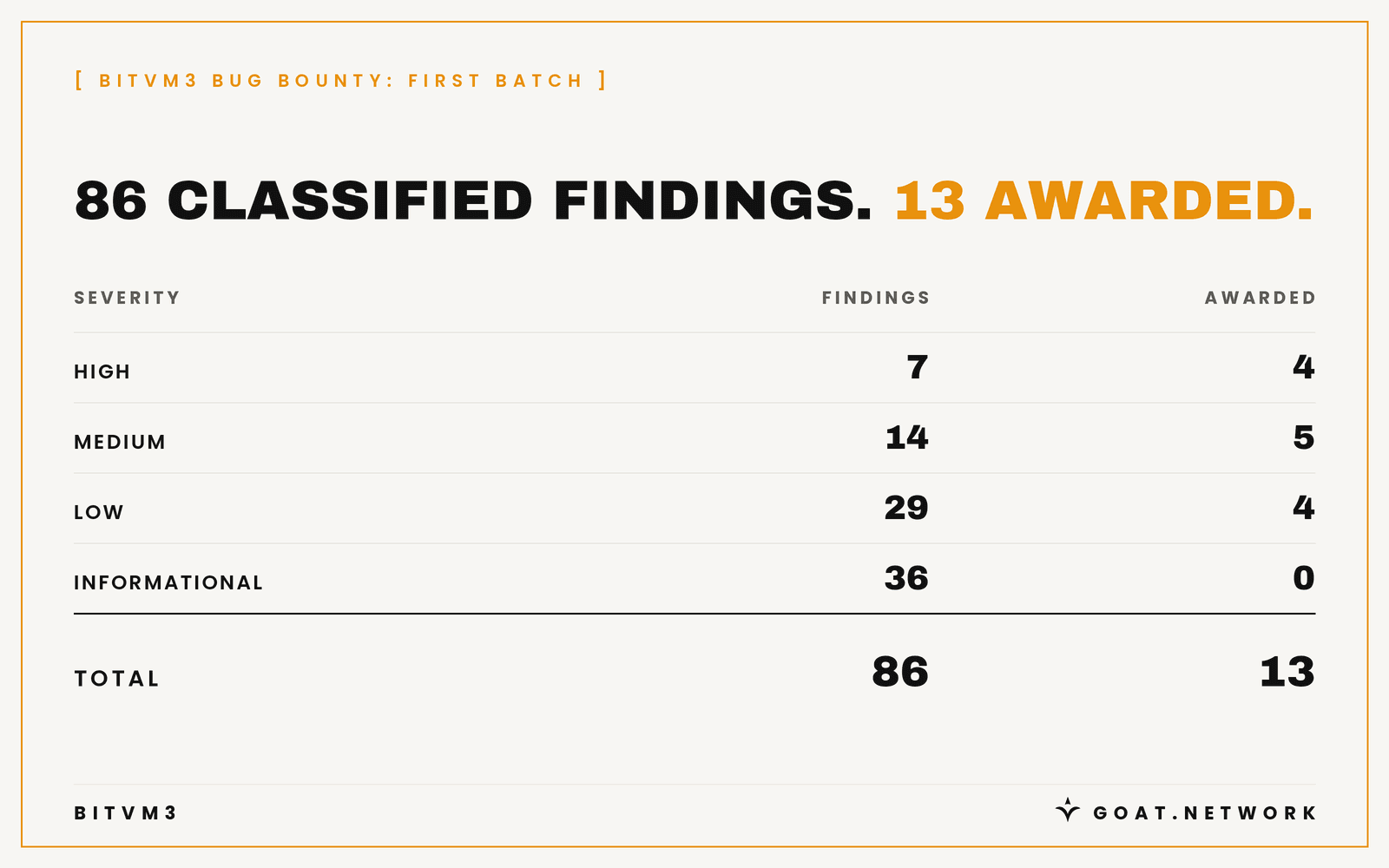
Not every submission appears in the table, and not every classified finding earned an award. The batch also drew a number of reports that described issues already patched before the program opened, duplicated other submissions, or were otherwise not relevant to the program - none of which were eligible. Among the classified findings, those not receiving awards were largely informational or fell below the award threshold.
The awarded findings
Thirteen findings are receiving awards from the $5,000 pool: four High, five Medium and four Low.
Five of the thirteen arrived as public GitHub issues on the bitvm-node repository. All five concern the bridge's automated defence paths - the logic that detects and challenges invalid operator behaviour - which is exactly where adversarial review matters most:
High: the verifier's assertion check could be skipped under specific conditions, leaving an invalid operator assertion unchallenged (#430)
High: the kickoff detector watched only one graph per operator, so a second unauthorized kickoff could pass without an automated challenge (#431)
Medium: the verifier's automated challenge to an unauthorized kickoff was one-shot and could fail open under a timing edge case (#429)
Medium: a cheap on-chain claim using a non-standard script could wedge a committee node's bridge-out watcher (#435)
Low: predictable bridge-out instance IDs allowed anyone to pre-plant a record that stalls the bridge-out cursor (#448)
The remaining eight awarded findings were submitted through the private submission form and span the bitvm-node, bitvm-gc and bitvm-L2-contracts codebases. Our thanks to every researcher who put time into the system, awarded or not.
Fixes for the awarded findings are moving through the public repositories, with several already closed. Award distribution follows validation of each accepted report, as set out at launch.
The program remains open
The bounty is still live, and the $5,000 pool is still paying out for accepted findings. If you work in protocol security, smart contracts, cryptography or distributed systems, the scope, resources and submission routes are all in the original announcement.
Reports can be opened directly on GitHub or submitted through the bug submission form.


