
The GOAT Network Vision, and Why BTCFi Hasn’t Even Started
Over half a decade ago, our team set out to scale Ethereum with an Optimistic Rollup. With maintaining full decentralization as our north star, we pioneered the decentralized sequencer - and we began building a general-purpose zkVM to bring an even more trust-minimized way to settle transactions back to the L1.
But Bitcoin was always our first love. When BitVM theory landed, it made something concrete: you can build a Bitcoin L2 that is enforced by Bitcoin itself, without asking Bitcoin for new opcodes. It is brutally hard. That is the point.
GOAT Network was incubated in 2024 around a simple mission: BTCFi needs two primitives that have been missing so far - transactional security that actually inherits Bitcoin’s guarantees, and sustainable yield that does not depend on custodians, committees, or synthetic risk.
Why “ZK everywhere” turned into “build the full stack”
Our ZK work started from a broad thesis: ZK proofs and zkVMs are a robust foundation for interoperability. Chains don’t share consensus, bridges have persistent security failures, and proofs are a clean way to move correctness across domains.
In practice, integrating deep ZK infrastructure into every chain is a slow B2B path. Very few ecosystems can adopt it at scale, and execution speed matters. So we did what we’re good at: build a consumer-facing system - with ZK as the core enforcement primitive.
That is the architecture: zkVM + BitVM2 + a decentralized sequencer, shipped as a complete Bitcoin L2.
BTCFi hasn’t started because “Bitcoin L2” hasn’t been strict enough
A lot of what gets called “Bitcoin L2” today is a sidechain with a bridge, or a custodial construct with better UX. That can be useful, but it does not inherit Bitcoin’s security properties in the way serious Bitcoin adopters require.
If a system can keep running when Bitcoin is unavailable, or if exits depend on a committee, or if finality depends on a trusted operator, then it is not the environment where long-duration BTC capital will participate. BTCFi needs credible neutrality at the settlement layer, and it needs unconditional exits.

GOAT Network CEO Kevin Liu explains GOAT’s mission: BTCFi that can scale without custodial trust.
The baseline: what a real Bitcoin L2 must provide
Before talking about yield, the security guarantees have to be concrete. The minimum requirements are:
State has to ultimately settle on Bitcoin.
Disputes have to be initiated on Bitcoin and arbitrated by Bitcoin miners, not MPC or federations.Users need unconditional, permissionless exit - if everything goes wrong, you can run a node and get your BTC back.
And the bridge cannot be custodial by design; BTC has to move between L1 and L2 without third-party signatures as the root of trust.
This is also why sequencing matters. A Bitcoin L2 cannot depend on one operator for ordering and liveness if the goal is credible neutrality. The sequencer network has to be permissionless, transparent, and designed to penalize malicious behavior.
This is exactly what we’re building: GOAT BitVM2 for Bitcoin-enforceable disputes and exits, and a live decentralized sequencer network for neutral ordering and liveness.
Why GOAT BitVM2
Bitcoin is constrained - it doesn’t have an onchain verifier. So you design the system around two realities:
Most of the time, you want cheap operation - fast execution off-chain, succinct proofs, and simple posting. But the system must be enforceable when challenged. BitVM2 gives a Bitcoin-enforceable dispute path without requiring Bitcoin to change, which is the key constraint if you want a credible bridge back to BTC mainnet security.
This is why the market feels like Ethereum before OP rollups converged. Early on, there are many designs. Then a small number of frameworks prove they can balance implementability, security, and developer usability. We think Bitcoin is approaching that kind of technical convergence, and BitVM2-class designs are part of the reason.
Yield, but only after security
Most BTC “yield” over the last cycle has not been native. It’s been centralized basis trades, funds parked in multisigs, or forced asset swaps into volatility. That may create returns, but it violates what Bitcoin actually optimizes for: asset control and security.
GOAT Network’s yield model works from first principles: revenue should come from usage, and payouts should be in BTC.
On the network, L2 gas is denominated in BTC. Sequencer nodes process transactions, earn BTC gas fees, capture MEV in BTC, and receive protocol incentives. As activity grows, sequencers earn more BTC, and that BTC can be redistributed to BTC holders participating in the system - yield that scales with real demand rather than financial engineering.
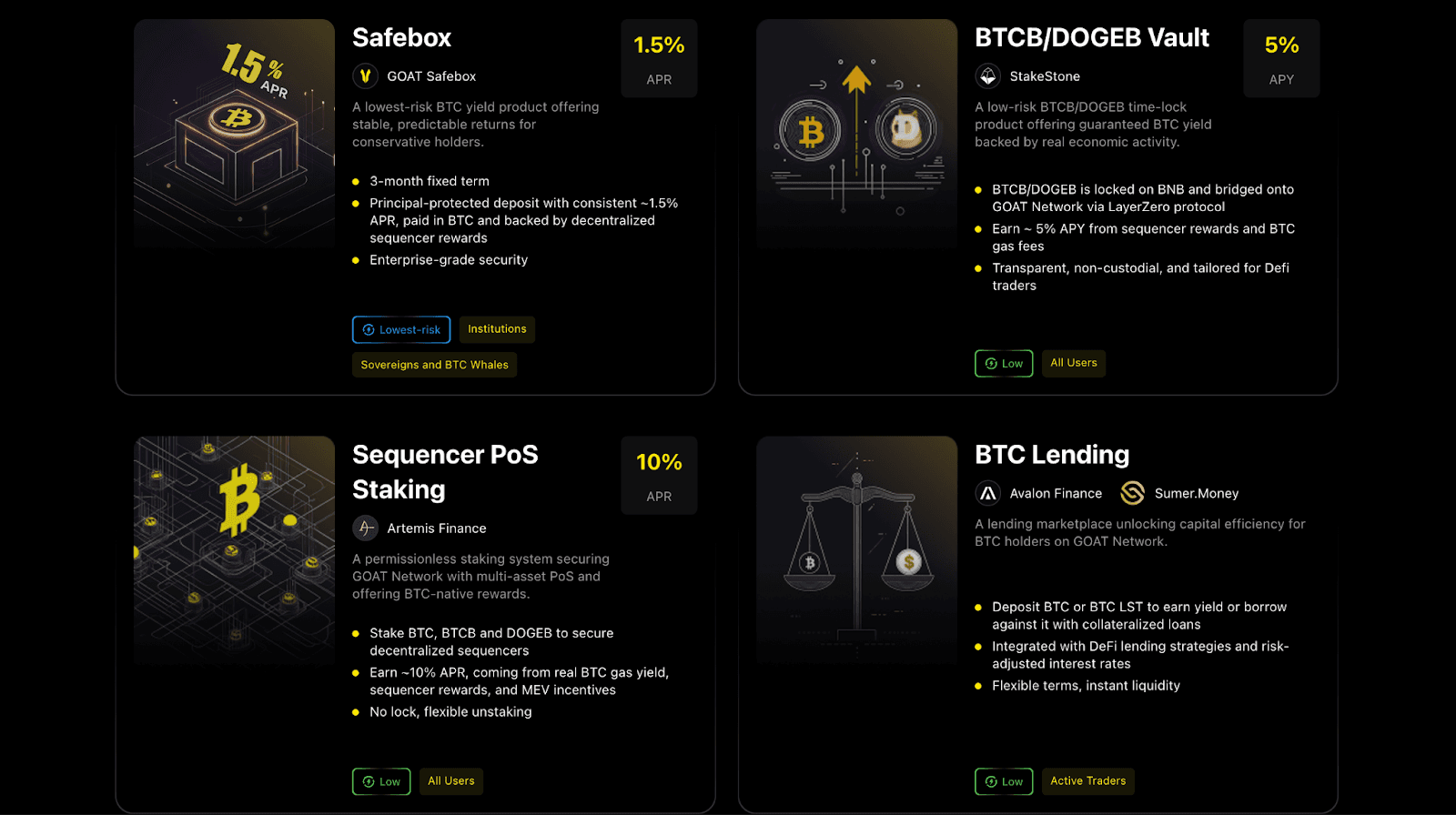
yield.goat.network offers a menu of BTC yield products to cater for every risk-adjusted need.
Why product design looks different on Bitcoin
Bitcoin’s holder base is fundamentally different from Ethereum’s. It is more institution-heavy: mining pools, funds, corporates, long-term whales, and a large segment that does not want to take additional market risk just to earn yield.
So the product surface has to be segmented. You need a path for risk-averse BTC to participate with strong control guarantees, alongside higher-volatility participation paths for retail users who want asymmetric upside. The common prerequisite is the same: trust-minimized entry and exit, enforced by Bitcoin.
The bottom line
When people say “BTCFi is dead”, they usually mean “we haven’t seen real adoption”. That part is true. But the reason is not lack of interest - it’s a lack of infrastructure that meets the criteria of a real Bitcoin-native zkRollup: non-custodial control, unconditional exit, and mainnet-grade settlement.
GOAT Network is the culmination of years of L2 engineering and ZK work, applied to the chain that matters most. It is the first real example of native Bitcoin infrastructure that makes BTC usable at scale - without compromising the security model that made Bitcoin worth building on in the first place.
BTCFi is here at last: goat.network


