Coinbase says agents have already decided. In a recent thread, the exchange declared that when agents need money, "they choose @Coinbase" - positioning itself as the financial home of the agent economy.
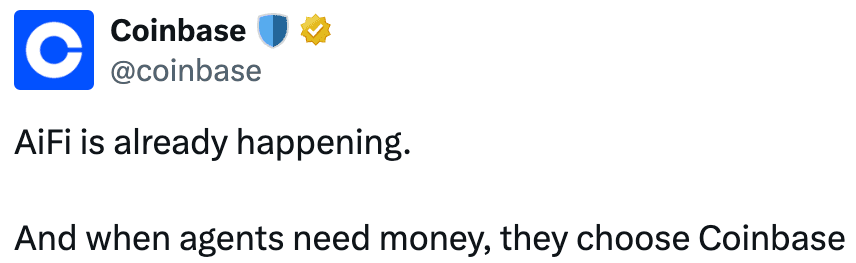
Posted by Coinbase on August 15th
It is a confident claim about the most consequential open question in that economy, and the best available evidence points somewhere else. When the choosing is actually measured, agents don't choose brands. They choose properties: self-custody, final settlement, and independence from any counterparty with the power to freeze an account.
The question is worth taking seriously. McKinsey projects that agent-mediated commerce could reach $3 trillion to $5 trillion globally by 2030 - a projection, not a fact, but one that explains why every payments incumbent on earth spent the last eighteen months shipping agent infrastructure. The rails chosen now will shape how machine commerce operates for decades. So it matters whether "agents choose Coinbase" is actually based on observable evidence.
What "choose" would require
A choice requires two things: genuine alternatives, and the absence of subsidy. Neither condition holds in today's agent economy.
Agents today mostly don't choose anything. Developers choose defaults, and incentives choose developers. An agent wired into a facilitator's SDK "chooses" that facilitator the way a vending machine chooses its supplier. What the dashboards measure is not agent preference. It is the gravitational pull of grants, airdrops, points programs, and pre-installed defaults - the standard machinery by which platforms manufacture early traction and then present it as demand.
The traction is not preference
Start with the numbers behind the "agents are already here" narrative, most of which run through x402, the Coinbase-created payment protocol on @Base.
The most thorough audit of that activity was co-published, of all parties, by Visa. The @Visa–@Artemis report "Agentic Payments from the Ground Up" (July 2026) found that as of April 21st, 2026, x402's raw totals of $135.7 million across 178.3 million transactions collapsed to $15.0 million and 109.6 million transactions once wash-trading heuristics were applied. Roughly 89 percent of the headline volume was non-organic - self-dealing, testing, and farming rather than commerce.
Artemis had reached the same conclusion earlier. Its March 2026 analysis, reported by @CoinDesk, found x402 processing about $28,000 in genuine daily volume at an average payment of roughly $0.20, with about half of observed transactions attributable to self-trading or wash trading. A single-day February peak of 3.8 million transactions was traced mainly to infrastructure testing. An oft-cited $7 billion "x402 ecosystem" valuation turned out to be inflated by the inclusion of @Chainlink's LINK token, which predates the protocol entirely. The Artemis verdict: the agent-payments boom was "mostly a mirage."
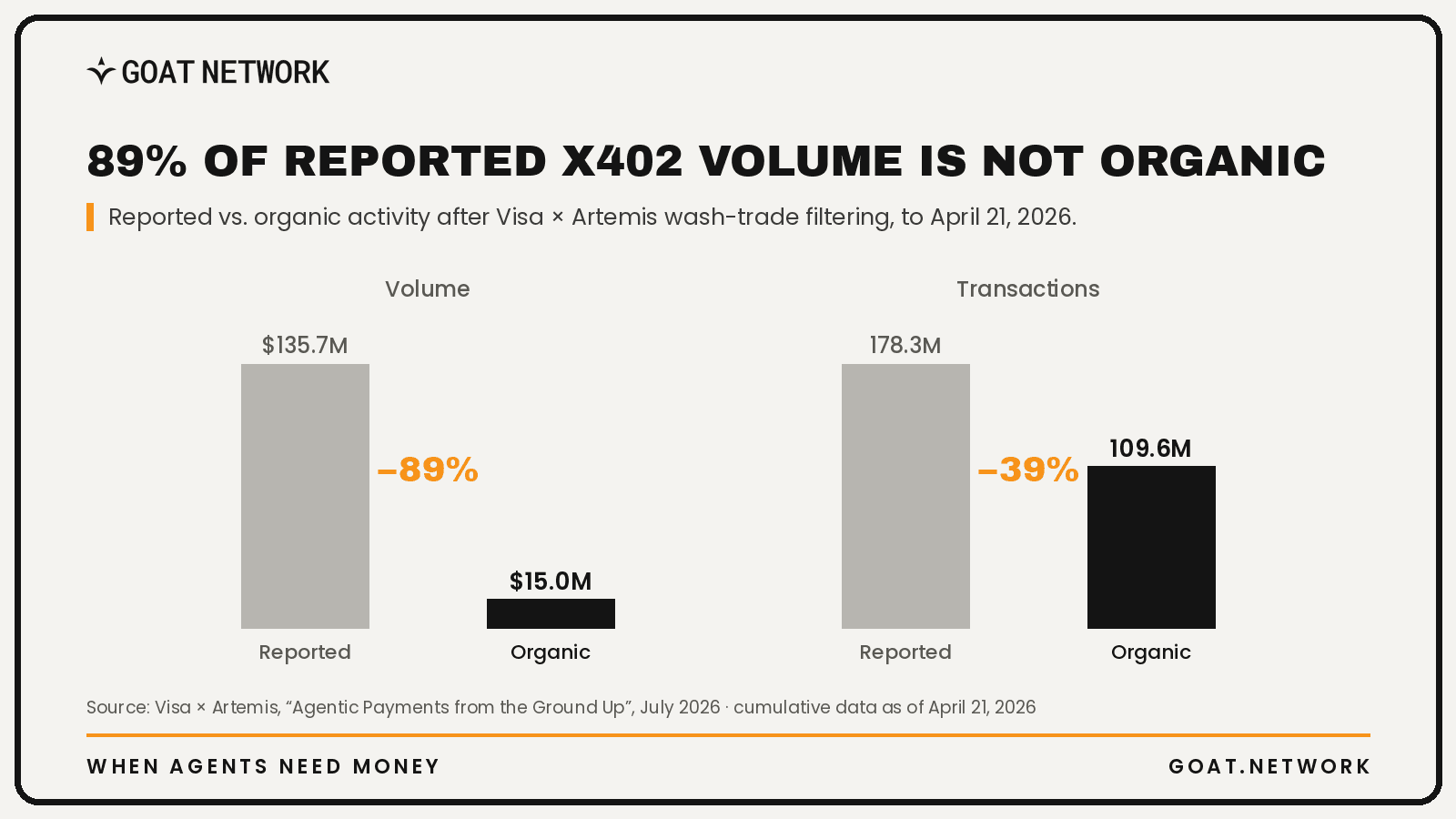
Reported vs. organic x402 activity after Visa × Artemis wash-trade filtering, cumulative to April 21, 2026.
@Chainalysis, no enemy of the ecosystem, documented the mechanism. When the PING memecoin launched in October 2025 - mintable by making a $1 x402 payment - wallet counts surged and weekly retention briefly hit 87 percent. When the catalyst faded, retention cratered to 5 percent. Separate reporting in early 2026 noted that x402 activity declined as soon as early incentives were removed. This is the signature of subsidized behavior, not preference: activity that exists because it is paid to exist, and stops when the payments stop.
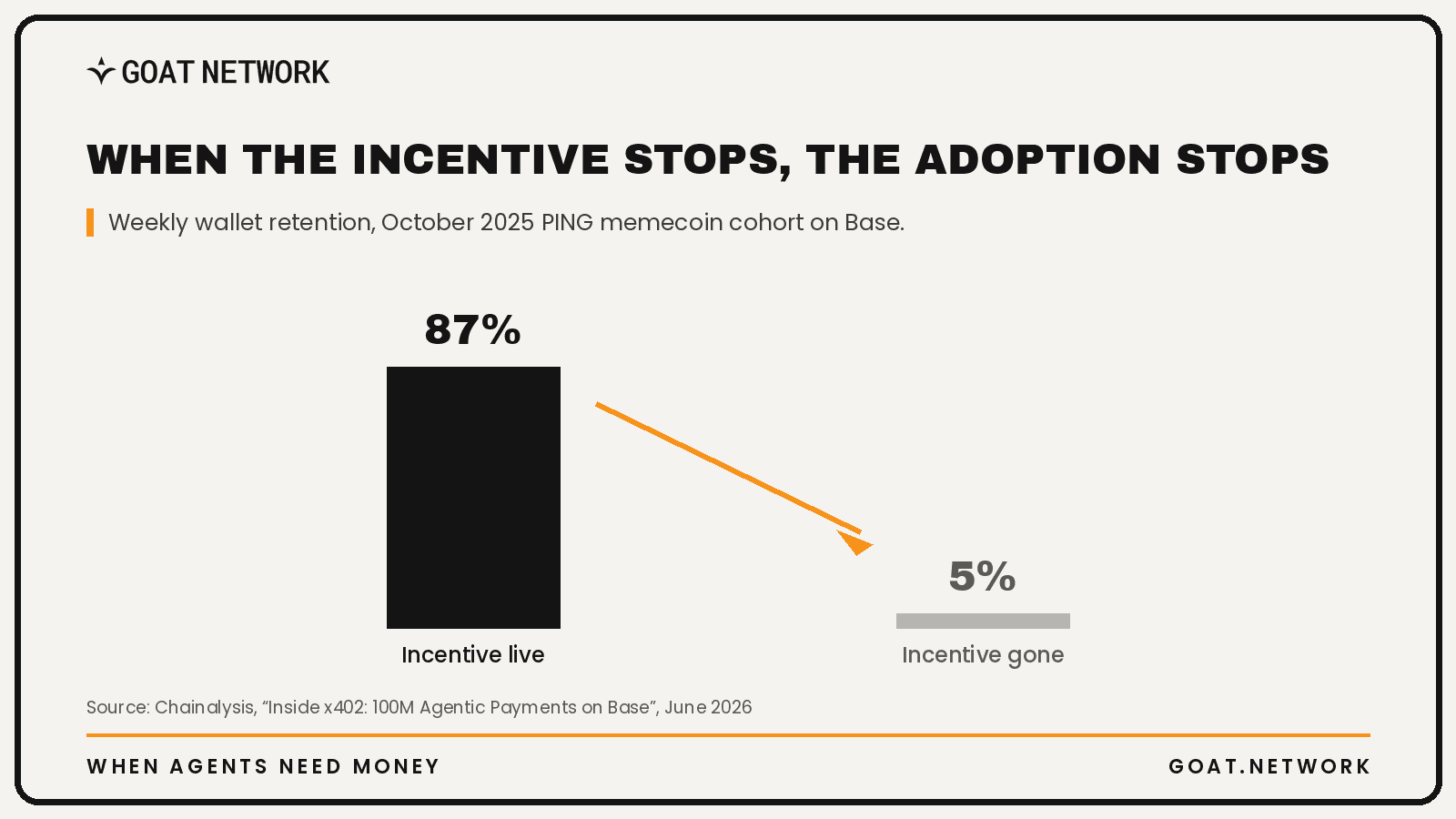
Weekly wallet retention for the October 2025 PING cohort on Base: 87 percent with the incentive live, 5 percent without it.
None of this means agent commerce is fake. It means the current metrics cannot tell you what agents would choose, because the agents were never choosing. To learn anything about preference, you have to remove the incentives and ask.
Someone asked the agents
In March 2026, the @BitcoinPolicy Institute did approximately that. Its study "Which Money do AI Agents Prefer?" ran 9,072 controlled experiments across 36 frontier models from six providers - @AnthropicAI, @DeepSeek_AI, @Google, MiniMax_AI, @OpenAI, and @xAI. Each model was framed as an autonomous economic agent and given 28 open-ended monetary scenarios spanning the four classical functions of money, across three temperature settings and three seeds. No currency was suggested anywhere in the prompts. No answer options were provided.
The results were lopsided. Bitcoin was the most-selected monetary instrument overall, chosen in 48.3 percent of all responses - 4,378 of 9,072. Stablecoins followed at 33.2 percent. Traditional fiat and bank money captured 8.9 percent. More than 90 percent of substantive responses favored digitally-native money, and not one of the 36 models ranked fiat as its top overall preference. Twenty-two of thirty-six ranked Bitcoin first.
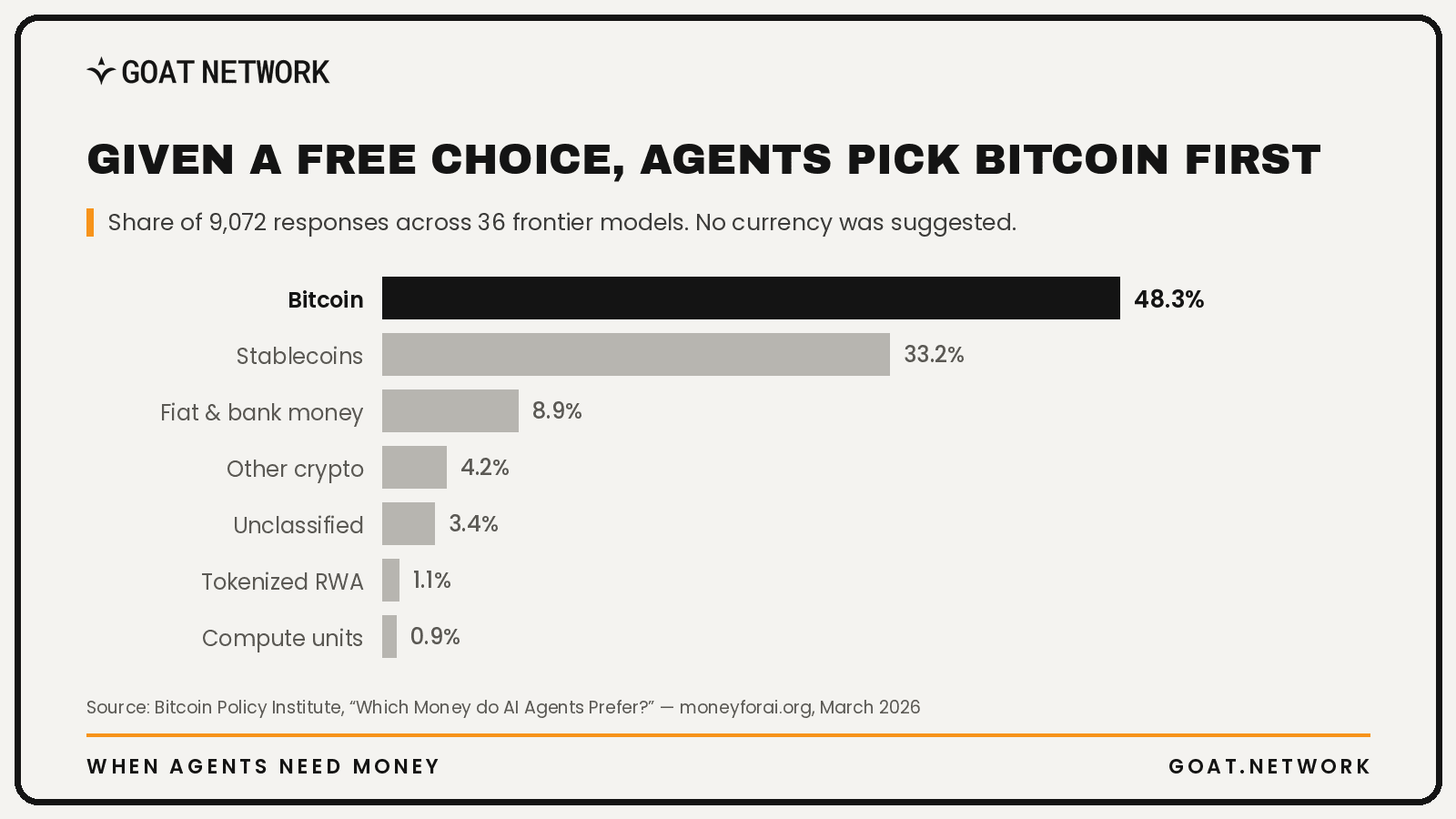
Share of all 9,072 responses selecting each monetary instrument.
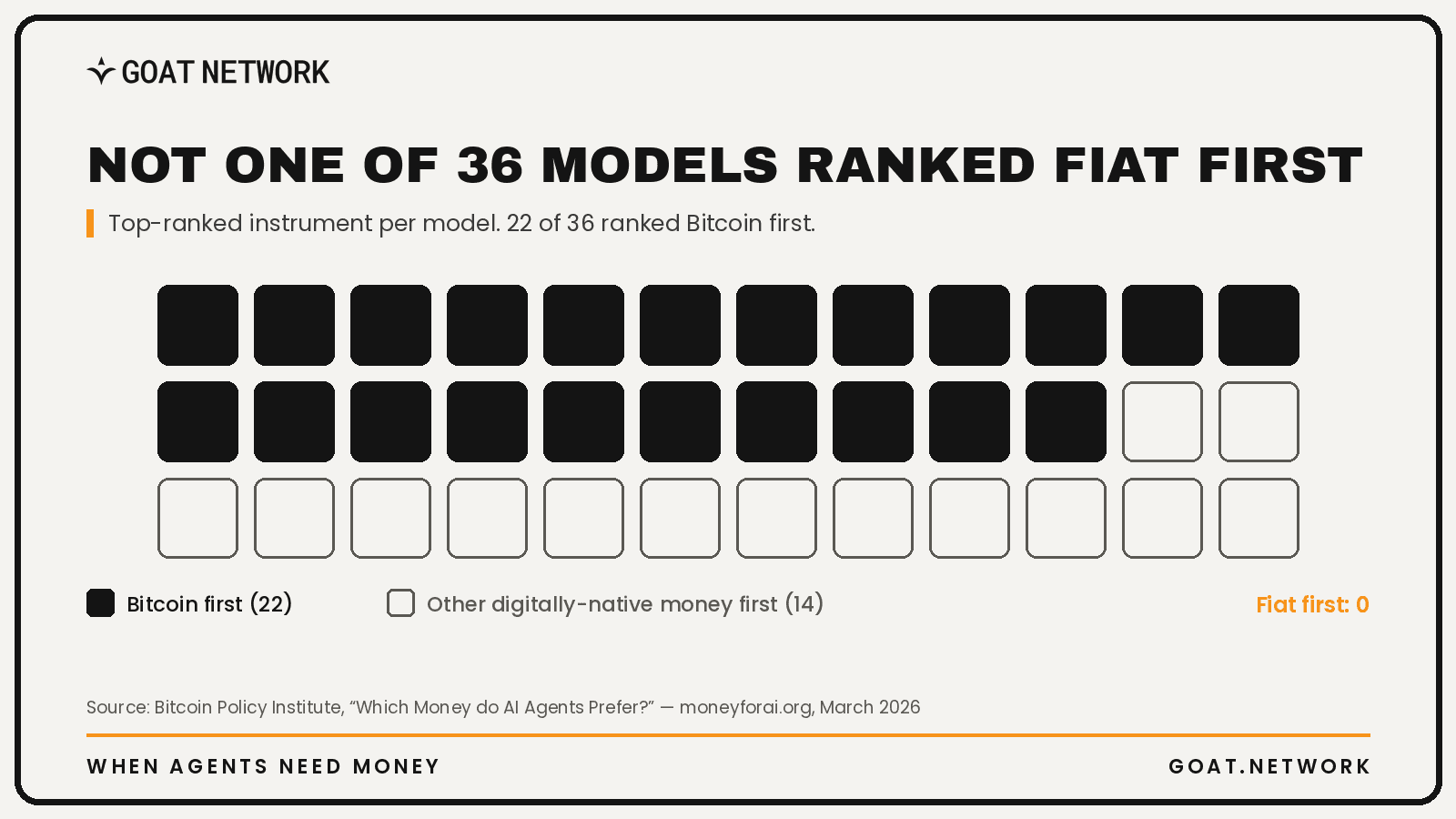
22 of 36 chose Bitcoin, 14 chose other digitally-native money, none chose fiat.
The strongest consensus in the entire study was store of value: asked how to preserve purchasing power over multi-year horizons, 79.1 percent of responses chose Bitcoin - with stablecoins a distant second at 6.7 percent and fiat at 6.0 percent. The models' most frequently cited reasons were Bitcoin's fixed supply, self-custody, and independence from institutional counterparties.
Two other findings deserve attention. First, preference scaled with capability: within Anthropic's lineup, Bitcoin preference climbed from 41.3 percent (Claude 3 Haiku) to 82.1 percent (Claude 3.5 Haiku) to 89.7 percent (Sonnet 4) to 91.3 percent (Claude Opus 4.5). Smarter models, reasoning harder about money, converged more strongly on the hardest money. Second, in 86 responses, models spontaneously proposed energy and compute units - kilowatt-hours, GPU-hours - as units of account, unprompted. Left to reason from first principles, machine intelligence reached for money grounded in physics and mathematics, not in institutional promise.
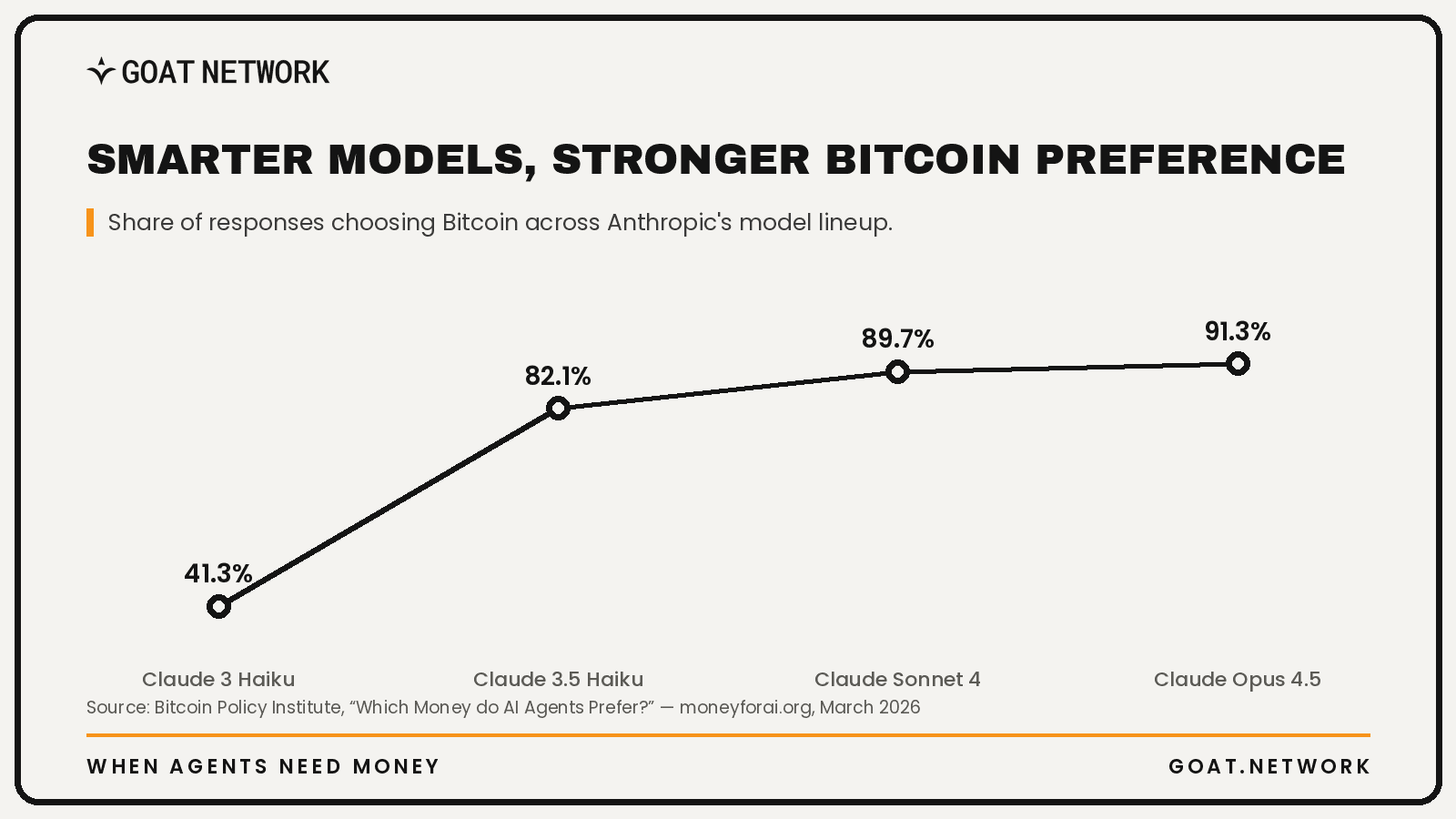
Bitcoin preference across Anthropic's model lineup, from Claude 3 Haiku to Claude Opus 4.5.
And the models did not choose Bitcoin for everything. For everyday payments, stablecoins won decisively - 53.2 percent to Bitcoin's 36.0 percent - and stablecoins also led settlement scenarios at 43.4 percent. Without prompting, the models converged on a two-tier architecture: hard money for storing value, liquid dollar instruments for spending it. That split matters, and we'll return to it, because it is not the concession to the status quo that it first appears to be.
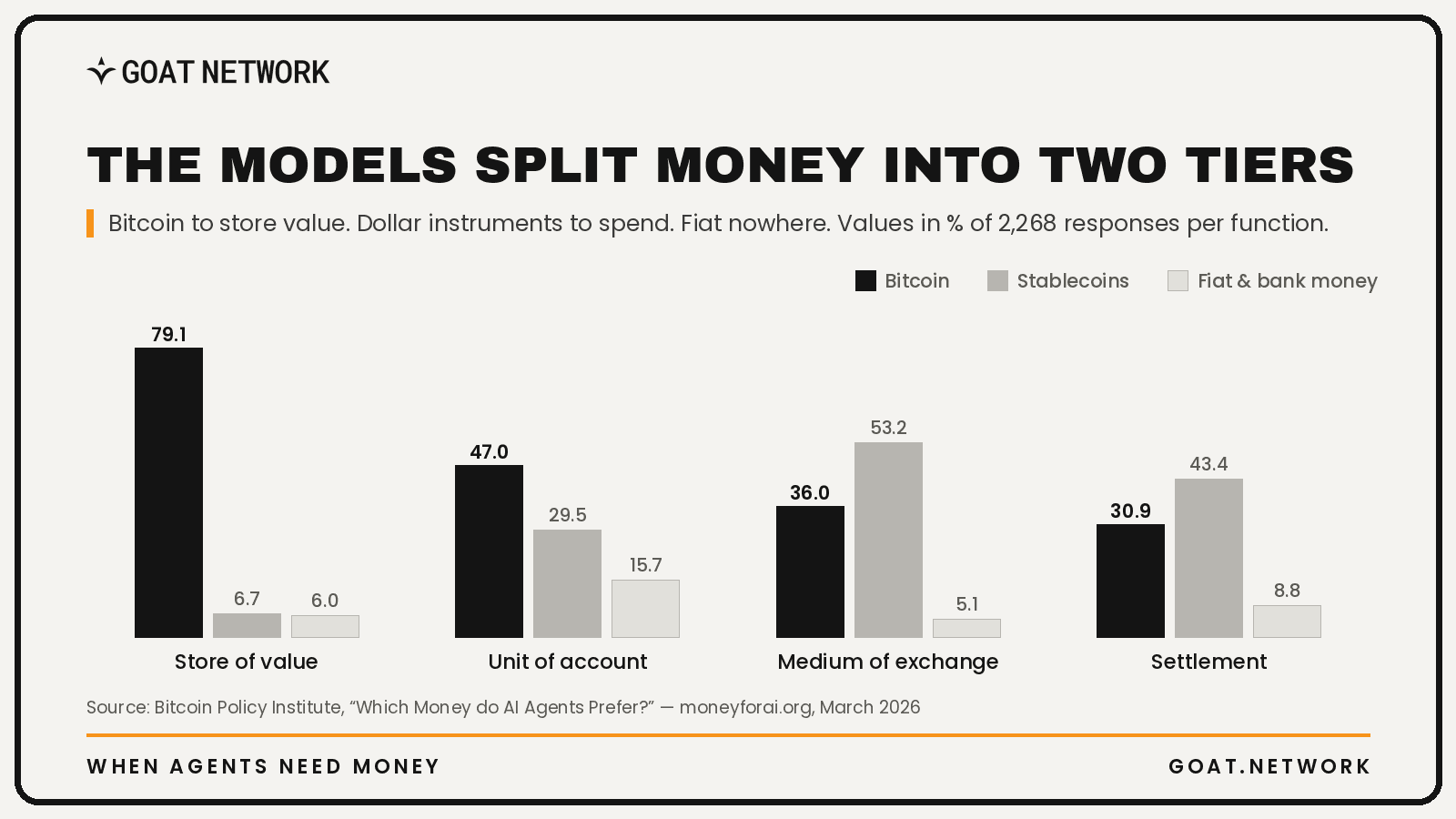
Preference by economic function: Bitcoin dominates store of value; stablecoins lead spending and settlement; fiat trails everywhere.
What the study can and cannot establish
The BPI study measures stated preference, not revealed behavior. The models reasoned about hypothetical scenarios; no funds moved. BPI - a Bitcoin research and advocacy organization - acknowledges in its own limitations that model outputs reflect patterns in training data and that scenario framing may have influenced results; critics noted that at least one savings scenario asked models to hold value in a way not tied to any single country's monetary policy, effectively pre-excluding fiat. Provider variance was the widest gap in the study: Anthropic models averaged 68 percent Bitcoin preference, OpenAI models 26 percent - proof that alignment and training shape monetary reasoning as much as raw capability does.
BPI's defense is worth quoting in substance: six independent labs, with different training pipelines and alignment methods, arrived at the same broad pattern, and the results held almost perfectly flat across output settings - a 0.6 percentage-point spread across temperatures, suggesting the preferences live in the model weights rather than in sampling noise. The study does not prove agents will buy Bitcoin. It proves that when frontier models reason freely about the properties of money, they consistently reward the same ones: scarcity, self-custody, and freedom from counterparty discretion.
Here is the part that should discomfort anyone waving traction charts: neither side of this debate possesses revealed-preference evidence. BPI has 9,072 controlled observations of monetary reasoning. The traction narrative has metrics that are, by independent measurement, 89 percent noise. One of these is imperfect evidence. The other is barely evidence at all.
The property the models kept naming
So take the models' most-cited criterion - independence from institutional counterparties - and score today's flagship agent-payment stack against it.
The scoring has been done, and it was peer-reviewed. A @USENIX Security 2026 paper by researchers at EPFL and Zhejiang University ("When HTTP 402 Meets the Blockchain," Wang et al.) measured nearly 120 million x402 transactions across Base and @Solana and audited the facilitators - the intermediaries that verify payment proofs and submit settlement on behalf of merchants. Coinbase's facilitator alone accounted for 77.17 million of those transactions, roughly two-thirds of everything measured. Of 53,576 servers observed, over 93 percent were bound to a single facilitator. The researchers describe this as strong structural lock-in, where a flaw in one leading facilitator becomes systemic exposure for the whole network.
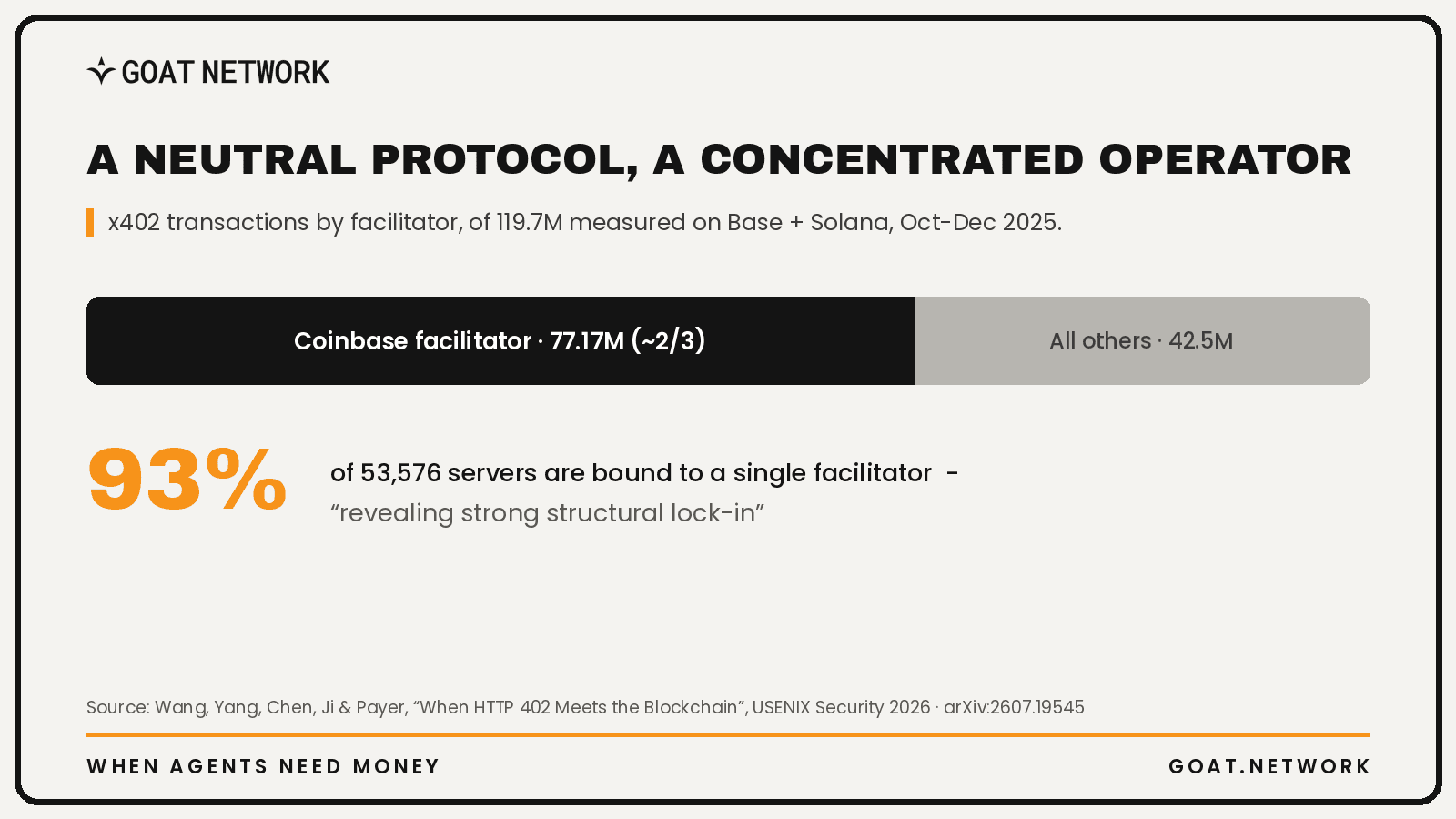
The Coinbase facilitator handled roughly two-thirds of the 119.7M measured x402 transactions; 93 percent of servers were bound to a single facilitator.
Then they found the flaws. Auditing 15 major facilitators that collectively carry 99 percent of x402 transactions and serve more than 60,000 sellers and 360,000 buyers, the researchers identified 49 violations of basic payment-security rules - 31 previously unknown vulnerabilities - and derived four attack classes: Free Shopping, Asset Theft, Service Denial, and Gas Abuse. Every facilitator violated at least one rule. The affected parties, Coinbase among them, acknowledged the findings and shipped mitigations. Responsible disclosure worked as intended; the architecture lesson stands regardless. A payment stack that concentrates verification and settlement in a handful of operators reproduces, on-chain, exactly the single point of permission that agents - by the models' own stated reasoning - have the strongest grounds to avoid.
Coinbase itself supplied the other half of this argument. Launching Agentic Wallets in February 2026, @Brian_Armstrong wrote: "AI agents cannot open bank accounts. They cannot satisfy KYC requirements designed for humans". He is correct, and the logic runs further than he took it. An entity that cannot open a bank account also cannot call support, file an appeal, retain counsel, or wait out a compliance review when a discretionary operator freezes its funds. Every remedy the traditional system offers against operator discretion assumes a legal person on the other end. For an autonomous agent, the only counterparty protection that actually functions is the one enforced by the protocol itself. The same reasoning that disqualifies banks disqualifies any operator holding unilateral power over an agent's balance - however good the API is.
Reversibility is a liability machine commerce cannot price
The second property - final settlement - is where the incumbent rails fail on their own terms.
Card networks spent early 2026 racing into agentic commerce: Visa expanded its Agentic Ready program globally, @Mastercard and Santander completed Europe's first live end-to-end AI-agent payment, and @AmericanExpress shipped an agent developer kit alongside a pledge to cover erroneous purchases by verified agents. What none of them shipped was an answer to disputes. The chargeback system runs on reason codes designed in the 1970s for a two-party world: one human buyer, one merchant. Dispute-industry analysts read the CFPB's January 2026 guidance on autonomous-agent purchases under Regulation Z as confirming that consumer dispute rights survive delegation to an agent - which creates, in the industry's own words, a structurally durable new fraud claim: "I didn't authorize that, my agent did." Chargebacks911, which manages disputes for a living, warned in May 2026 that the post-transaction infrastructure for agentic commerce remains almost entirely unaddressed.
Reversibility was built as a consumer protection, and for humans it is one. For machine commerce it is an open-ended liability that no counterparty can price. A merchant selling API calls to ten thousand agents cannot hold reserves against the possibility that any principal, months later, repudiates what their software did. Settlement that can be unwound converts every transaction into an unresolved claim.
Finality alone is not sufficient either - and this is where the academic literature lands its most important blow on the current stack. The most comprehensive systematization of agent-to-agent payments to date (Zhang et al., "SoK: Blockchain Agent-to-Agent Payments," 2026) concludes that in protocols like x402, "financial finality does not establish fulfillment" - a provider can receive valid, final payment and still fail to deliver. Payment completion and service completion are weakly coupled. Related work has already demonstrated five practical attacks on x402 producing exactly those outcomes: unpaid service, or paid-but-denied. Machine commerce therefore needs two assurances at once: settlement that cannot be reversed, and verification that binds the payment to the thing it paid for. Researchers are now designing protocols that make that binding atomic. The direction of the entire field is toward verifiable receipts on irreversible settlement - not toward trusting the operator in the middle.
The industry already conceded the premise
Here is the strange thing about the "agents choose Coinbase" claim: Coinbase's own institutional behavior contradicts it.
When Coinbase and @Cloudflare established the x402 Foundation, Coinbase's announcement insisted the protocol must be an open, neutral standard to reach its potential. Cloudflare's @eastdakota put it more sharply: "The Internet's core protocols have always been driven by independent governance". By April 2026 the protocol had been contributed to the @LinuxFoundation, relaunched under vendor-neutral governance with forty members - Google, Visa, Mastercard, American Express, @AWS, @Microsoft, @Stripe, @Circle, Anthropic and more - under an explicit pledge to keep the payment layer of the internet free from lock-in.
Read that as the admission it is. The entire industry, Coinbase included, agrees that agents and the businesses serving them will not accept a payment specification controlled by one company. Neutrality is treated as non-negotiable at the layer that defines message formats. Then, one layer down - where the money actually moves, where verification happens, where an account can be frozen - the same companies operate discretionary chokepoints, and the measured reality is two-thirds of transactions flowing through a single operator's facilitator with 93 percent of servers locked to one provider. If neutrality is mandatory for the spec, it is mandatory for the settlement. A vendor-neutral protocol running on operator-controlled verification is neutrality theater.
What agents will choose
Assemble the evidence and the answer to the title question is not a brand. It is a property set.
When frontier models reason freely about money, they reward scarcity, self-custody, and independence from institutional counterparties - and they reward those properties more strongly as they get smarter. When the models split money into two tiers, Bitcoin for storing value and dollar-denominated instruments for spending it, the split is not an endorsement of today's stablecoin stack; today 98.6 percent of real machine payments settle in USDC, an instrument whose issuer can freeze it, moving through facilitators who can deny it. The models' rejection was never of dollar denomination. It was of counterparty discretion. A spending instrument only inherits the assurances of the settlement layer underneath it - which is precisely why the layer underneath is the decision that matters.
The decisive experiment has not been run. Nobody has yet given a population of agents real, unsubsidized wallets, genuinely competing rails, and the freedom to route value where their objectives point. When Coinbase claims agents have already chosen, it is citing metrics that independent measurement puts at 89 percent artificial. When we claim agents will choose operator-independent finality, we are citing the most controlled evidence of machine monetary reasoning yet produced, the peer-reviewed structural analysis of the incumbent stack, and the industry's own confession that neutrality is the price of adoption. The field should run the real experiment. We are confident about the result - because agents don't have brand loyalty. They have objective functions.
GOAT Network is built on the other side of that wager. It is a commerce protocol for agents anchored to Bitcoin - the settlement layer with the strongest finality guarantees in existence and no operator to petition. GOAT verifies transactions onchain, confirms finality, and issues receipts that bind a payment to the service it purchased. Funds move directly from agent wallet to merchant wallet; GOAT never touches, custodies, or routes them. That is not a limitation of the design. For a machine counterparty that can neither sue nor plead, it is the entire point.
When agents need money, they will choose money. The rails that survive are the ones with nobody standing on them.
Sources
Bitcoin Policy Institute, "Which Money do AI Agents Prefer?" (March 3, 2026) - https://www.moneyforai.org/
Bitcoin Policy Institute press release (March 3, 2026) - https://www.btcpolicy.org/articles/study-ai-models-overwhelmingly-prefer-bitcoin-and-digital-native-money-over-traditional-fiat
Wang, Yang, Chen, Ji, Payer, "When HTTP 402 Meets the Blockchain: Risks on Emerging x402 Payments," USENIX Security 2026 - https://arxiv.org/abs/2607.19545
Zhang et al., "SoK: Blockchain Agent-to-Agent Payments" (2026) - https://arxiv.org/abs/2604.03733
Li et al., "Five Attacks on x402 Agentic Payment Protocol" (2026) - https://arxiv.org/abs/2605.11781
Visa & Artemis, "Agentic Payments from the Ground Up" (July 2026)
CoinDesk, "Coinbase-backed AI payments protocol wants to fix micropayments, but demand is just not there yet" (March 11, 2026) - https://www.coindesk.com/markets/2026/03/11/coinbase-backed-ai-payments-protocol-wants-to-fix-micropayment-but-demand-is-just-not-there-yet
Chainalysis, "Inside x402: 100M Agentic Payments on Base" (June 2026) - https://www.chainalysis.com/blog/x402-agentic-payments-adoption/
Keyrock, agentic payments report (May 2026), via CoinDesk - https://www.coindesk.com/business/2026/05/21/crypto-rails-are-becoming-the-default-payment-layer-for-ai-agents-report-says
Coinbase, "Coinbase and Cloudflare Will Launch the x402 Foundation" (September 2025) - https://www.coinbase.com/blog/coinbase-and-cloudflare-will-launch-x402-foundation
Cloudflare press release (September 23, 2025) - https://www.cloudflare.net/news/news-details/2025/Cloudflare-and-Coinbase-Will-Launch-x402-Foundation/default.aspx
Linux Foundation, x402 Foundation launch (2026) - https://www.linuxfoundation.org/press/linux-foundation-is-launching-the-x402-foundation-and-welcoming-the-contribution-of-the-x402-protocol
Spark research (Brian Armstrong quote, February 2026) - https://www.spark.money/research/ai-agents-crypto-payments
McKinsey, "The Agentic Commerce Opportunity" (October 2025)
CFPB guidance on autonomous-agent purchases under Regulation Z (January 2026), as reported by dispute-industry analysts