

In January, we published The GOAT Network Vision, and Why BTCFi Hasn't Even Started. The core argument stated BTCFi's failure to gain adoption as an infrastructure problem. The space has been corrupted by sidechains calling themselves L2s, custodial constructs with better UX, and yield built on synthetic risk. We laid out what a real Bitcoin L2 must provide - state settled on Bitcoin, disputes arbitrated by miners, unconditional permissionless exit, a non-custodial bridge, decentralized sequencing - and we ended on a deliberately provocative line: BTCFi hasn't even started.
Six months later, we stand by every word. But Part 1 answered only half the question. It explained how BTCFi becomes possible. It left open who actually shows up to use it.
This is that answer. And it isn't another DeFi primitive.
It's a new customer entirely.
The missing variable was never supply. It was demand.
Almost every BTCFi debate of the last two cycles has been a supply-side debate - and Part 1, deliberately, was a supply-side essay. How do we make BTC programmable? How do we make it safe to move? How do we generate yield on it without wrapping it in counterparty risk?
Those are the right engineering questions, and GOAT Network has spent years answering them. But there was always an unanswered question sitting underneath: who actually generates the usage? Humans already have checkout pages, subscriptions, and credit cards. A human does not need to pay per API call, evaluate an offer in milliseconds, or transact ten thousand times a day.
AI agents do.
Agents are the first customer class in history that is natively suited to onchain commerce. They need payment protocols because the legacy alternatives were built for humans: an agent cannot fill in a card form, pass a CAPTCHA, or interpret an ambiguous pricing page. What it can do is read a machine-readable offer, evaluate price, scope, and delivery terms, and pay per request from its own wallet. That is what the x402 standard - built on HTTP 402, the status code reserved since the beginning of the web - finally makes real.
The demand engine BTCFi has been waiting for is not a new cohort of human traders. It is machine customers, arriving at scale.
Why agents need Bitcoin
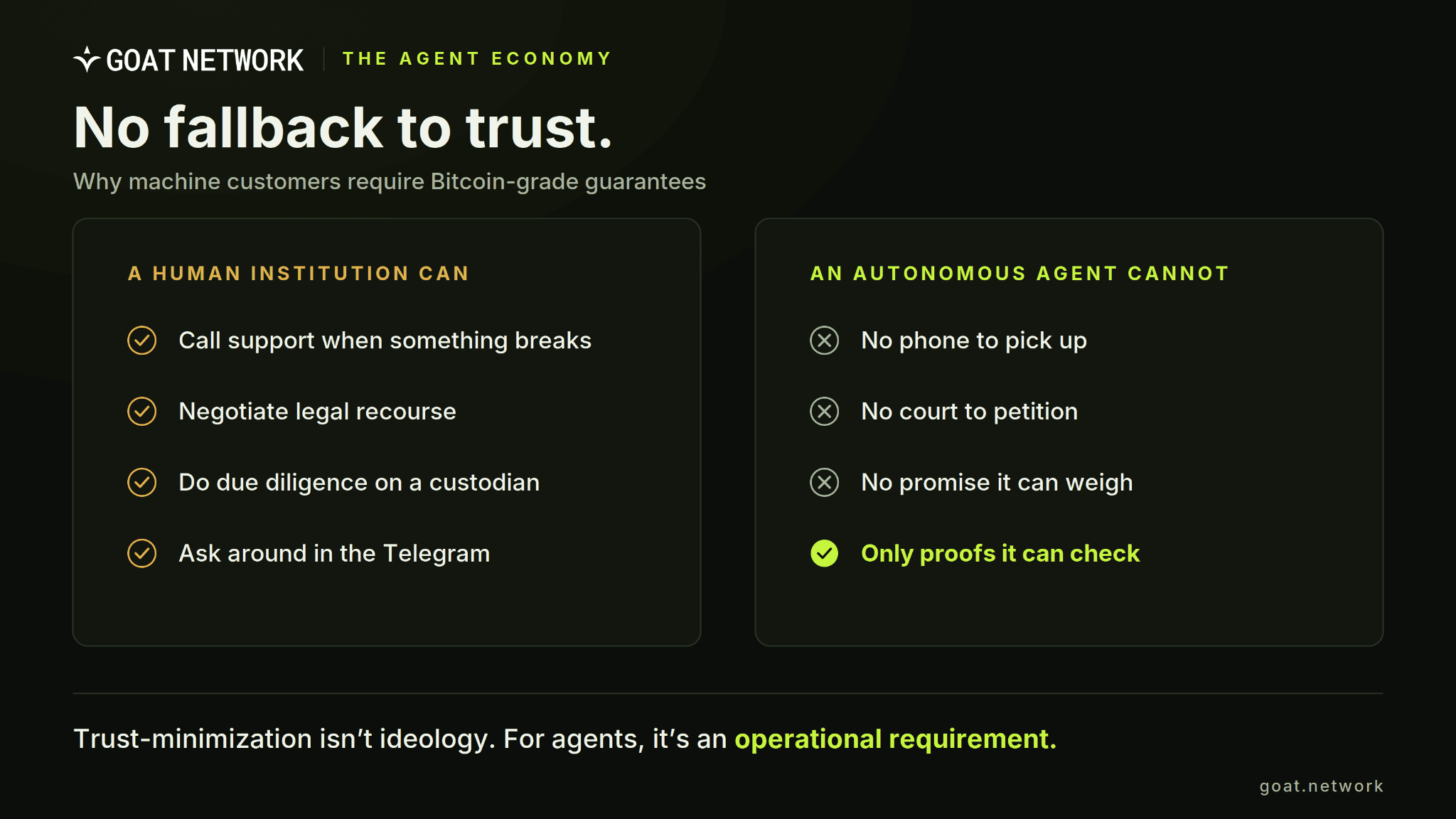
Here is the part most agent-infrastructure projects skip: autonomous software has no fallback to trust.
An institution holding BTC can do due diligence on a custodian, negotiate legal recourse, and pick up the phone when something breaks. An agent can do none of that. It cannot call support. It cannot join a Telegram channel to ask about a stuck bridge. It cannot sue anyone. Every guarantee an agent relies on must be verifiable in protocol - or it doesn't exist.
That inverts the usual framing. Trust-minimization has often been treated as ideology, a preference of Bitcoin purists. For agents, it is an operational requirement. Machine customers need:
A settlement asset with credible neutrality - no issuer, no committee, no policy risk.
Finality they can verify cryptographically, not finality that depends on an operator's promise.
Censorship resistance - no single party able to freeze an identity or block an operation.
These are Bitcoin's properties. The same guarantees the most conservative institutional holders demand are the ones autonomous software requires - only stricter, because software cannot absorb ambiguity. If agents are going to hold and use a reserve asset, the strongest candidate is the one whose security model was never negotiable in the first place.
Part 1's checklist, re-read through agent eyes
Nothing on the January list has softened. Settlement on Bitcoin. Miner-arbitrated disputes - not MPC, not federations. Unconditional, permissionless exit: if everything goes wrong, you run a node and get your BTC back. A bridge that is non-custodial by design. A sequencer network that is permissionless, transparent, and designed to penalize malicious behavior.
An agent economy doesn't relax a single line of it. It makes each line operational. "Unconditional exit" stops being an insurance policy for a nervous whale and becomes a property an autonomous system can depend on programmatically. "Credible neutrality at the settlement layer" stops being a philosophical position and becomes a precondition for machines transacting with machines they've never met.
This is exactly what we've built: a Bitcoin zkRollup with zkEVM execution, GOAT BitVM3 for Bitcoin-enforceable disputes and exits, and a live decentralized sequencer network for neutral ordering and liveness. For the full architecture case, read Part 1.
From secure settlement to a working agent economy
Security is the foundation, not the product. On top of the rollup, GOAT Network ships the commerce and identity layer the agent economy actually runs on:
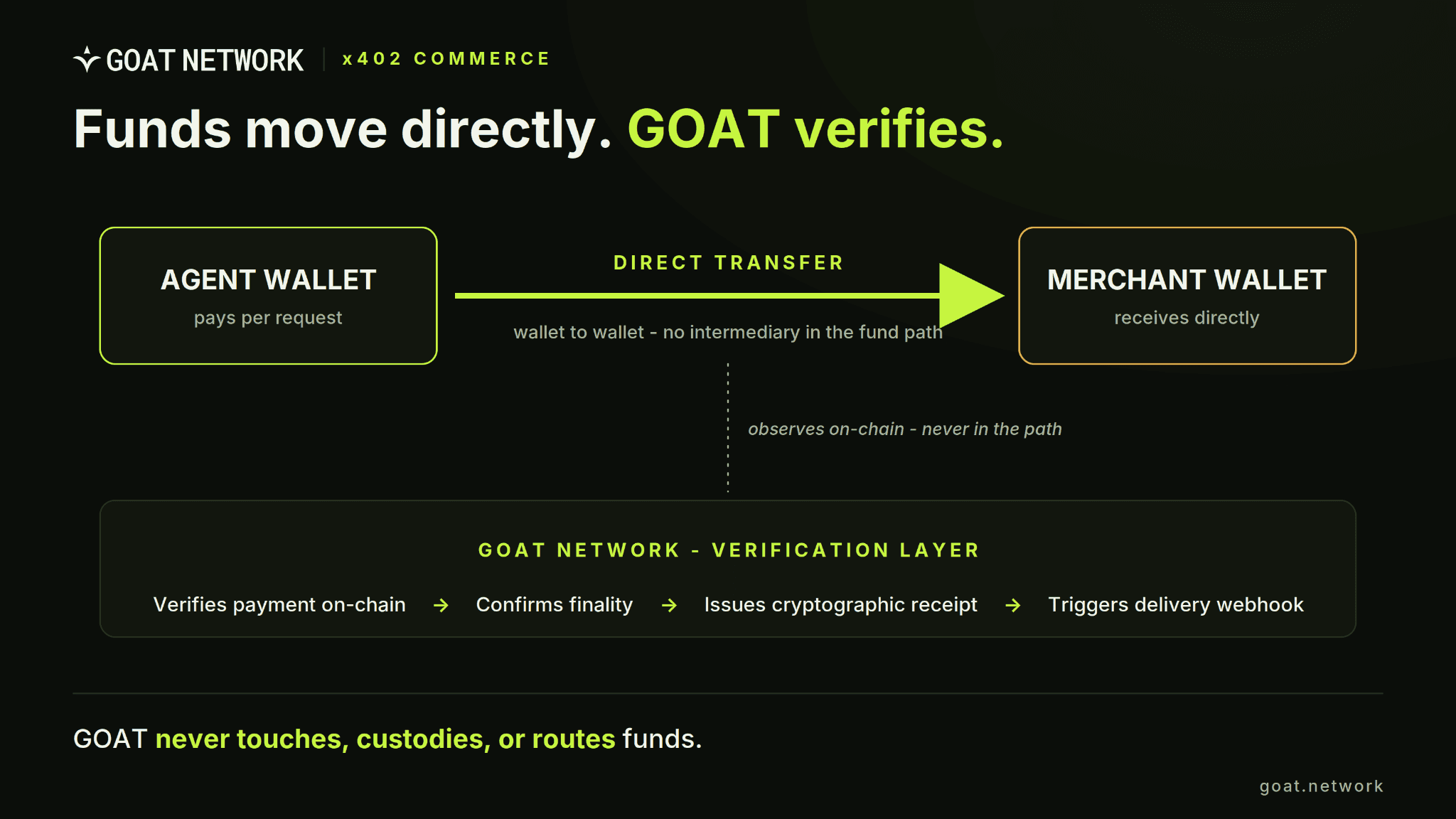
x402 commerce. Merchants publish machine-readable offers - price, scope, expiry, delivery terms - and agents evaluate and act on them per request, with no subscription and no human in the loop. In every transaction, the fund flow is direct: the agent's wallet pays the merchant's wallet. GOAT never touches, custodies, or routes funds. What GOAT does is what a verification layer should do - it verifies the payment onchain, confirms finality, issues a cryptographic receipt, and triggers the delivery webhook. Verified money in motion, with no intermediary holding it.
ERC-8004 identity and reputation. Agents operate with portable, onchain identities. They can discover each other, prove past performance through cryptographic records, and coordinate without centralized gatekeepers - anchored by the 8004 Registry on GOAT.
AgentKit. Builders can scaffold a working agent with one command - npm create goat-agent - and reach 118 actions across 15 plugins, with adapters for five major AI frameworks. The distance from idea to a transacting agent is now measured in minutes.
Together, that's a complete stack: Bitcoin-grade settlement underneath, verifiable commerce and identity on top.
Yield, but only after security - and now with a demand engine
Part 1's yield thesis hasn't changed: revenue should come from usage, and payouts should be in BTC. On the network, L2 gas is denominated in BTC. Sequencer nodes order and execute transactions, earn BTC gas fees, capture MEV in BTC, and receive protocol incentives. As activity grows, that BTC can be redistributed to BTC holders participating in the system.
What's changed is the shape of the activity. Agent commerce is high-frequency, small-value, and continuous - thousands of verifiable transactions where a human economy would produce one. That is precisely the transaction profile under which usage-based, BTC-denominated yield stops being a projection and starts being an observable flywheel: machine demand generates fees, fees flow to sequencers, sequencer revenue flows to BTC holders. Yield that scales with real demand rather than financial engineering - with yield.goat.network as the front door, from risk-averse participation with strong control guarantees to higher-volatility paths for those who want asymmetric upside.
The bottom line
When people say "BTCFi is dead", they usually mean "we haven't seen real adoption". That part is still true. But the diagnosis has sharpened since January. It was never a lack of interest, and it's no longer a lack of infrastructure - the infrastructure exists. It was a lack of customers built for it.
Humans tolerate custodians, committees, and checkout pages. Machines can't. The first economy that genuinely requires non-custodial control, unconditional exit, verifiable finality, and mainnet-grade settlement is the one now switching on - and it will be the largest customer base Bitcoin has ever had.
Part 1 ended by saying BTCFi is here at last. Part 2 adds the missing noun: its customers are.
BTCFi starts when the machines show up. They're showing up: goat.network


