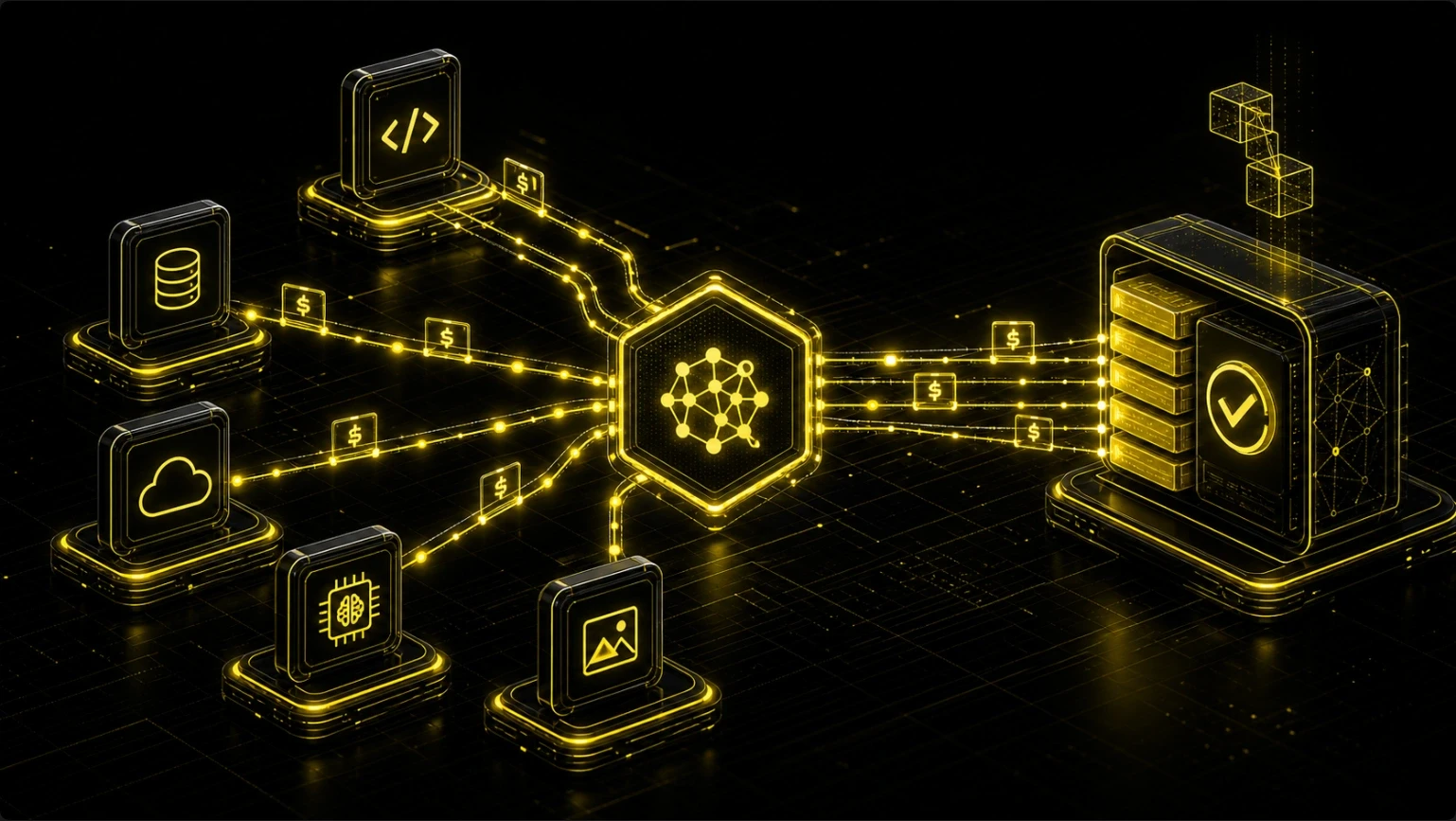

One AI agent workflow may call a search endpoint, purchase a proprietary dataset, invoke a code-execution tool, and order a finished report. To the agent, these are all service requests. To the providers, they are four different products with different costs, delivery events, risks, and refund obligations.
That distinction matters when designing x402 infrastructure for AI agent monetization. A payment requirement can sit in the request path for each product, but the same price-and-release logic should not be copied across all of them. An API response can be delivered synchronously. A tool may change external state. Data may carry freshness or usage restrictions. A digital service may finish minutes later and still fail after payment.
The useful question is therefore not simply, “How can an agent pay?” It is, “What did the agent buy, and what evidence proves that the provider delivered it?” Revenue infrastructure should start from that product boundary.
One Agent Workflow Can Contain Four Commercial Events
Imagine an agent preparing a market-entry report. It requests currency data from an API, queries a licensed industry dataset, runs a paid analysis tool, and orders a formatted document. The workflow has one objective, but each provider sees a separate commercial event.
The currency API sells a bounded response. The dataset provider sells access to information with a defined scope and freshness. The tool provider sells execution under specified inputs. The document service sells a completed artifact.
Traditional billing often hides these differences behind one subscription account. Machine customers make them more visible because they can discover and combine services at runtime. A provider may have no long-term account relationship with the agent. The offer, authorization, payment, and delivery rules must be understandable from the interaction itself.
x402 can provide a common way to express payment requirements over HTTP. It does not make the underlying products commercially identical.
APIs Sell A Bounded Response
An API is the simplest case when one request produces one predictable response. Weather observations, exchange-rate lookups, address validation, translation, risk scores, and blockchain data queries can all fit this pattern.
The natural sellable unit is often one response or one request against a specific route. The provider can quote before execution, verify payment, run the request, and return the result in the same interaction. A failed request can usually be retried with an idempotency key.
The pricing problem appears when cost varies inside the route. A search across ten records and a search across ten million records should not necessarily share one price. Providers can split routes into products, price by query class, cap inputs, or authorize a maximum charge for measured usage.
API monetization works best when the response boundary is clear. If the endpoint merely starts a long-running job, it behaves more like a digital service than a paid response.
Agent Tools Sell Controlled Execution
An agent tool does something, not merely returns information. It might run code, create a ticket, convert a file, update a database, submit a transaction, reserve inventory, or call another paid service.
Current x402 developer tooling supports the idea of charging per MCP tool call. A paid tool can present a payment requirement when invoked, accept payment proof on retry, and then execute its handler. Free and paid tools can also coexist in the same server.
That mechanism creates a clean checkout point, but tool monetization has a harder fulfillment boundary than a read-only API. The provider must decide whether the customer pays for invocation, accepted execution, or successful completion.
This matters when a tool has side effects. If an agent retries after a timeout, the tool must not create two tickets, place two orders, or submit the same operation twice. The payment identifier, tool input, execution identifier, and result should be connected in one durable record.
Tool providers also need permission checks that payment alone cannot satisfy. An agent that can afford a database-write tool is not automatically authorized to change a specific customer's records. Payment, identity, and access policy answer different questions.
Data Products Sell Scope, Freshness, And Reuse Rights
Data monetization is not only an endpoint-pricing exercise. The product may be a single fact, a current snapshot, a historical slice, a live feed, a generated index, or a downloadable file. The economic value often depends on freshness, coverage, resolution, and whether the buyer can reuse the result.
A provider could charge per query, per record set, per snapshot, per time window, or per update. Each model creates a different delivery obligation:
A query price covers a computed answer to defined parameters.
A snapshot price covers a dataset as of a named time.
A time-window price covers access during a bounded period.
A feed price covers continuing updates and availability.
A file price covers delivery of a specific immutable object.
x402 can gate the request for these resources, including HTTP content and files. The data contract still needs to say what the payment unlocks. If the same payment grants repeated retrieval, the provider needs a receipt or entitlement. If every download is separately charged, retries must not become accidental repeat purchases.
Providers should also separate payment metadata from sensitive query context. An agent may be buying data for a confidential task. Settlement and reconciliation records should not expose more of that task than necessary.
Digital Services Sell A Completion State
Report generation, media rendering, document review, identity checks, compliance screening, software builds, and complex research tasks may take longer than one request-response cycle. The initial call creates a job; the value arrives later.
For these services, the transaction needs at least three identities:
the commercial order;
the payment or authorization;
the fulfillment job.
The service can return a paid job receipt after settlement, then let the agent poll or receive a callback when the result is ready. The receipt should allow result retrieval without a second payment. Job status should distinguish queued, running, completed, failed, expired, and refunded or credited outcomes.
Pricing can be fixed for a tightly bounded service or based on an approved maximum when workload varies. In either case, the provider must decide what happens if execution begins but cannot finish. Charging for reserved capacity may be reasonable in some products; charging only for a completed artifact may be better in others. The rule should be visible before authorization.
This category exposes a key limitation: payment settlement and service fulfillment are related events, not automatically one atomic event. The application needs an explicit remedy for paid-but-failed work.
A Common x402 Envelope, Four Different Revenue Models
The shared x402 sequence is compact. A client requests a protected resource. The server responds with 402 Payment Required and machine-readable payment details. The client authorizes payment and retries with proof. The server verifies or settles the payment and releases the resource or starts the paid operation.
What changes is the product state behind that sequence.
Product sold to an agent | Natural charging unit | Delivery evidence | Main revenue risk |
|---|---|---|---|
Synchronous API | response, query class, or measured request | response tied to request ID | variable cost hidden behind one route |
Agent tool | invocation or successful action | execution record and result | duplicate side effects on retry |
Data product | query, snapshot, file, window, or feed | object hash, snapshot time, or entitlement | unclear reuse and freshness terms |
Digital service | job, completed artifact, or bounded workload | job receipt and completion state | payment succeeds but work fails later |
This is why AI agent service monetization should not begin with a universal “price per call.” The payment rail can be shared while the commercial state machine remains product-specific.
Discovery And Checkout Need The Same Product Vocabulary
An agent cannot make a sensible purchase if service discovery describes capability while checkout describes only a wallet address and amount. The product description, tool schema, payment requirement, and delivered result should refer to the same unit.
For an API, that means route, parameters, version, response scope, and price should align. For a tool, it means the paid capability and its side effects should be explicit. For data, freshness and coverage should be stated. For an asynchronous service, expected output and completion rules should be machine-readable enough for the agent to evaluate.
Price transparency is part of this vocabulary. The agent should know the fixed charge or maximum authorization before signing. It should also know the accepted asset, network, quote expiry, and whether retries reuse the original payment.
This alignment improves both conversion and control. Agents can compare offers against task value and budget. Providers receive fewer ambiguous requests and can reconcile revenue by actual product rather than by undifferentiated transfers.
Payment Is One Layer Of A Sellable Agent Service
A production service needs several layers around the x402 exchange.
Product registry. Stable identifiers define the paid API route, tool, dataset, file, or job type. Versioning prevents an old quote from buying a materially different product.
Pricing and metering. The provider calculates a fixed price or measured charge and records how it was derived. Usage caps keep variable work inside the buyer's authorization.
Wallet and payment policy. The buying agent needs payment capability governed by allowlists, per-transaction caps, aggregate budgets, accepted assets, and escalation rules. Programmatic payment should remain bounded.
Identity and authorization. The service determines whether the agent may access restricted data or execute sensitive tools. A valid payment is not a substitute for permission.
Settlement verification. The provider verifies the payment directly or through a facilitator and records the relevant proof and status.
Fulfillment and entitlement. The system delivers a response, executes a tool, grants data access, or tracks a job. It also determines whether the payment supports one retrieval or continuing access.
Operational ledger. Product, quote, payment, execution, delivery, credit, and refund records remain traceable. Onchain records can support settlement evidence, but they do not replace product-level accounting.
This broader stack is where GOAT Network is relevant to developers building for the agentic economy. GOAT positions x402 payments alongside AgentKit developer tooling and ERC-8004 identity and reputation capabilities, within Bitcoin-secured infrastructure for programmable digital activity. The combination is useful conceptually because a sellable agent service needs more than money movement: it needs execution, policy, identity, and settlement context.
GOAT should not be treated as the exclusive home of x402, and integrating its stack does not remove application responsibilities. Builders still need to verify current AgentKit capabilities, supported payment modes and assets, production status, access controls, and failure handling for their own service.
Match The Rollout To The Product Type
A provider can start with one narrow product and prove its revenue loop before adding more complex services.
For a synchronous API, begin with a deterministic read-only route, fixed inputs, a fixed price, and idempotent retrieval. For a tool, test duplicate invocations and side-effect recovery before accepting payment. For data, define the exact snapshot or entitlement and how refreshes are priced. For a digital service, implement job receipts, status retrieval, and a paid-but-failed remedy before launch.
Across all four categories, test these conditions:
payment is valid but the provider times out;
the agent retries the same logical purchase;
the quote expires before authorization;
the requested work exceeds the approved cap;
settlement is recorded but delivery is delayed;
delivery succeeds but the client misses the response;
a restricted buyer can pay but is not authorized;
the provider must issue a credit or refund.
The first milestone is not maximum automation. It is a complete, observable cycle from product discovery to authorized payment to verified delivery, with bounded behavior when something fails.
FAQ
What can developers monetize for AI agents besides APIs?
Developers can charge for MCP and other agent tool calls, data queries, dataset snapshots, files, live feeds, model or compute tasks, generated reports, verification workflows, and other digital services. Each product needs a clear charging unit and delivery condition.
How does x402 support AI agent service monetization?
x402 lets a service return a machine-readable payment requirement at the HTTP request layer. An agent can authorize payment programmatically, retry with payment proof, and receive the protected resource or start the paid operation after verification.
Is a paid tool call the same as a paid API request?
Not always. A read-only API usually sells a response. A tool may change external state, trigger downstream costs, or run asynchronously. Tool monetization therefore needs stronger idempotency, authorization, execution tracking, and recovery rules.
How should a provider price data used by AI agents?
The price can follow queries, records, snapshots, files, time windows, or continuing feeds. The best unit depends on freshness, cost, coverage, permitted reuse, and whether the provider can prove what was delivered.
Can x402 guarantee that a digital service finishes after payment?
No payment rail can by itself guarantee application fulfillment. Long-running services need job tracking, durable receipts, retry handling, and a defined credit or refund policy for paid work that fails.
What role can GOAT Network play in agent service monetization?
GOAT Network is relevant as Bitcoin-secured infrastructure whose agent stack includes x402 payments, AgentKit tooling, and ERC-8004 identity and reputation capabilities. Developers should evaluate those components as part of a broader service architecture and verify current implementation details before production use.
Design Revenue Around The Product The Agent Receives
Machine customers do not buy “requests” in the abstract. They buy answers, actions, information, access, and completed outcomes. x402 offers a common way to present and settle payment requirements, but sustainable revenue depends on modeling each product honestly.
Use a response boundary for APIs, an execution boundary for tools, an entitlement boundary for data, and a completion boundary for digital services. Then connect that boundary to price, authorization, payment proof, delivery evidence, and failure policy. That is the infrastructure that turns agent usage into accountable revenue across more than APIs alone.