
A transfer confirms in two seconds, but the agent waits 40 seconds for a compliance decision. The payment fee is tiny, but every agent wallet must be prefunded on the correct network. The SDK completes a demo in ten lines, but a delayed callback forces an engineer to reconcile three ledgers manually.
Calling that rail fast, cheap, or developer-friendly would be technically true and operationally misleading.
Teams evaluating payment rails for AI agents should measure the completed purchase, not only the movement of funds. The relevant path begins when the agent decides to buy and ends when payment, delivery, and accounting agree. Latency includes policy and recovery. Cost includes capital, failures, and operations. Compliance depends on business roles and jurisdictions. Developer UX is revealed by exceptions, not the quickstart.
The best rail is therefore workload-specific. A rail that fits a low-value API request may be unsuitable for a high-value physical purchase, an enterprise settlement, or thousands of sub-cent machine interactions.
Define The Workload Before Scoring The Rail
Rail comparisons often fail because they start with technologies rather than transactions. “Cards versus stablecoins” is too broad to produce a useful answer.
Create a workload envelope first:
Purchase type: API response, data access, digital product, physical good, contract action, or long-running task.
Ticket distribution: typical amount, maximum amount, and frequency—not only the average.
Traffic shape: occasional purchases, steady requests, or short bursts of parallel agent activity.
Merchant environment: one controlled service, a closed network, or many unrelated merchants.
Geography: where the operator, customer, merchant, and service providers are located.
Funding source: card credential, bank balance, stablecoin wallet, prefunded allowance, or internal credits.
Delivery timing: synchronous response, queued job, delayed fulfillment, or outcome-based completion.
Reversibility: refund expected, dispute process required, or transfer effectively irreversible.
Risk level: read-only information, digital access, asset transfer, or side-effecting execution.
Two workloads with the same monthly volume may require different rails. Ten enterprise purchases and one million API calls create different latency, fee, reconciliation, and control requirements.
Do not assign scores until this envelope exists. Otherwise, teams optimize generic attributes that may not matter to the actual agent.
Latency Has Five Clocks
Rail latency is often reported as authorization time or network confirmation time. An agent experiences a longer sequence.
Decision latency: time to discover the price, merchant, asset, and payment method.
Policy latency: time to screen the transaction and obtain any required approval.
Execution latency: time to sign, submit, and receive an accepted payment response.
Settlement latency: time until the merchant has sufficient payment confidence.
Fulfillment latency: time until the agent receives the resource or completed service.
The useful metric is:
purchase latency = decision + policy + execution + settlement acceptance + fulfillment
These stages can overlap, but the decomposition reveals where time is actually spent. A fast settlement rail may not improve an architecture dominated by merchant screening or a slow generation task. Conversely, an apparently slower rail may support authorization and delivery in parallel, reducing the user's observed wait.
Measure distributions rather than one average:
median for normal behavior;
p95 or p99 for tail behavior;
timeout rate;
callback delay;
time to recover an unknown state;
time to return a duplicate request safely.
Agents amplify tail latency because they can run many dependent operations. One delayed payment can block a workflow while independent retries create duplicate attempts. Status queries and idempotency may matter more than shaving a small amount from the median confirmation time.
Cost Means Total Completion Cost
Visible transaction fees are only one line in the rail's cost structure.
A more useful model is:
total completion cost = transfer fee + funding cost + conversion cost + failure cost + dispute or refund cost + compliance operations + reconciliation + engineering operations
Transfer And Conversion
This includes network fees, processor charges, foreign exchange, spreads, routing, minimum charges, and any cost of moving between the customer's funding source and the merchant's preferred asset.
Funding And Capital
An agent may need prefunded balances across wallets, networks, providers, or internal accounts. Idle funds and rebalancing create capital and operational costs even when the payment fee is low.
Failure And Exception Cost
Failed authorizations, reverted transactions, dropped callbacks, duplicate requests, paid-but-denied services, and manual investigations consume money and engineering time. The relevant unit is cost per successfully completed purchase, not cost per attempted transfer.
Refund And Dispute Cost
Reversible rails can impose dispute handling and delayed financial exposure. Less reversible rails can reduce chargeback risk while increasing the importance of pre-transaction screening and merchant-controlled refunds. Neither model makes exceptions disappear; it moves their cost and timing.
Operational Cost
Consider key management, transaction monitoring, liquidity or balance management, tax and accounting exports, customer support, webhook operations, and reconciliation.
A low headline fee can still produce a high total completion cost when exception rates are material or the workload requires many funding paths.
Compliance Follows Roles, Not Marketing Labels
No rail is “compliant” in isolation. Obligations depend on jurisdiction, asset, transaction, customer, merchant, and the legal role of each service provider.
The architecture should map who is responsible for:
customer or business verification when required;
sanctions and destination screening;
transaction monitoring;
merchant onboarding and category restrictions;
source-of-funds or enhanced review triggers;
required transaction information;
record retention and audit access;
suspicious-activity escalation where applicable;
privacy, consent, and data minimization;
refunds, complaints, and disputes;
licensing or registration analysis.
Card, bank, stablecoin, and internal-balance systems expose different control points. A provider may perform some controls, but the application operator can retain responsibilities based on its activities. Using stablecoins does not remove regulatory analysis. Using a card processor does not guarantee that an agent's delegated use fits the processor's rules or the application's obligations.
Virtual-asset guidance is generally risk- and role-based, including for stablecoin arrangements and service providers. Implementation should therefore be reviewed for the actual jurisdictions and functions involved rather than inferred from the technology name.
Compliance also affects latency and developer UX. Screening may be synchronous, asynchronous, or triggered after a threshold. A rail should expose actionable decisions—approved, denied, pending review, restricted destination—not a generic failure that causes the agent to retry.
This article provides an engineering selection framework, not a jurisdiction-specific legal determination.
Developer UX Is Exception UX
A quickstart measures time to first success. Production developer experience measures time to explain and recover the first ambiguous payment.
Evaluate at least these interfaces:
sandbox behavior that matches production states;
deterministic error codes and retry guidance;
idempotency for payment and delivery requests;
synchronous status plus webhook or event updates;
queryable state after a callback is lost;
test controls for delayed, rejected, duplicated, and refunded payments;
key rotation and signer isolation;
support for per-agent policy metadata;
logs with stable transaction references;
reconciliation exports and adjustment records;
versioning and migration behavior;
SDK support for the team's actual runtime;
rate limits and concurrency behavior;
local verification or fallback paths where applicable.
The best SDK cannot compensate for an opaque state model. If every non-success response is payment_failed, the agent cannot know whether to retry, select another rail, request approval, change funding, or stop.
Documentation should explain commitment points. When are funds reserved? When can a request be canceled? What state permits delivery? What happens if settlement succeeds after the client times out? These details determine whether developers can make automation bounded and predictable.
Compare Rail Shapes Without Declaring A Universal Winner
Rail shape | Latency profile | Cost profile | Compliance/control profile | Developer-UX pressure |
|---|---|---|---|---|
Card-based | fast authorization; settlement and disputes remain asynchronous | processor, FX, dispute, and minimum-charge effects may apply | established merchant and issuer controls; delegated agent use still needs policy | mature APIs, but agent identity, credential scope, and dispute mapping need care |
Bank/account rail | often suited to larger or scheduled value movement | can fit higher-value transfers; poor fit for some tiny purchases | strong account and institutional context | asynchronous status, cutoff, return, and reconciliation handling |
Stablecoin/onchain | programmable submission and observable network state | network, conversion, funding, and liquidity costs vary | role, asset, wallet, jurisdiction, screening, and record duties vary | signing, chain state, nonce, fee asset, confirmation, and refund design |
Internal balance/credits | low-latency local decisions after funding | efficient repeated use but requires prefunding and ledger operations | operator controls onboarding, ledger, redemption, and account restrictions | simple purchase path; hard ledger integrity, portability, and exit questions |
HTTP payment protocol such as x402 | adds machine-readable negotiation around web resources | depends on selected scheme, network, facilitator, and settlement design | does not replace operator or provider obligations | strong request-level integration; merchant still owns delivery and exception logic |
The rows are not mutually exclusive. x402 can coordinate payment over supported schemes and networks. An internal balance can be funded through cards or stablecoins. An enterprise workflow can use bank settlement for treasury movement and a local ledger for per-agent allowances.
Architecture may require more than one rail. The goal is to minimize unnecessary variation while preserving the merchant and workload coverage the product needs.
x402 Coordinates Payment At The HTTP Boundary
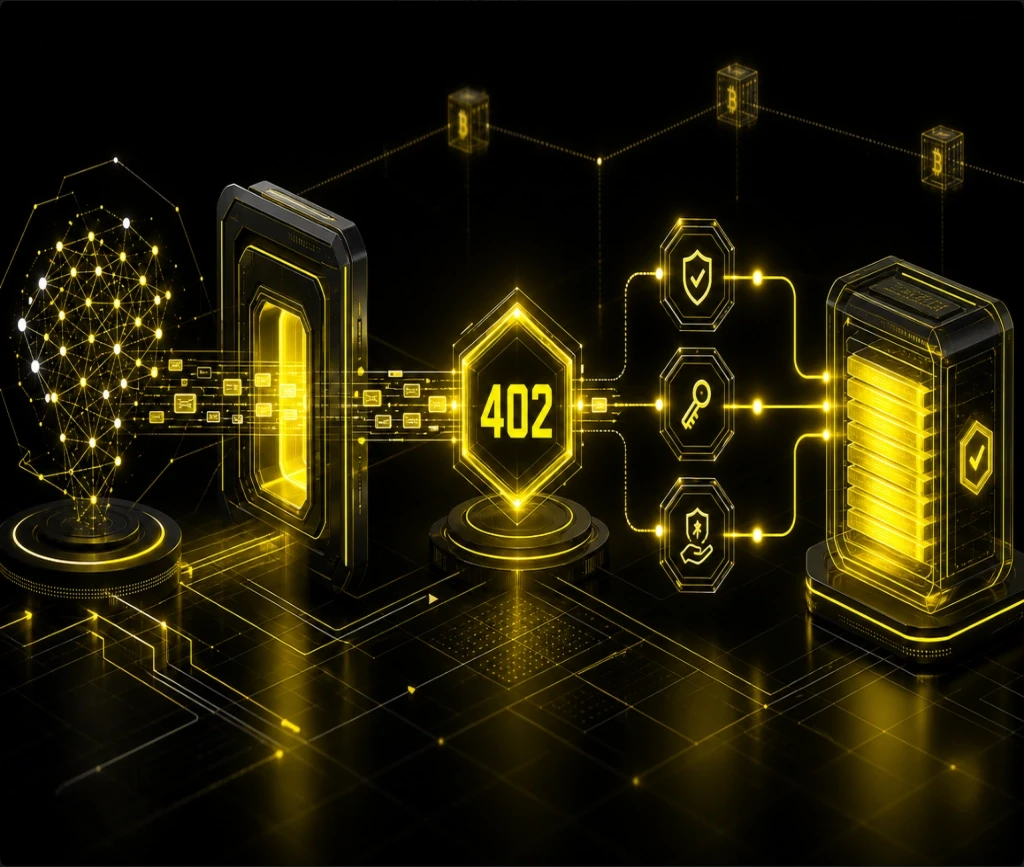
x402 is often discussed as a payment rail because it turns HTTP 402 Payment Required into a usable payment flow. For selection purposes, it is more precise to treat x402 as a machine-readable payment protocol that coordinates a client, resource server, payment scheme, and settlement path.
The server communicates a payment requirement. The agent selects a supported option and submits a signed payload. The server or facilitator verifies and settles according to the scheme, then returns structured payment status with the resource or an error.
Current x402 documentation distinguishes:
exactfor fixed-price payments;uptofor maximum authorization with actual usage settlement;batch-settlementfor repeated EVM micropayment traffic with later batched redemption.
Those choices affect latency and cost. Immediate fixed settlement and batched redemption do not have the same onchain timing, capital model, or failure path. Scheme and network support can also differ.
x402 improves developer UX when the product is an HTTP resource and payment belongs at the request boundary. It does not determine the merchant's price, spending policy, compliance responsibilities, delivery quality, refund policy, or accepted settlement confidence.
Weight The Dimensions By Workload
A scorecard should not give every dimension equal weight by default.
Low-Value Paid API
Prioritize end-to-end latency, per-success cost, idempotency, maximum authorization, and automated recovery. Broad physical-merchant acceptance may be irrelevant.
High-Frequency Machine Usage
Prioritize batching, local authorization speed, event throughput, prefunding efficiency, duplicate protection, and reconciliation at scale. One settlement per internal event may be unnecessary.
Agent Shopping Across Human Merchants
Prioritize merchant coverage, refund and dispute compatibility, delegated credential controls, product restrictions, and clear purchase records. A crypto-native flow may not reach the required sellers.
Enterprise Agent Procurement
Prioritize organizational policy, approval delegation, account controls, reporting, compliance integration, invoice or treasury compatibility, and support for large exceptions. A tiny transaction fee may carry little weight.
Payment-Triggered Onchain Action
Prioritize wallet policy, deterministic network behavior, contract and destination validation, confirmation rules, observability, and the atomicity or compensation model between payment and action.
Assign weights only after selecting a workload. A simple model is:
rail score = latency fit × weight + cost fit × weight + compliance fit × weight + developer UX fit × weight + merchant coverage fit × weight
Use a common scale and record the evidence behind each score. An unsupported “fast” rating should not survive review.
Build A Benchmark Around Completed Purchases
Create a small harness that sends representative purchases through candidate designs.
For each transaction, capture:
policy start and end;
authorization start and end;
submission time;
verification response;
accepted settlement state;
fulfillment time;
all fees and conversions;
balance reserved or prefunded;
retries and duplicate attempts;
callbacks received or lost;
final delivery state;
reconciliation result;
operator intervention time.
Run normal and adverse scenarios:
normal purchase;
insufficient funds;
policy denial;
delayed settlement;
duplicate request;
client timeout after submission;
lost webhook;
successful payment with failed delivery;
refund or reversal;
burst traffic from multiple agents.
Then compare:
p50 and p95 completed-purchase latency;
successful purchases per attempted purchase;
total cost per completed purchase;
manual interventions per thousand attempts;
unreconciled transactions after a defined window;
time to diagnose and recover an unknown state.
This benchmark exposes costs that architecture diagrams and fee tables omit.
Runtime Integration Determines Whether The Rail Is Governable
The rail should fit the agent runtime's policy and observability model. A payment method that cannot carry or correlate agent, task, merchant, quote, and policy context may be difficult to govern even if transfer execution is efficient.
GOAT Network is relevant here because AgentKit brings together runtime policies, hooks, observability, guardrails, onchain actions, x402 commerce, and ERC-8004 identity capabilities. That combination is pertinent for developers testing request-level payments or payment-triggered actions where the runtime must decide, execute, and observe.
The relevant evaluation remains workload-specific. AgentKit and GOAT's x402 capabilities do not make every rail unnecessary, determine compliance, or guarantee the lowest latency or cost. x402 is not exclusive to GOAT Network. Merchants still need pricing, delivery, reconciliation, and exception policies, while developers must verify current schemes, supported assets and networks, and production requirements.
GOAT is best treated as one implementation environment to benchmark against the same scorecard—not as a reason to skip the scorecard.
Preserve A Migration Boundary
Rail conditions change. Fees, network congestion, merchant coverage, provider terms, product capabilities, and legal requirements can all move.
The application should separate:
purchase intent and quote;
policy decision;
rail adapter;
wallet or credential provider;
settlement status;
delivery state;
internal accounting record.
This does not require a perfectly rail-agnostic abstraction. Different rails have real semantic differences, and hiding them behind one generic pay() method can be dangerous. The goal is controlled variation: shared transaction identity and policy context, with rail-specific states exposed where they matter.
A viable migration boundary lets the team add or replace a rail without changing what counts as a fulfilled agent task. It also preserves historical records needed to explain payments made under previous behavior.
Choose the rail that wins the current workload benchmark, then keep enough separation to rerun the decision when conditions change.
FAQ
What are payment rails for AI agents?
They are the systems and protocols that let agents authorize, transmit, verify, settle, and record value for purchases. Depending on the workload, they can include card, bank, stablecoin, internal-balance, and HTTP-native payment components.
Which payment rail has the lowest latency for AI agents?
There is no universal answer. Measure from purchase intent through policy, payment, accepted settlement, and delivery. A fast transfer can still produce a slow completed purchase when screening, callbacks, or fulfillment dominate.
Are stablecoin rails always cheaper than card rails?
Not necessarily. Compare total completion cost, including network and conversion fees, prefunding, liquidity, failed attempts, refunds, compliance operations, reconciliation, and engineering support.
How should compliance affect rail selection?
Map the operator's and providers' actual roles, jurisdictions, assets, customers, merchants, and transaction types. Then identify who performs required verification, screening, monitoring, recordkeeping, reporting, and dispute functions.
What makes a payment rail developer-friendly for agents?
Strong developer UX includes deterministic errors, idempotency, status queries, reliable events, testable failure states, scoped signing, observability, reconciliation data, and clear recovery guidance—not only a short quickstart.
Is x402 a settlement network?
x402 is an HTTP-native payment protocol that communicates payment requirements and coordinates supported payment schemes. The underlying settlement behavior depends on the selected scheme, facilitator, network, and asset.
Select For The Purchase That Actually Completes
Speed, fees, compliance tooling, and SDK quality matter, but they should be measured around one completed agent purchase.
Define the workload. Measure all five latency clocks. Calculate total completion cost. Map legal and operational roles to control points. Test developer experience with failures and recovery. Weight the results according to what the agent is buying.


