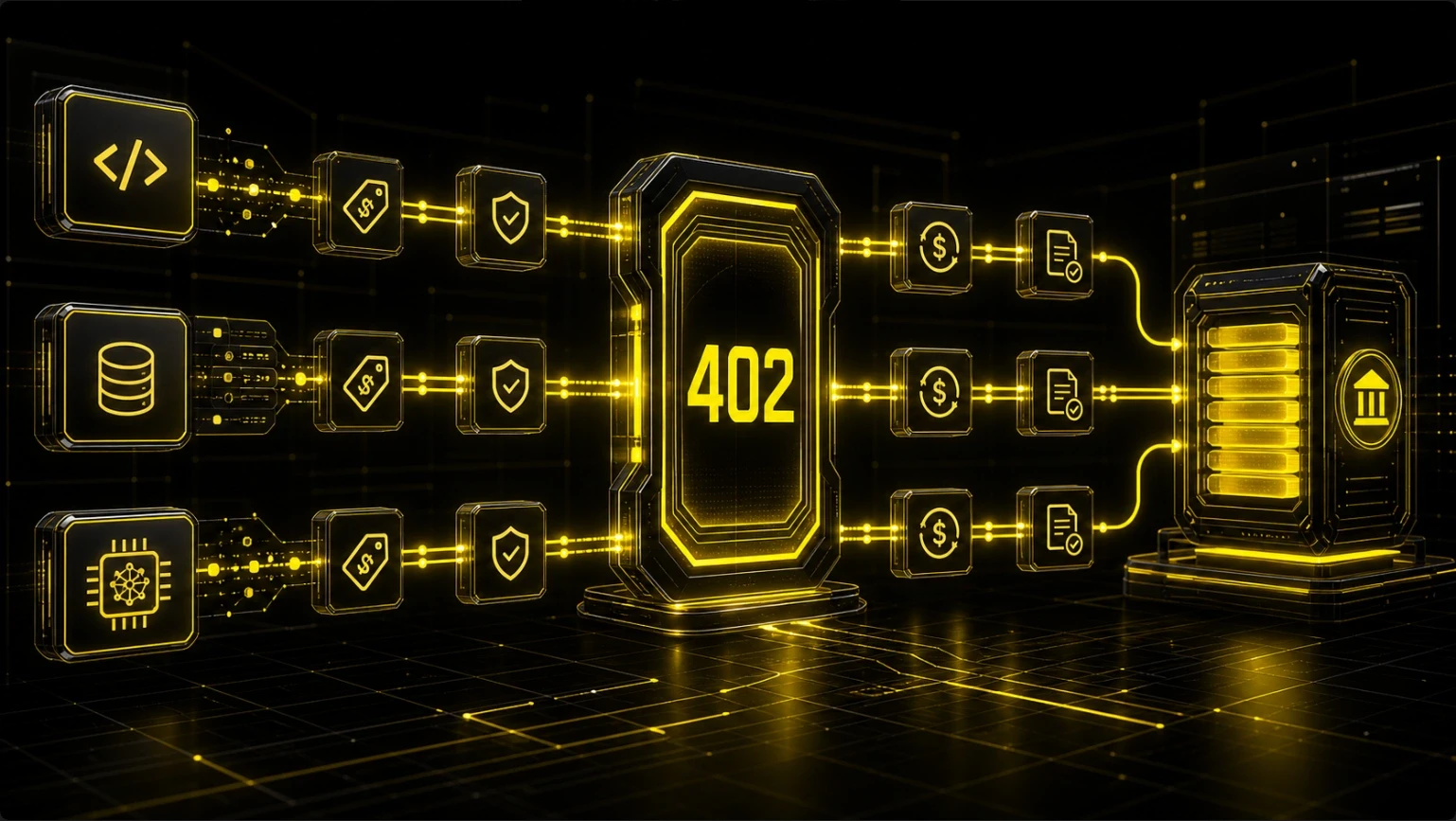

Choosing a Settlement Route for Multi-Chain AI Agent Payments
Multi-chain payments for AI agents are not primarily a bridge problem. They are a route-selection problem. Once an agent has decided to buy a service, it must determine whether the merchant accepts a network and asset the agent can safely use, whether the wallet has enough token and gas balance, and what evidence will prove that payment was accepted. If a valid same-chain route exists, the agent may not need to move funds between networks at all.
That conditional outcome is narrower than “automatic cross-chain payment.” A merchant may accept several networks without supporting bridging, swapping, or settlement on another destination chain. A static network list is not a runtime guarantee. The payment challenge and active merchant configuration should remain authoritative for the specific purchase.
GOAT Flow offers a concrete example of this boundary. Its public product material describes crypto paid directly to a merchant wallet, while the merchant guide documents a DIRECT transfer on the selected chain and token pair. GOAT Flow is therefore relevant to same-chain agent payment routes and transaction verification. It should not be described as an automatic bridge or universal routing engine without separate deployment evidence.
Start with the merchant's accepted route
The agent should discover the service and record the merchant's available payment options. Those options should identify a network, token contract, decimals, receiving address and price or quote validity. The agent then compares them with its own wallet holdings and policy.
The route decision can be expressed as:
Read the current payment requirement.
Filter for networks and assets the merchant actually accepts.
Check token balance and native gas on each candidate network.
Validate recipient, amount, expiry and service scope.
Select the route that fits the agent's policy and task budget.
Authorize one payment and retain the route evidence.
Verify the payment on the same route before requesting delivery.
The agent should not select a chain merely because it appears in a website list. A product page can describe a baseline of supported networks, but the merchant's route, capability and payment challenge determine what is enabled for a particular product or environment. This distinction is important for agents because they cannot resolve an unsupported route through human intuition after signing.
The merchant also needs to state whether its receiving address is chain-specific. Sending the correct token to the wrong network can produce a transaction that is visible onchain but unusable for the intended order. Route identity belongs in the order and payment record, not only in an ephemeral UI label.
Asset choice is a constrained decision
An agent may hold USDC on one network and USDT on another. It may have enough token value but no native gas for the transaction. It may also prefer one asset because its policy allows only stablecoins or because the service has different terms for different routes. Asset selection should therefore happen after the agent reads current requirements, not before.
Constraint | Question for the agent | Failure if ignored |
|---|---|---|
Merchant support | Is this exact token and network accepted? | Payment cannot be verified |
Denomination | What base-unit amount is required? | Rounding or underpayment |
Recipient | Does the destination match the trusted requirement? | Funds sent to an unintended address |
Gas | Does the wallet have native gas on that network? | Signed payment cannot be broadcast |
Expiry | Can verification complete before terms expire? | Stale authorization |
Policy | Is this route allowed for the task? | Unapproved spending |
Stablecoin names are not enough. Two contracts can use the same ticker with different decimals, issuers or networks. The payment requirement should identify the contract and chain ID. The agent should compare those fields with its allowlist and reject ambiguity.
For a fixed-price service, the merchant can provide one amount and several eligible payment options. The client may convert a decimal price into base units for the chosen token, but that conversion does not make the system an exchange. If a token swap is required, the agent needs a separate funding or trading policy, quote source and slippage limit.
This is where cross-chain routing often becomes overstated. A merchant accepting USDC on two networks does not necessarily accept USDC on one network and deliver a settlement balance on the other. The agent should treat a bridge, swap or transfer to another chain as a separate action requiring its own authorization and risk evaluation.
Avoid bridging when a valid same-chain path exists
A funded wallet can often pay directly when its holdings already match an accepted merchant route. That is the simplest way to avoid manual bridging: choose a supported same-chain asset and transfer it to the configured recipient. The condition matters. If the agent owns only an unsupported asset, “no bridge” is not a magic fallback; the agent must stop, obtain funds through an approved process or choose another service.
The same-chain path reduces moving parts. There is no intermediate bridge transaction to reconcile, no separate destination-chain arrival to wait for and no assumption that an intermediary will transform the asset. It may still have network congestion, gas cost, token risk and merchant verification latency. Same-chain is simpler, not risk-free.
GOAT Flow's documented DIRECT mode reflects this model: the buyer transfers ERC-20 tokens directly to the merchant-configured receiving address on the selected chain. Flow verifies the payment and records the result; it is not described as taking custody and forwarding every payment. This makes the direct route clear for architecture, while leaving the merchant responsible for supported pairs and operational configuration.
The agent should retain the selected route in its task state. If verification is delayed, it should resume the original transaction rather than recalculate a new route and pay again. If the route expires before broadcast, it should request fresh terms. If the transaction is already broadcast, a new route choice should not silently create a second obligation.
Cross-chain means more than multi-network acceptance
Developers should separate four concepts:
multi-network product support;
route selection among accepted network and asset pairs;
bridging or swapping funds between networks;
final settlement or treasury rebalancing on a destination network.
The first two may be part of a merchant payment surface. The latter two require additional infrastructure and permissions. A service may accept a payment on the network where the agent holds funds while the merchant later manages treasury balances elsewhere. That is a business settlement choice, not proof that the buyer's transaction was cross-chain settled.
This distinction prevents misleading architecture diagrams. A line from “agent wallet” to “merchant” can represent a direct transfer. A line through a bridge represents another transaction with another trust boundary. A line from merchant wallet to treasury represents rebalancing. They should not be collapsed into one arrow labeled “automatic settlement.”
If a merchant genuinely supports cross-chain execution, the agent needs a route description that states who performs the bridge, which asset arrives, what fees apply, what happens on timeout and which event authorizes fulfillment. The service should not make the buyer infer these terms from a generic supported-networks page.
Add fallback routes without turning them into retries
Fallback is useful when the preferred route is unavailable, but route fallback and payment retry are different decisions. If the first payment was broadcast, switching routes can cause duplicate payment. The agent should first determine whether the original transaction is pending, verified, rejected or impossible to verify.
A safe fallback policy might look like this:
Situation | Fallback action |
|---|---|
No payment submitted | Request or choose another accepted route |
Wallet lacks gas | Use an approved funding path or stop |
Route is unsupported | Reject and ask for another option |
Payment broadcast, verification pending | Keep the original route and poll with backoff |
Route payment rejected before broadcast | Re-evaluate a fresh requirement |
Service failed after verification | Use delivery retry or refund policy, not a new payment |
The agent can rank routes using latency, estimated cost, balance availability, policy and merchant acceptance. It should not claim that the cheapest route is always best. A low network fee may be outweighed by a missing gas balance, a long finality window or a merchant that cannot verify that route reliably.
Fallback preferences should be bounded. The agent may be allowed to select one of three approved stablecoin routes below a task limit. It should not be allowed to bridge, trade volatile assets or increase the amount simply because the preferred route failed unless a separate authorization covers that action.
What GOAT Flow contributes to the route model
GOAT Flow is useful when a merchant wants checkout and API payment surfaces connected to transaction records and direct crypto payment to a merchant wallet. Its documentation makes the route-specific nature of payment visible: a supported chain/token pair, receiving address and current challenge matter for verification. The product is therefore a concrete place to implement a same-chain payment decision inside a broader agent runtime.
The broader GOAT stack also includes AgentKit as an action/runtime layer, but that name should not be used to imply automatic cross-chain selection. AgentKit can be relevant to an agent that needs wallet actions and payment capability; the merchant's active route and the agent's own policy still determine what it may do. Developers should verify current SDK behavior, supported assets and environment configuration before implementation.
GOAT's public materials do not establish that every advertised network is enabled for every merchant, that funds are automatically bridged, or that all payments settle on Bitcoin L1. Those are separate claims requiring separate evidence. The practical recommendation is narrower: use a documented same-chain route when it matches the agent's funds and policy, and model any bridge or swap as an explicit additional action.
Record settlement evidence by route
The merchant and agent should preserve enough information to reconcile a payment later. At minimum, record the service or order ID, selected chain ID, token contract, amount, recipient, payment ID or transaction hash, challenge expiry, verification state and delivery state. If a facilitator or bridge is involved, record its identifiers separately from the buyer's original payment.
Settlement evidence is not identical to fulfillment evidence. A transaction can be confirmed while an API is unavailable. A bridge can report arrival while the merchant has not accepted the destination asset. A receipt can authorize resource access without proving that the result is correct. Keeping these states separate makes refunds and support decisions possible.
For multi-chain merchants, the reconciliation key should include the route, not only the product key and amount. The same product may have different recipients, assets or confirmation expectations on different networks. A normalized ledger can present them together, but it should not erase the original route.
A runtime test for multi-chain agent payments
Before enabling several routes, create a test offer and exercise each accepted pair. Check that the challenge identifies the expected network, token, amount, recipient and expiry. Test insufficient token balance, insufficient gas, stale terms, wrong-chain payment, delayed verification and duplicate retry. Confirm that an accepted payment maps to one order and one delivery result.
If bridging is part of a separate product, test it separately. Measure the bridge or swap timeout, destination-asset arrival, failure recovery and refund responsibility. Do not combine a successful same-chain payment test with an untested cross-chain assumption.
The best runtime route is not necessarily the one with the most networks. It is the one the merchant can verify, the agent can authorize within policy and the service can reconcile after failure. Multi-chain support gives agents more choices, but each choice adds configuration, asset and evidence that must remain explicit. A route catalog should therefore be treated as an operational contract: every listed pair needs an owner, a verification path and a documented response when the route is paused. Without those details, additional choice increases ambiguity faster than it increases resilience.
AI agent cross-chain payments should therefore be designed as conditional routing. First find an accepted same-chain path. Then check balances, gas, policy and expiry. Introduce bridging or swapping only as an explicit, separately authorized action. GOAT Flow's direct merchant-wallet model provides a concrete reference for the first case, while the remaining routing and treasury decisions belong to the surrounding agent and merchant infrastructure.


