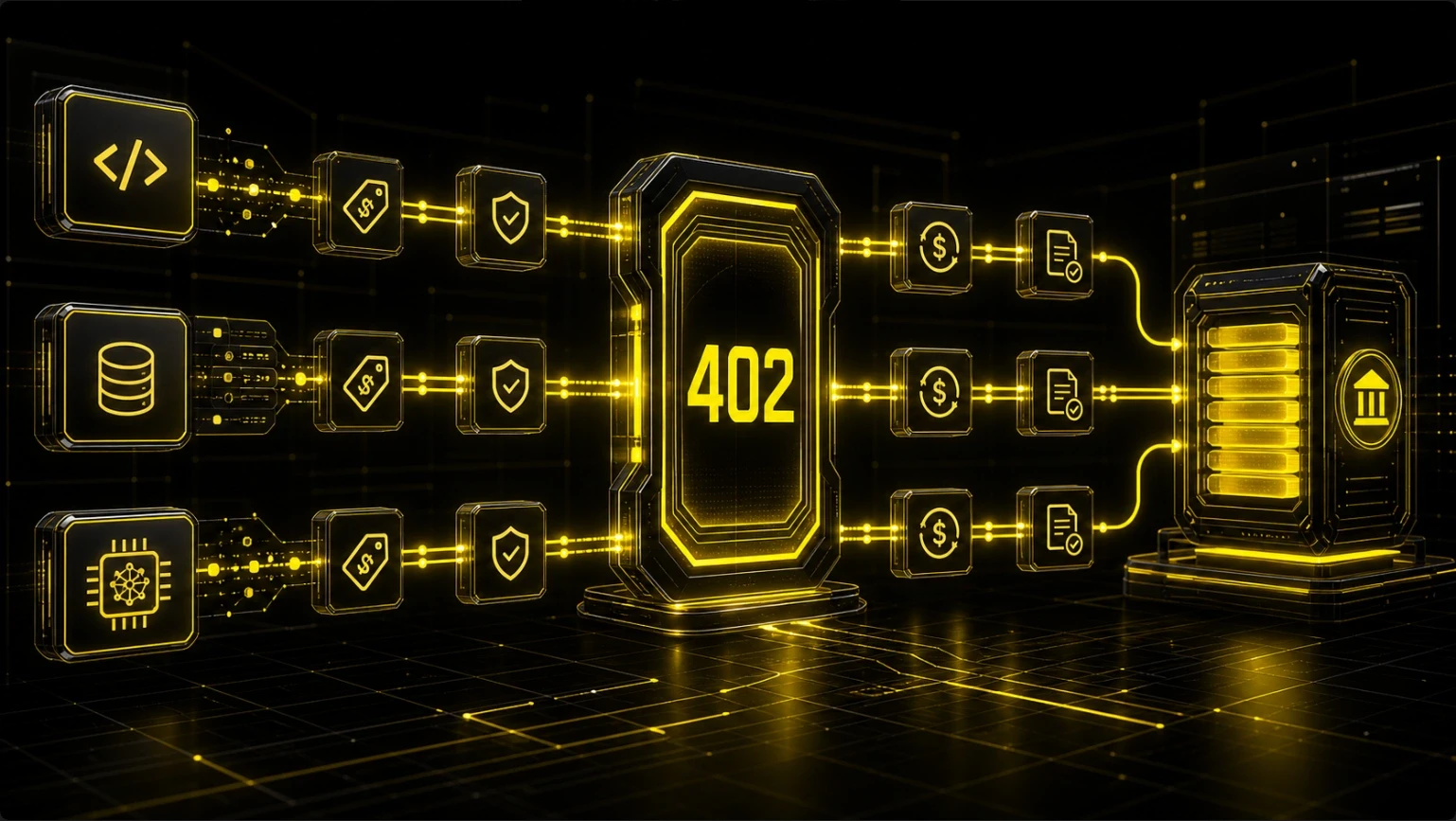

The Merchant Stack for AI Agent Commerce: Discovery, Checkout, Payments, Orders, and Fulfillment
The Merchant Stack for AI Agent Commerce: Discovery, Checkout, Payments, Orders, and Fulfillment
Meta Description: Understand the merchant stack for AI agent commerce, from product discovery and checkout to payment verification, order operations, webhooks, and fulfillment.
Slug: merchant-stack-ai-agent-commerce
Merchants do not become agent-ready by adding one payment endpoint. They need a stack that makes products discoverable, terms understandable, payments verifiable, orders traceable, and fulfillment recoverable.
The main layers are:
Discovery: publish products, variants, offers, and constraints.
Checkout: create an exact purchase request.
Payment: accept the selected rail and payment proof.
Order operations: track status, webhooks, retries, refunds, and reconciliation.
Fulfillment: deliver the physical, digital, API, or tool result.
These layers may come from different systems. They should still share stable IDs and clear state transitions.
Discovery should expose a decision, not a slogan
An agent needs enough information to decide whether an offer fits its task. Expose the product identity, unit, price, asset, restrictions, delivery form, and route to current terms. Keep internal credentials and sensitive fulfillment details private.
A discovery record is not necessarily a quote. Mark whether the price is indicative, current, or reserved. If a price can expire, the purchase endpoint must revalidate it. If a variant is required, do not let an agent infer it from a title.
Checkout creates a commercial commitment
Checkout should turn a selected offer into an order or payment intent. For fixed products, a product-bound flow may be sufficient. For dynamic quantities or data services, the merchant backend should calculate the amount and create the request.
The checkout response should return an order identity, payment requirement, expiry, and next action. It should not expose a client-controlled amount as the final authority for a merchant-priced product.
GOAT Flow is positioned in this operational area. Its public product surfaces include Checkout, QuickPay, API Payments, and merchant operations. This makes it relevant to merchants that need more than an x402 middleware function, while the merchant still owns the catalog and fulfillment rules. Review the GOAT Flow product page and merchant guide for the active integration boundary.
Payment is a state transition
The payment layer should record what was requested and what was verified. A successful transfer does not by itself mean that an order can be fulfilled. The merchant may need to confirm destination, amount, asset, network, expiry, and order binding.
For an API, verification can unlock one request. For a digital product, it can create an entitlement. For a physical product, it can move an order to fulfillment review. The result is different, but the order and payment IDs should remain linked.
Operations are where most integrations mature
Merchant operations need more than a success response:
order creation and lookup;
balance or settlement records;
payment status;
webhooks and retry handling;
API credentials;
refunds and disputes;
fulfillment evidence;
reconciliation exports.
This is why a facilitator and a merchant platform are different categories. A facilitator may verify or settle a payment. It does not automatically manage a merchant's product catalog, order lifecycle, customer support, or delivery exceptions.
Fulfillment needs product-specific proof
Do not use the same delivery record for every product:
Product | Useful delivery evidence |
|---|---|
Physical product | shipment or delivery state |
Digital good | entitlement, license, or download receipt |
API response | request ID and result record |
MCP or agent tool | invocation ID and returned result |
The proof should be retrievable after the original HTTP response is gone. A buyer agent needs to know whether it can retry, wait, or ask for a refund.
Build the minimum complete stack
Start with one offer, one payment rail, one order state machine, and one fulfillment path. Add idempotency before adding more automation. Add webhooks when asynchronous verification or delivery requires them. Add multiple rails only after the merchant can reconcile each one.
The right test is not “can an agent pay?” It is “can the merchant identify, verify, fulfill, recover, and reconcile every agent purchase?” A platform earns its place by making those answers observable.
Plan the operator's daily workflow
Merchant infrastructure should make routine questions easy to answer. Which offers sold today? Which requests were paid but not delivered? Which webhooks failed? Which refunds remain open? Which settlement records have not been reconciled? A stack that answers only “how many payment proofs were valid?” is incomplete for a seller.
Use dashboards and exports that retain the same identifiers used by the APIs. Operators should be able to move from an order to its payment, from a payment to its settlement reference, and from the order to its fulfillment record. This is also where permissions matter: a fulfillment operator may not need the ability to change pricing, and a finance operator may not need access to raw customer inputs.
The stack should support controlled change. Merchants may add a new payment asset, adjust a price, or introduce an asynchronous service. Each change should have a test environment, an effective date, and a rollback or recovery plan. Agent traffic makes silent changes more expensive because the buyer may act without a human watching each step.
The merchant stack is complete enough when it turns every automated purchase into an observable, supportable business event.
The merchant should also ask whether records can be exported. Agent commerce creates a financial trail that may cross a checkout service, wallet, facilitator, and fulfillment backend. If those records cannot be reconciled outside a dashboard, the integration may be difficult to operate at scale even when the happy path works.
Treat the stack as a state machine
The layers are easier to operate when each transition has a trigger and a permitted next state. A selected offer can become a quote only after current terms are checked. A quote can become payment pending only after the order is created. Payment verified can become fulfillment pending only after the merchant confirms the correct amount and destination.
This prevents a common error: a checkout callback advances an order even though the backend has not verified the payment, or a payment webhook triggers fulfillment without checking that the order has not already been fulfilled.
Choose ownership before choosing a vendor
Ask which system owns each operational fact. The catalog may own offer identity; checkout may own session creation; a facilitator may own payment verification; the merchant database may own order state; a warehouse or API backend may own delivery. A platform can simplify these boundaries, but it should still expose them clearly.
This is why merchant infrastructure should be compared by failure handling, not only by payment support. Two products may both support machine payments while giving the operator very different answers when an order is duplicated or a service fails.
A merchant can use one platform for all layers or combine specialist services. The choice should follow control needs, not a preference for a single brand. A platform may reduce integration work, while modular components may offer more control. In either case, stable IDs and explicit failure states are the connective tissue that makes the stack operable.
The result is a merchant stack that can be evaluated by its evidence and recovery behavior.
Implementation note
Start by tracing one successful and one unsuccessful purchase across every layer. For the success, find the offer, order, payment, settlement, and delivery records. For the failure, identify whether the right response is retry, wait, refund, or manual review. If one link is missing, the stack has an observability gap.
This method also clarifies vendor selection. A service may be excellent at payment verification but not own order or fulfillment state. A merchant can still use it, provided the missing responsibility is assigned to another component.
Final review checklist
Before opening the flow to more agents, review the offer, request, payment, and delivery records together. Confirm that the price or terms are current, the buyer policy can reject an out-of-scope action, the payment proof is bound to the right resource, and the service can return a result or a recoverable status. Confirm that retries do not create duplicate orders or duplicate charges.
Also review the human boundary. A merchant may require approval for an unusual quantity, a sensitive product, a high amount, a new network, or a delivery condition that the agent cannot validate. The agent should receive a clear escalation response, not a generic error. This is especially important when the merchant supports both humans and machines: the machine path should be automated where the business is comfortable, but it should not erase the controls that make the human path supportable.
Document the active configuration and revisit it when the product, payment scheme, or fulfillment system changes. A repository example or protocol capability is not proof that every option is enabled for the current merchant deployment.
Define the contracts between layers
The stack becomes modular only when each layer has a narrow input and output contract.
Discovery to checkout: pass the canonical offer ID, revision, selected variant, quantity, and buyer constraints. Checkout returns either current terms or a structured conflict.
Checkout to payment: pass the order or session ID, exact amount, currency or asset, supported rail, destination, expiry, and an idempotency key. Payment returns a state and evidence reference, not a fulfillment decision.
Payment to order operations: pass the verified requirement and settlement status tied to the order. Operations decide whether to wait, release the order, or open an exception.
Order to fulfillment: pass a product-specific delivery instruction that can be processed idempotently. Fulfillment returns a shipment, entitlement, result, or invocation reference.
Fulfillment to support and finance: pass terminal or recoverable state, timestamps, amounts, fees, and exception reason. Support should not need access to wallet keys or private agent context.
These contracts allow a merchant to replace one component without rewriting the rest. They also make ownership explicit when records disagree. The payment layer cannot change a product price, and the fulfillment layer cannot declare a payment settled.
Use an event model for asynchronous work
Agent purchases often cross asynchronous systems. A stable event model prevents a temporary timeout from becoming a duplicate commercial action.
Useful events include:
offer refreshed;
order created;
payment requirement issued;
payment submitted;
payment verified;
settlement confirmed or failed;
fulfillment started;
delivery completed or failed;
refund requested and completed;
reconciliation exception opened and resolved.
Every event should carry the merchant order ID and its own event ID. Consumers retain processed event IDs or use a durable idempotency strategy. Webhook handlers verify authenticity and tolerate duplicate or out-of-order delivery.
The state machine should reject impossible transitions. A delivery-completed event should not create an order that never existed. A late payment-failed event should not automatically reverse an order that has already been reconciled under a different authoritative event. These conflicts enter an exception workflow.
For synchronous API products, the event path can be compact, but the same separation remains useful. Payment verified and response delivered are different facts even when they happen within one HTTP request.
Put policy on both sides of the transaction
The buyer agent controls whether it may spend. The merchant controls whether it may sell and deliver. A merchant stack needs interfaces for both policy domains without pretending they are the same.
Buyer-side policy may enforce budget, destination allowlists, approved assets, maximum slippage or fees, human confirmation thresholds, and task-level limits. Merchant-side policy may enforce product eligibility, rate limits, sanctions or jurisdiction rules where applicable, fraud controls, inventory, abuse prevention, and refund eligibility.
The checkout or paid resource is where those policies meet. It should state final terms clearly enough for the buyer to authorize and return reason codes clearly enough for the buyer to stop. “Payment failed” is insufficient when the actual reason is expired quote, unsupported network, order already paid, or human review required.
Neither policy should grant unlimited authority. A valid payment does not override the merchant's product restrictions, and an available product does not override the buyer's spending controls.
Evaluate build-versus-buy by operational ownership
Merchants can assemble the stack from protocol SDKs and specialist services or use a commerce platform that covers several layers.
Decision | Modular stack | Integrated platform |
|---|---|---|
Protocol and rail control | High; merchant selects and configures components | Bounded by platform capabilities |
Integration effort | Higher; contracts and operations are merchant-owned | Lower when product surfaces and records are integrated |
Failure visibility | Depends on merchant observability | May be centralized if the platform exposes full state |
Portability | Easier when interfaces remain standard | Can require migration from platform-specific order models |
Operations | Merchant builds dashboards, webhooks, reconciliation | Platform may provide merchant operations |
Custom fulfillment | Maximum flexibility | Depends on APIs and extension points |
A hosted facilitator is not automatically an integrated merchant platform. It can simplify verification and settlement while leaving product, order, webhook, refund, and support systems to the merchant. Conversely, a commerce platform may include a facilitator or protocol support but should be evaluated on the records and controls it exposes.
The selection question is: which responsibilities does the merchant want to own, and can the chosen combination produce one coherent transaction record?
Map GOAT Flow to the merchant stack
GOAT Flow is relevant to this layered model because its public merchant documentation describes surfaces and operations on both sides of the payment moment. Checkout supports merchant-created sessions; QuickPay supports fixed products and public payer links; paid API routes cover machine-facing resources; merchant operations include orders, receiving configuration, API credentials, webhooks, balances, and reconciliation functions.
That does not mean GOAT Flow replaces the merchant's product information, inventory, tax, compliance, customer support, or product-specific fulfillment systems. Its value should be evaluated at the boundary it actually occupies: turning selected offers or protected routes into payment-aware orders and operational records.
The current guide describes DIRECT transfer workflows for public merchant use and instructs integrators to derive supported chains, tokens, limits, and capabilities from the active portal, manifest, challenge, or API response. This runtime boundary matters because an agent may act on published data without a person checking it.
x402 remains the broader protocol for machine-readable payment interactions. GOAT Flow can implement x402-related commerce surfaces, but the protocol and product should not be treated as interchangeable or exclusive.
Secure the merchant control plane
The control plane contains the permissions that can change prices, receiving addresses, API credentials, webhooks, team access, refunds, and product availability. It deserves stronger protection than the public checkout surface.
Use separate roles for product administration, finance, fulfillment, and developer operations. Rotate keys without changing public product IDs. Keep merchant credentials out of browsers, agent manifests, prompts, and logs. Verify webhook signatures or authenticated delivery, and limit webhook consumers to the actions they require.
Audit configuration changes. A new receiving address or asset can redirect funds; a price change can invalidate cached offers; a webhook endpoint change can interrupt fulfillment. Record who changed the value, when it became effective, and how to roll it back.
Agent-facing errors should expose enough information for safe recovery without leaking internal fraud rules or infrastructure details. Public status endpoints can use opaque references and scoped authorization.
Operate the stack with service-level measures
Payment volume alone does not show whether the commerce stack works. Track:
discovery-to-current-offer resolution;
checkout creation success;
payment authorization and verification conversion;
verification and settlement latency;
payment-to-fulfillment success;
duplicate requests recovered idempotently;
paid-but-undelivered orders;
webhook delivery and processing failures;
refunds, disputes, and reconciliation exceptions;
support time per agent order.
Measure each stage by product and rail. A low checkout rate may reflect ambiguous variants. A high payment verification rate with low delivery success points to fulfillment. A large unmatched-transfer queue suggests weak order binding rather than weak demand.
Set operational objectives for the states the merchant controls. For example, all verified digital orders should enter fulfillment within a defined time, and every paid-but-undelivered exception should have an owner. Do not promise settlement or delivery timing that the underlying network or provider cannot guarantee.
A deployment sequence for the complete stack
First, map current systems and owners. Identify the source of product truth, order truth, payment evidence, fulfillment evidence, and financial reconciliation.
Second, expose one fixed offer and one checkout or paid-resource path. Carry stable identifiers through every layer and build an operator view before broad automation.
Third, test asynchronous and negative cases: stale offer, wrong amount, duplicate webhook, paid delivery failure, late settlement, refund, and control-plane shutdown.
Fourth, add buyer autonomy under narrow policies. Increase value, product scope, or rail support only after operations can recover the previous slice.
The stack is production-ready when a buyer can stop safely, a merchant can fulfill exactly once, and an operator can reconstruct the transaction without consulting hidden agent reasoning.
FAQ
Is a payment gateway the same as a merchant platform?
No. A gateway or facilitator can verify or move money. A merchant platform additionally connects offers, orders, webhooks, status, refunds, reconciliation, and often checkout or product surfaces.
What identifiers should be shared across layers?
Use a stable offer or product ID, order or session ID, idempotency or request ID, payment reference, and fulfillment reference. Correlate them without exposing private credentials or unnecessary customer data.
Can different providers supply different layers?
Yes. A modular stack can combine catalog, checkout, facilitator, wallet, order, and fulfillment services. The merchant must define contracts, authority, and recovery across those boundaries.
Where does x402 fit?
x402 fits the machine-readable payment interaction for protected resources. It does not by itself provide the full catalog, order, fulfillment, support, and finance functions of a merchant stack.