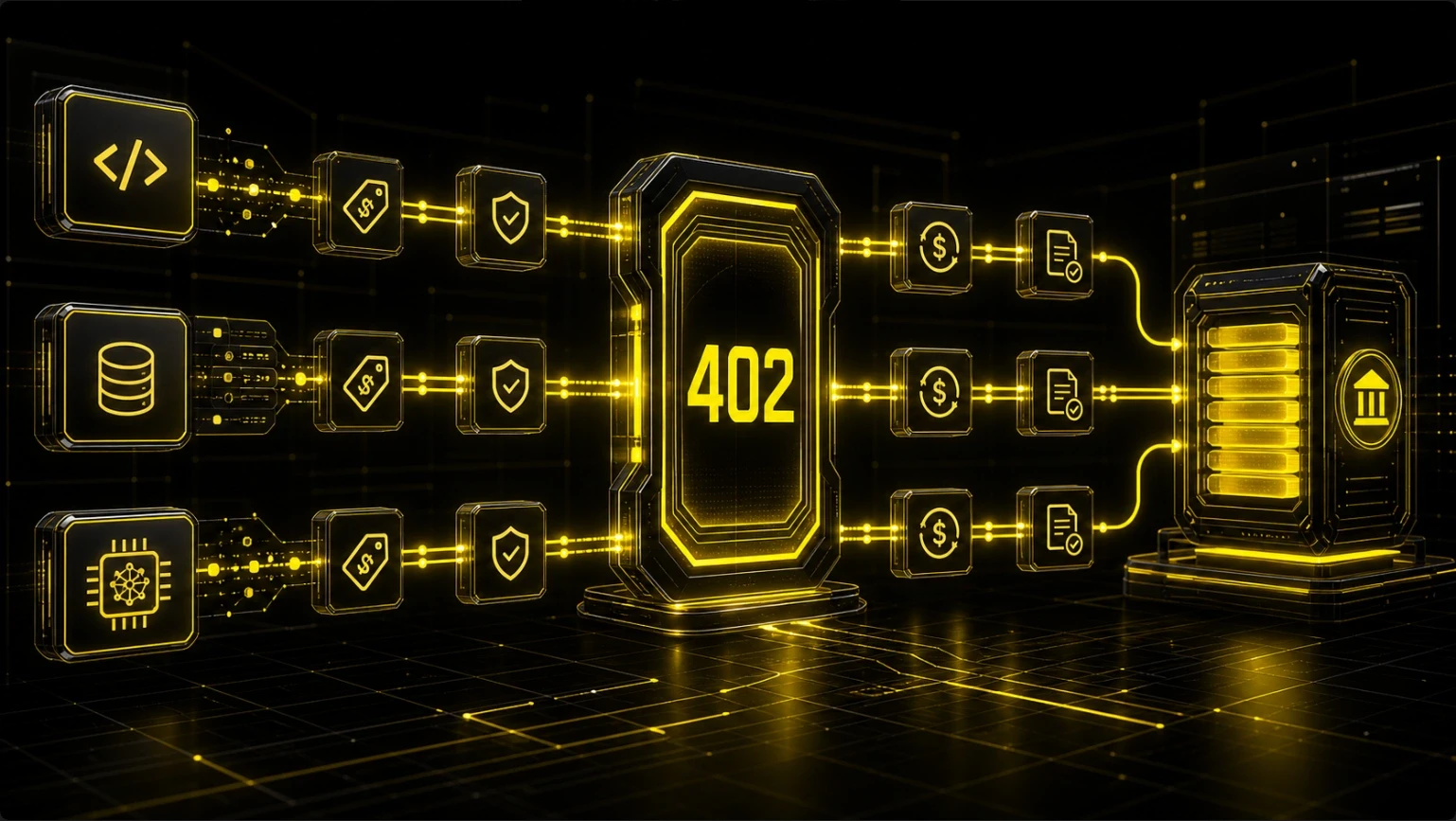

API monetization used to mean picking one of three imperfect models: sell subscriptions, issue API keys after account setup, or ask users to prepay credits before they know how much they need. That works for many SaaS products, but it is a poor fit for AI agents and automated clients that need one paid API call, one data lookup, one browser session, one inference result, or one digital service during a live workflow.
x402 infrastructure gives developers a different pattern: payment can become part of the HTTP request lifecycle. A client requests a protected resource, the server returns 402 Payment Required, the client submits a payment payload, the payment is verified or settled, and the server releases the resource.
For AI agent developers and API providers, x402 is not just “crypto checkout for APIs.” It is infrastructure for request-level pricing, machine-readable payment requirements, policy-controlled agent spending, settlement proof, and pay-per-use access to APIs, data, and AI services.
What Is x402 Infrastructure?
x402 infrastructure is the set of server, client, wallet, facilitator, and settlement components that make HTTP-native payments usable in production.
At minimum, it includes:
Component | Role |
Protected API route | The endpoint, data feed, tool, or service that requires payment |
Pricing logic | Defines price, asset, route, expiration, and supported networks |
HTTP 402 response | Tells the client payment is required |
Payment payload | Signed authorization or payment data from the client |
Verification layer | Confirms payment terms match the request |
Settlement layer | Finalizes or records payment outcome |
Delivery logic | Returns the paid resource only after valid payment status |
Proof store | Persists order, quote, payment, and delivery records |
Agent policy layer | Limits what an agent is allowed to pay for |
The official x402 site describes x402 as an open, neutral standard for internet-native payments between clients and servers. Coinbase’s x402 documentation explains the core flow: a buyer requests a resource, receives a 402 Payment Required response, submits a payment payload, and receives the requested resource after verification.
Why Developers Need x402 Infrastructure
The developer problem is not “how do I add a payment button?” It is “how do I monetize a resource that may be requested by software instead of a human?”
That resource may be:
Monetized resource | Example |
API call | One company enrichment lookup |
Data feed | One real-time market data response |
AI service | One specialized model inference |
Browser session | One rendered page or automation run |
Agent tool | One paid tool invocation |
Digital content | One premium document or media asset |
Compute task | One simulation, validation, or transformation |
Traditional billing systems are often too coarse for this. Subscription plans work when users know they need recurring access. API keys work when the relationship already exists. Credit cards work when a person is present.
AI agents and automated services need something more granular: a way to discover the price at the point of access, decide whether the price is allowed, pay only for the requested resource, and move on.
The Core x402 Flow
A basic x402 flow has five steps.
The client sends a normal HTTP request.
The server returns
402 Payment Requiredwith payment instructions.The client evaluates the payment terms.
The client retries with a signed payment payload.
The server verifies payment and returns the resource.
A simplified request might start like this:
GET /v1/premium-risk-score?company=example HTTP/1.1
Host: api.provider.com
Accept: application/json
If payment is required, the server returns:
HTTP/1.1 402 Payment Required
Content-Type: application/json
{
"amount": "0.10",
"asset": "USDC",
"recipient": "0xMerchantAddress",
"resource": "/v1/premium-risk-score",
"expiresAt": "2026-06-16T10:30:00Z"
}
The client then decides whether to pay. If the request passes policy, it submits the payment payload and retries the original resource request. The provider verifies the payment and returns the paid response.
What API Providers Need to Build
To monetize APIs with x402 infrastructure, a provider needs more than middleware. The backend must treat payment as part of the resource delivery contract.
Backend layer | What it should handle |
Route catalog | Which endpoints require payment |
Pricing engine | Static, dynamic, tiered, or usage-based prices |
Quote generation | Amount, recipient, resource, asset, network, expiry |
Merchant configuration | Payment recipient, credentials, supported settlement paths |
Payment verification | Signature, amount, recipient, network, nonce, and expiry |
Order state | Pending, paid, failed, expired, cancelled, delivered |
Resource gating | Prevent delivery before valid payment status |
Idempotency | Avoid duplicate charges on retries |
Proof persistence | Store quote, payment, settlement, and delivery proof |
Monitoring | Track stuck orders, failed settlement, and payment errors |
For developers building on GOAT Network, the x402 developer quick start is the most relevant internal starting point because it focuses on implementation steps such as merchant setup, order creation, payment verification, and proof handling.
Choosing What to Monetize
Not every API endpoint should be paid. x402 works best where the paid unit is easy to understand and verify.
Good candidates include:
Good x402 fit | Why it works |
Expensive inference calls | Cost maps clearly to each request |
Premium data lookups | Value is tied to a specific response |
Browser rendering sessions | Session-level cost is measurable |
Agent tool execution | Tool use is discrete and auditable |
Compliance or security checks | Each result has a clear unit of value |
High-quality content access | One payment unlocks one resource |
Simulation or validation APIs | Workload is bounded per call |
Weak candidates include vague “access” products with unclear value per request, long-running subscriptions that already work well with accounts, or services where refund and dispute handling cannot be operationalized.
Pricing Models for x402 APIs
x402 infrastructure does not force one pricing model. Developers can choose the model that matches the resource.
Pricing model | Best for | Implementation note |
Fixed per call | Simple API endpoints | Easiest to quote and verify |
Tiered per route | APIs with different value levels | Keep route pricing predictable |
Dynamic price | Compute-heavy services | Include expiry and quote ID |
Bundle access | Small groups of related calls | Requires balance or session tracking |
Pay per result | Search, data, or AI outputs | Define what counts as a billable result |
Pay per session | Browser, compute, or streaming tasks | Needs timeout and session closure logic |
For AI services, fixed per-call pricing is often easiest to launch. Dynamic pricing can work, but it raises more edge cases: stale quotes, race conditions, partial results, timeout handling, and user complaints when price changes are not transparent.
DIRECT vs DELEGATE x402 Infrastructure
Developers should choose payment modes based on what the payment needs to trigger.
Mode | Best for | Developer complexity |
DIRECT | Paid API calls, content access, simple data delivery | Lower |
DELEGATE | Payment-triggered callbacks, contract actions, advanced workflows | Higher |
A direct flow is usually enough when payment unlocks an API response. A delegated flow becomes useful when payment should trigger additional business logic: contract execution, access issuance, callback processing, or multi-step settlement.
GOAT Network’s x402 payment modes are useful for developers deciding between simpler direct payment and more advanced delegated logic.
x402 for AI Services
AI services are strong candidates for x402 because usage cost is often granular. A provider may want to charge for:
AI service | Monetizable unit |
Model inference | Per prompt, token window, or generated result |
Agent tool call | Per successful tool execution |
Retrieval service | Per document, search, or vector query |
Evaluation API | Per scored response |
Workflow automation | Per completed task |
Image or video generation | Per generated asset |
Fine-grained data enrichment | Per enriched entity |
The important design rule is to price the unit that the client can reason about. If an agent receives a 402 response, it should be able to answer: “Is this exact service worth this exact price under my current task budget?”
x402 for Data APIs
Data APIs can use x402 to sell access without forcing every buyer into a subscription.
Examples include:
Data type | Pay-per-use pattern |
Market data | Per real-time quote or premium signal |
Business data | Per company, domain, or contact enrichment |
Risk intelligence | Per score or report |
Weather data | Per forecast call |
Onchain data | Per wallet, transaction, or contract query |
Research databases | Per document or query result |
For data APIs, proof storage matters. Providers should record which data product was delivered, the payment quote, the client payment reference, and the delivery timestamp. That helps resolve disputes when a client claims payment succeeded but the resource was not delivered.
Agent-Safe Payment Controls
The biggest misconception about x402 infrastructure is that it lets agents pay without limits. It should not.
A payment-capable agent should enforce policy before it signs or submits payment.
Control | Why it matters |
Per-call limit | Prevents one expensive mistaken request |
Daily budget | Limits aggregate spend |
Merchant allowlist | Prevents payments to unknown providers |
Route allowlist | Restricts payment to expected services |
Asset allowlist | Controls what the wallet can spend |
Network allowlist | Avoids unsupported settlement paths |
Quote expiry | Rejects stale payment requests |
Nonce checks | Reduces replay risk |
Human approval | Escalates high-value or unusual payments |
Metadata filtering | Prevents leaking sensitive task details |
This is why x402 infrastructure and agent runtime infrastructure are closely related. Payment is not just a wallet action. It is a policy decision.
GOAT Network’s agent stack is relevant here because it combines x402 payment flows with AgentKit tooling and ERC-8004 identity and reputation concepts. For developers building payment-aware agents, the next practical step is to Explore AgentKit.
Security and Failure Modes
x402 sits across HTTP, wallet authorization, settlement, and resource delivery. That creates failure modes that developers should address before production.
Failure mode | What can happen | Mitigation |
Replay | A payment payload is reused | Nonces, expirations, and resource binding |
Underbinding | Payment is valid but not tied to the exact resource | Bind route, amount, recipient, and quote ID |
Paid but denied | Client pays but does not receive service | Proof storage, idempotent retries, support path |
Delivered but unpaid | API releases resource before terminal payment state | Verify before delivery |
Duplicate retries | Timeout causes multiple payments | Idempotency keys and retry limits |
Metadata leakage | Payment fields expose sensitive user context | Minimize and redact metadata |
Callback abuse | Delegated flow triggers unsafe logic | Validate callbacks and use allowlists |
Price confusion | Client pays stale or unexpected quote | Short expiries and explicit quote IDs |
Recent x402 research has focused on authorization binding, replay protection, paid-but-denied outcomes, unpaid-service outcomes, and payment metadata privacy. These concerns do not make x402 unusable; they define what production-grade x402 infrastructure needs to handle.
Where GOAT Network Fits
GOAT Network is Bitcoin-secured infrastructure for the Digital Economy and Agentic Economy. Its stack includes EVM-compatible execution, x402 payment flows, ERC-8004 identity and reputation concepts, and AgentKit developer tooling.
For this article, the relevant GOAT angle is developer infrastructure. GOAT should not be treated as the exclusive owner of x402. x402 is a broader ecosystem standard. GOAT’s role is to provide an environment where x402 can be used alongside agent identity, onchain actions, and Bitcoin-secured infrastructure.
Developers mapping the category can use GOAT’s Agentic Economy page to understand how x402, ERC-8004, and AgentKit fit into the broader agent infrastructure narrative.
Implementation Checklist for x402 Infrastructure
Before launching an x402-enabled API, developers should verify the following:
Area | Launch question |
Route design | Is each paid endpoint clearly defined? |
Pricing | Can clients understand the price before paying? |
Quote binding | Is the payment tied to resource, amount, recipient, and expiry? |
Settlement | Is payment verified before delivery? |
Idempotency | Can clients retry without duplicate charges? |
Proof | Are quote, payment, and delivery records stored? |
Error states | Are failed, expired, cancelled, and paid-but-denied states handled? |
Agent policy | Can agents reject requests outside budget or scope? |
Metadata | Are descriptions free of sensitive user data? |
Monitoring | Can operators inspect stuck or disputed payments? |
Security | Are callbacks, credentials, and merchant settings protected? |
Documentation | Can developers integrate without guessing payment semantics? |
The Developer Takeaway
x402 infrastructure is most useful when developers stop thinking of payment as a checkout page and start treating it as a resource access protocol.
For API providers, it enables per-request monetization without forcing every buyer into a subscription or account flow. For AI agent developers, it enables paid access to tools, data, and services inside a bounded policy framework. For digital service providers, it creates a path to sell small units of value that were previously too expensive or awkward to bill.
The practical architecture is straightforward:
protect a route;
return a machine-readable
402 Payment Requiredresponse;verify the payment payload;
settle or confirm the payment;
deliver the resource;
store proof;
enforce policy and retry controls.
That is the foundation of x402 infrastructure for developers: programmable access, pay-per-use monetization, and payment-aware agent workflows with limits built in.
FAQ
What is x402 infrastructure?
x402 infrastructure is the set of backend, client, wallet, verification, settlement, and proof-storage components that let developers accept HTTP-native payments for APIs, data, AI services, and digital resources.
How does x402 help developers monetize APIs?
x402 lets an API return 402 Payment Required when a protected route is requested. The client can submit a payment payload, the provider verifies payment, and the API returns the paid resource. This supports pay-per-use monetization without requiring every buyer to start with a subscription.
Is x402 only for AI agents?
No. x402 can be used by human developers, software clients, services, and AI agents. It is especially relevant for agents because they need machine-readable payment flows that fit API workflows instead of manual checkout pages.
Can x402 be used for AI services?
Yes. x402 can be used to charge for AI inference, agent tool calls, retrieval, evaluations, browser sessions, generation tasks, simulations, and other discrete AI service units.
Do agents pay automatically with x402?
Agents can execute payment flows programmatically, but responsible implementations should enforce spending limits, route allowlists, merchant checks, approval thresholds, and retry controls. x402 should not be implemented as unlimited autonomous spending.
What is the difference between DIRECT and DELEGATE x402 flows?
DIRECT flows are simpler and fit paid API calls or content access where payment unlocks a resource. DELEGATE flows support more advanced callback or contract-triggered logic, but require stricter security and testing.
What risks should x402 developers handle?
Developers should handle replay, stale quotes, underbound payment payloads, duplicate retries, paid-but-denied states, delivered-but-unpaid states, metadata leakage, unsafe callbacks, and proof persistence.
How does GOAT Network relate to x402 infrastructure?
GOAT Network supports an agent infrastructure stack that includes x402 payment flows, ERC-8004 identity and reputation concepts, and AgentKit developer tooling. It is one environment for building x402-enabled and agent-aware applications, while x402 itself is a broader ecosystem standard.


