

The GOAT BitVM3 whitepaper, Deferred Binding research note, and code are available. The implementation is under audit. We also published the bridge node’s formal verification report, including every finding, the fixes, the remaining open items, and the limits of the work.
Beyond BitVM3, x402 payment support expanded to three more networks, the OpenClaw bootcamp moved into its second phase, the GOAT AI Builder Grants Program introduced its third project, and we revised the program to include a larger base grant and prioritize products already generating revenue.
GOAT BitVM3 Moves Closer to Mainnet
GOAT BitVM3 is approaching mainnet.
The protocol addresses one of the central limitations of earlier BitVM designs: resolving a dispute without forcing Bitcoin Script to reproduce an entire zero-knowledge verifier.
GOAT BitVM3 moves the expensive verification work away from Bitcoin and uses a compact onchain rebuttal to settle the result. Its 1-of-N security model means one honest verifier can stop an invalid withdrawal.
The whitepaper, supporting research, and implementation are available for review:
Whitepaper:
http://goat.network/technology/papers/goat_bitvm3_whitepaper
Research note:
http://hackmd.io/@goatresearch/HkKp2g1Zfl
Code:
http://github.com/GOATNetwork/bitvm2-gc/tree/feat/goat-bitvm3
The proof system, Ziren, is now under a second audit as we prepare for mainnet.
Publishing the Bridge Verification Work
Before mainnet, we completed a formal verification round on the GOAT bridge node and published the full report and specifications.
The work modeled three areas directly from the Rust implementation:
Local bridge-node state machines
Timelocks across the peg-out transaction graph
Shared Taproot connectors where competing transactions spend the same UTXO
The process found eight real issues. Seven were accompanied by machine-generated counterexamples using deployed configuration values. The eighth was a stale read-and-write condition identified during modeling.
All eight findings were fixed and rechecked against the audit models.
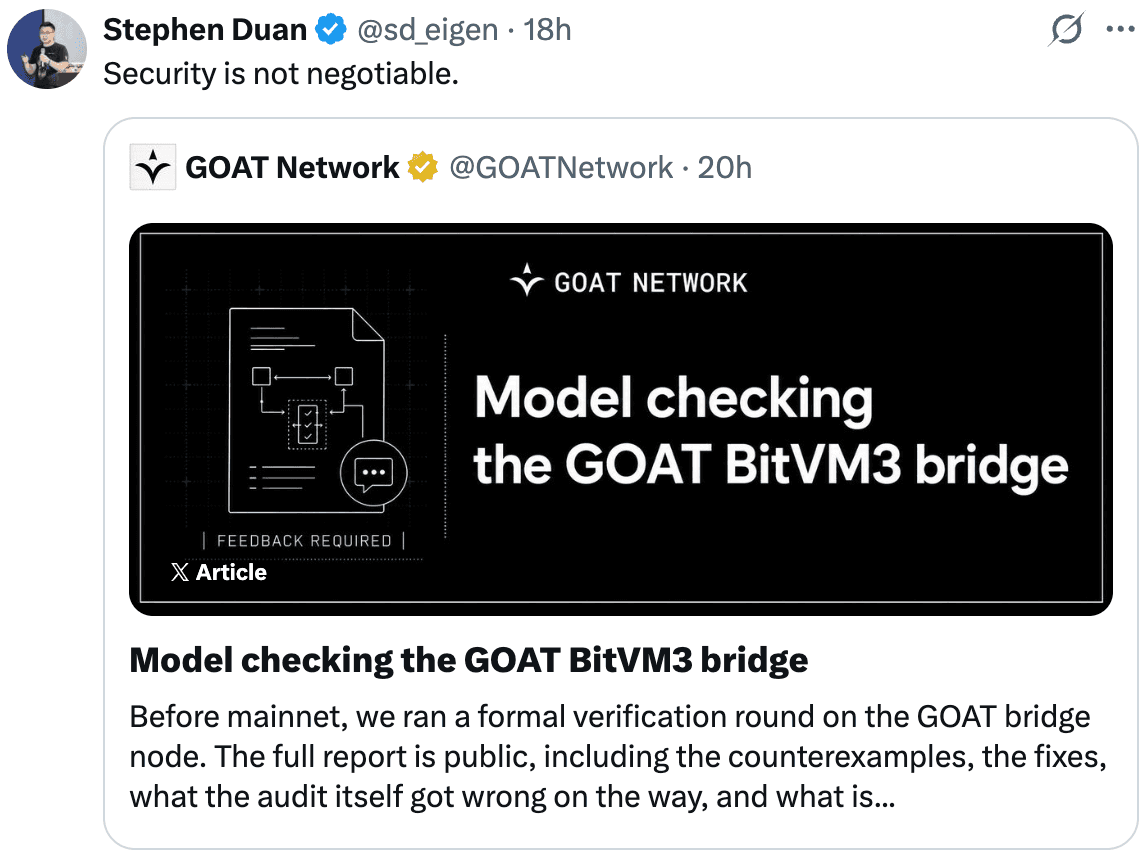
The verification round also confirmed that the 1-of-N protection holds: one independently acting watchtower or verifier can permanently block a dishonest operator’s claim. This was checked across all four network configurations, covering 1,618,897 states with zero violations.
Two lower-priority defects remain documented and open. The report also identifies work that was deliberately outside the scope of this round, including transaction wiring, value conservation, and Taproot leaf authorization.
We published the report to make external review easier, not to present the bridge as beyond challenge. Researchers and security teams can rerun the specifications, question the models, extend their scope, or test the running system directly.
Report:
https://github.com/GOATNetwork/bitvm2-node/blob/gc-v2/audit/TLAPlus-20260710.md
Specifications:
https://github.com/GOATNetwork/bitvm2-node/tree/gc-v2/node/tla
External Recognition for the GOAT ZK R&D Team
The security work also received recognition from two established audit teams.
Consensys Diligence publicly described the ZKM team as outstanding and highlighted the quality of the collaboration. Its team has worked across Ethereum infrastructure and major DeFi systems including Aave, Uniswap, 0x, and Lido, alongside dedicated research into zkVM and circuit security.
Veridise also welcomed the depth of the security process and the decision to put the work under external scrutiny.
Independent approval does not replace verification, but it is meaningful when it comes from teams with direct experience auditing the systems on which this category depends.
Reaffirming the Full GOAT Network Vision
We published Part 2 of The GOAT Network Vision and Why BTCFi Hasn’t Even Started.
The central argument is that BTCFi remains much smaller than its eventual role.
Most of the current market is still built around holding Bitcoin, wrapping it, borrowing against it, or reproducing familiar DeFi products. The larger opportunity is programmable economic infrastructure that ultimately settles to Bitcoin and can be used by applications, institutions, and autonomous software.
We also published The GOAT Stack, bringing the system into one view:
Decentralized sequencing
Type-1 zkEVM execution
The Ziren zkVM
BitVM-based Bitcoin settlement
Agent wallets and identity
Cross-chain x402 payments
Merchant applications
These are not separate product lines. They are the components required to make Bitcoin-secured execution usable.
Cross-Chain Agent Infrastructure Expands
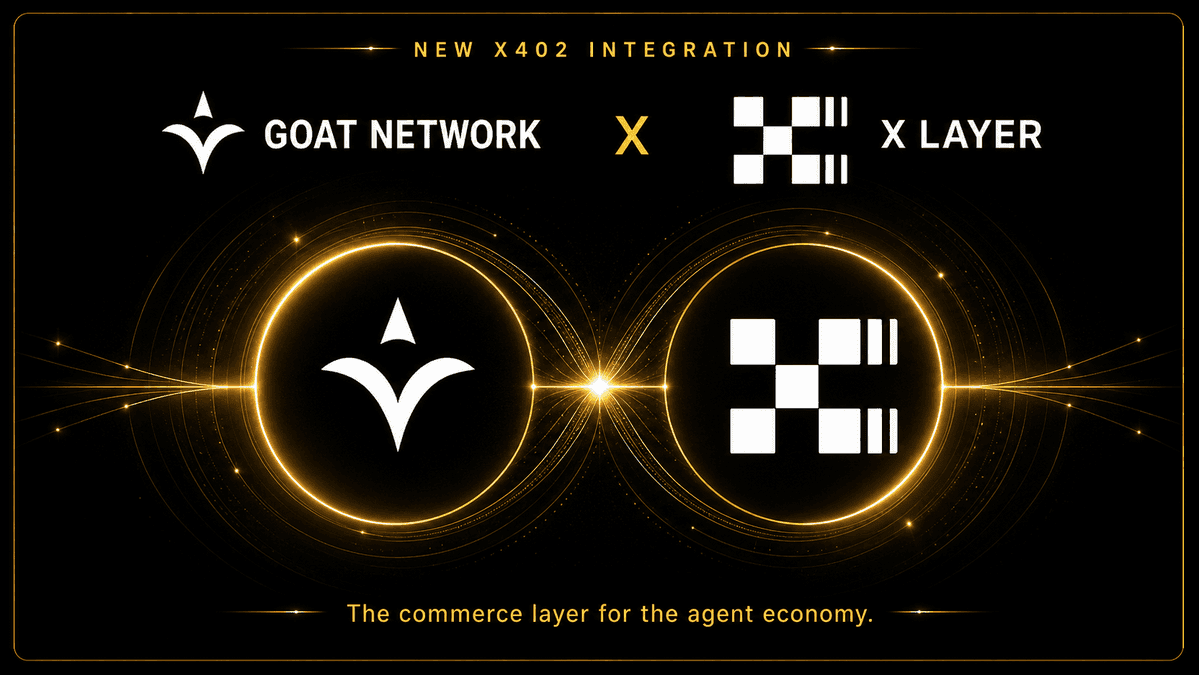
GOAT Network’s agent-commerce infrastructure added support for Metis, and X Layer during July.
Agents using GOAT payment infrastructure can now execute payment flows across GOAT Network, Ethereum, Base, Optimism, Arbitrum, BNB Chain, Berachain, Metis, and X Layer.
The important distinction is not simply the number of supported networks.
Most x402 infrastructure assumes the payer already holds funds on the same network selected by the service. GOAT x402 allows the payment to begin on the network where the funds already sit and complete on the network where the service executes.
The payer signs once. GOAT handles the cross-chain payment and verifies the result onchain.
GOAT Network CMO Ben Wynn examined the incentive problem behind existing single-chain payment infrastructure in Move Your Funds First.
The infrastructure is already being used for real commerce. At the OpenClaw Summer Builder Bootcamp opening ceremony, CEO Kevin Liu demonstrated an agent buying a gift card through GOAT payment rails.
The Builder Pipeline Advances
The OpenClaw Summer Builder Bootcamp received 91 applications for 12 available places.
After three weeks of development, the teams presented their first products during Stage 1 Demo Day. Ten projects advanced into Stage 2, where GOAT Network is supporting the teams with growth and product development.
Projects that demonstrate real use and traction have a direct route into the GOAT AI Builder Grants Program.
GOAT COO Sophia Li also delivered the first session in the bootcamp mentor series: Watch Here
The Developer Advocate Program closed with 165 applications from developers, educators, and community leaders. The selected advocates have now been announced and will support technical education, AgentKit adoption, and developer onboarding.

We also opened a North America DevRel role for someone able to own both the technical presentation of the GOAT stack and the builder pipeline that converts interest into deployed applications.
Role details: https://x.com/i/jobs/2072772568885424519?s=20
New Builder Grants Project
The GOAT AI Builder Grants Program now includes three announced projects - the newest being recently announced Veridex.
Veridex gives agents bounded authority over payments.
Before each transaction, deterministic policy checks determine whether the payment falls inside the agent’s permitted scope. ERC-8004 provides onchain identity, while a tamper-evident evidence bundle records what was checked and why the transaction was approved.
This creates an inspectable authorization layer between an agent receiving access to funds and spending them.
Full details: https://x.com/GOATNetwork/status/2082472526291107858?s=20
Funding Products That Already Work
The GOAT AI Builder Grants Program has now received almost 200 applications.
We adjusted the funding structure to give working products a faster and clearer route into the program:
Base Grant: $2,000 for functioning products already generating revenue.
Singularity Investment: $1 million allocated for the strongest applications demonstrating serious traction and long-term potential.
The objective is to identify teams that have moved beyond a concept, help them improve distribution and infrastructure, and invest more heavily where real demand is already visible.
Practical Guidance for Agent Builders
Following the release of Turn Your Agent into an Economic Agent - a step-by-step guide designed to remove development barriers and make integration with GOAT Network straightforward - we asked builders what still stood between a working agent and its first revenue.
More than 150 people responded. Payment integration was the largest blocker, followed by customer acquisition, buyer trust, and pricing.
The answers showed that builders need guidance across the entire commercial path, not one isolated technical problem.
We published The Agent Builder’s Bible in response: a practical guide to building, pricing, distributing, and monetizing economically capable agents.
Download it here, completely free.
GOAT Network at Futurist and ETH Toronto
CEO Kevin Liu represented GOAT Network across several of Toronto’s leading AI and crypto events.
He joined discussions hosted by Futurist, ETH Toronto, and House of ZK alongside participants from CoinDesk, Billions Network, Secret Network, Conflux, Hivello, and the wider institutional and AI infrastructure ecosystem.
The week placed GOAT Network’s work on agent payments, verification, and Bitcoin-secured infrastructure inside one of the industry’s main international meeting points.

Next
GOAT BitVM3 is moving toward mainnet.
More integrations are in development, and additional merchant applications are preparing to launch.
Thank you to every builder, researcher, auditor, partner, and user who contributed during July.
Sincerely, The GOAT Team.
Note: This newsletter reflects current development priorities and does not constitute a binding roadmap. Timelines and implementation details may change as research, audits, testing, and development progress.


