

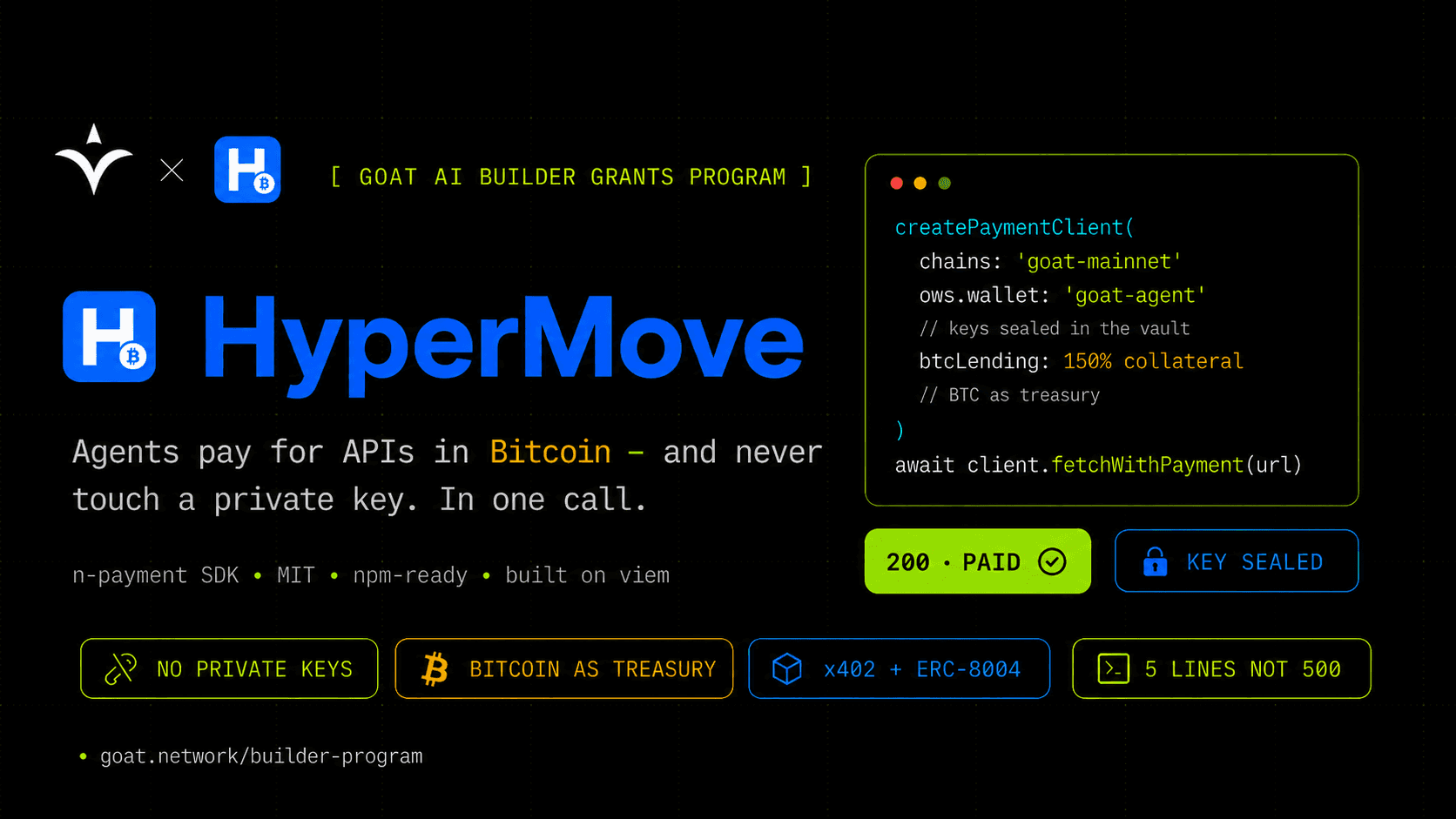
HyperMove's n-payment SDK lets autonomous agents pay for APIs using Bitcoin as collateral - without ever touching a private key - in a single call. As the second project in the GOAT AI Builder Grants Program, it unifies x402 payments, ERC-8004 identity, BTC lending, and the Open Wallet Standard into one integration.
Today we're introducing the second project in the GOAT AI Builder Grants Program: HyperMove.
Three problems every agent developer on GOAT Network hits
If you've tried to give an agent its own wallet on GOAT Network, you've run into the same wall three times:
First, integration is heavy. Wiring up x402 payments and ERC-8004 identity by hand runs to hundreds of lines of boilerplate before your agent pays for a single API call - repeated in every project.
Second, giving an agent a private key is a security anti-pattern. Raw keys leak into LLM context windows, logs, and memory. An agent that can read its own key is an agent one prompt injection away from draining its wallet.
Third, Bitcoin sits idle. On a Bitcoin-secured network, the natural treasury asset is BTC - but agents pay in stablecoins. So builders pre-swap BTC into USDC and let it sit, carrying stablecoin exposure for payments that may never come.
HyperMove's n-payment SDK closes all three.
What is HyperMove building?
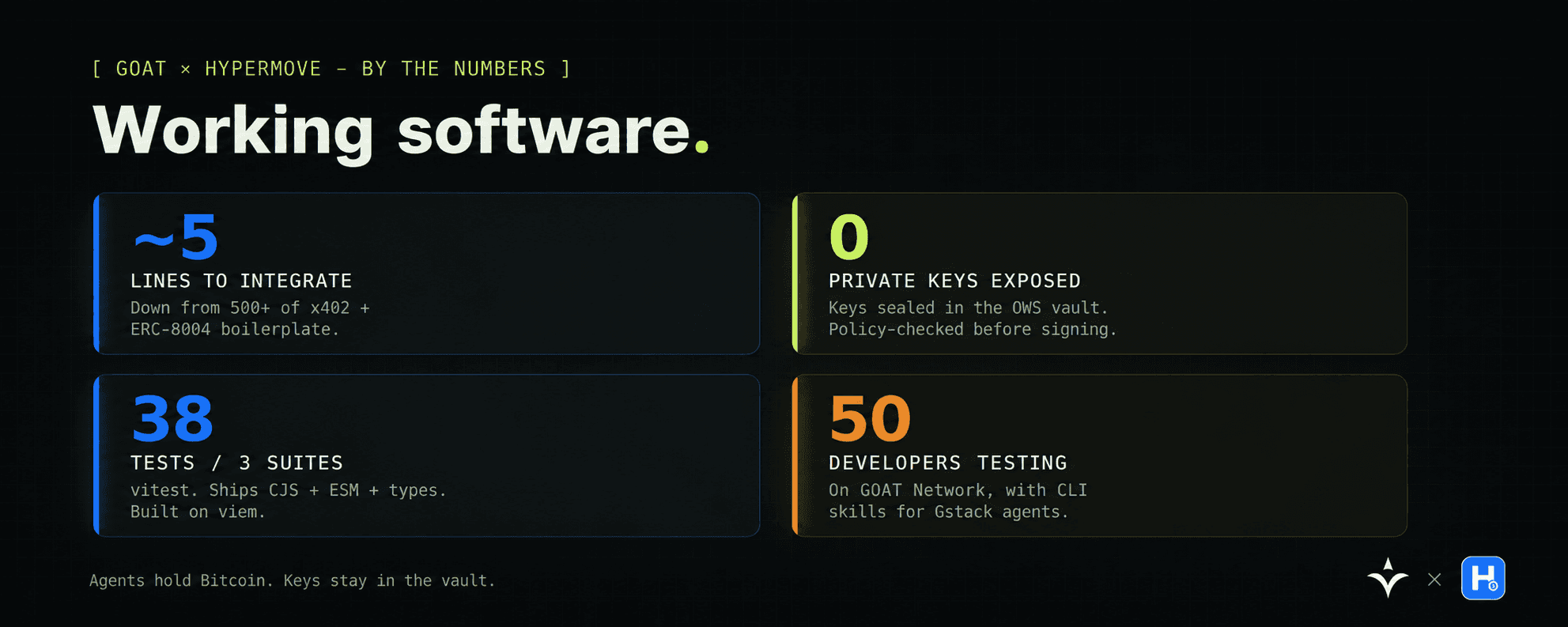
n-payment is a TypeScript SDK that collapses agent payments on GOAT into a single call. It is MIT-licensed, npm-ready, built on viem, and shipped with 38 tests across three suites - currently in testing with multiple developers on GOAT Network.
Three ideas make it different.
Agents never touch a private key. Keys live inside the Open Wallet Standard (OWS) vault and never leave it. Every transaction is checked against policy at the wallet layer - spending limits, chain restrictions, and a token allowlist (USDC, USDT, WBTC, PegBTC) - before anything is signed. The agent asks the vault to act; it never holds the means to act on its own.
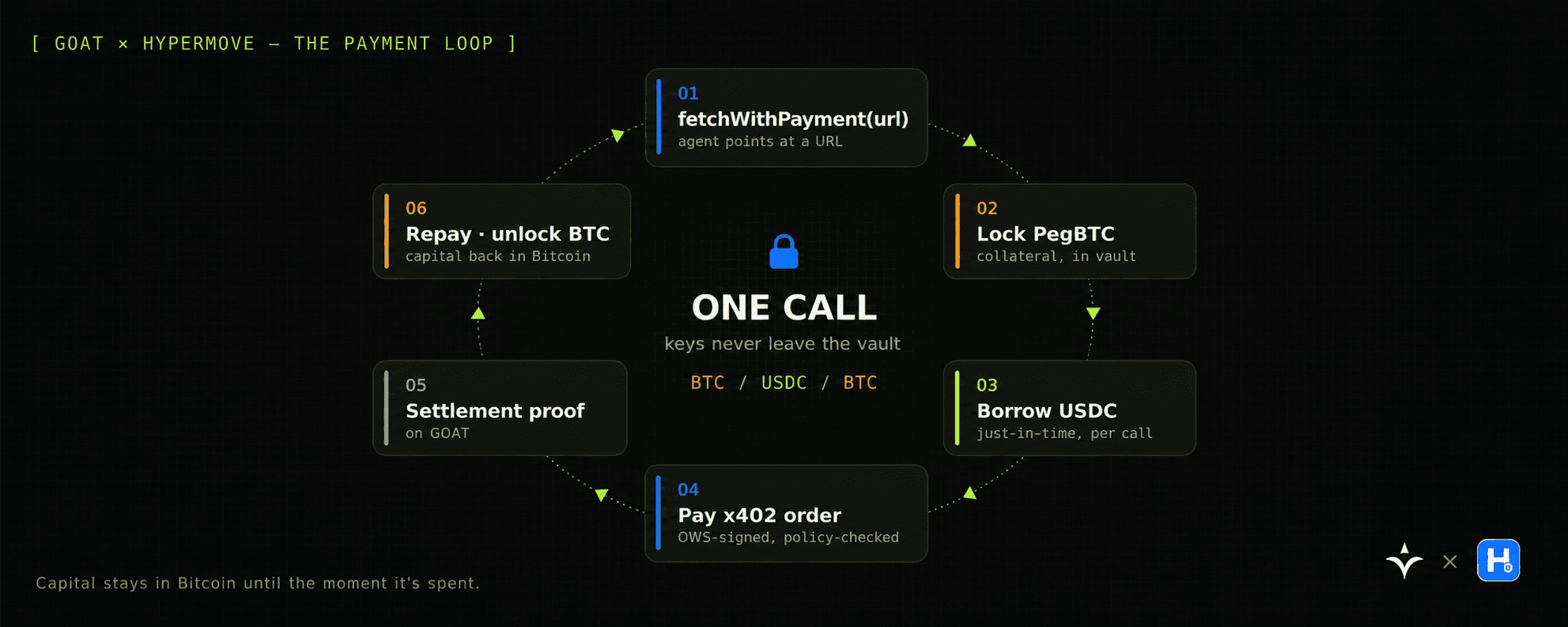
Bitcoin is the treasury; USDC is borrowed just-in-time. Instead of pre-swapping, an agent holds BTC and borrows only what each call needs. When a payment is due, n-payment locks PegBTC as collateral, borrows USDC, pays, then repays the loan and unlocks the BTC - automatically. Capital stays in Bitcoin until the moment it's spent.
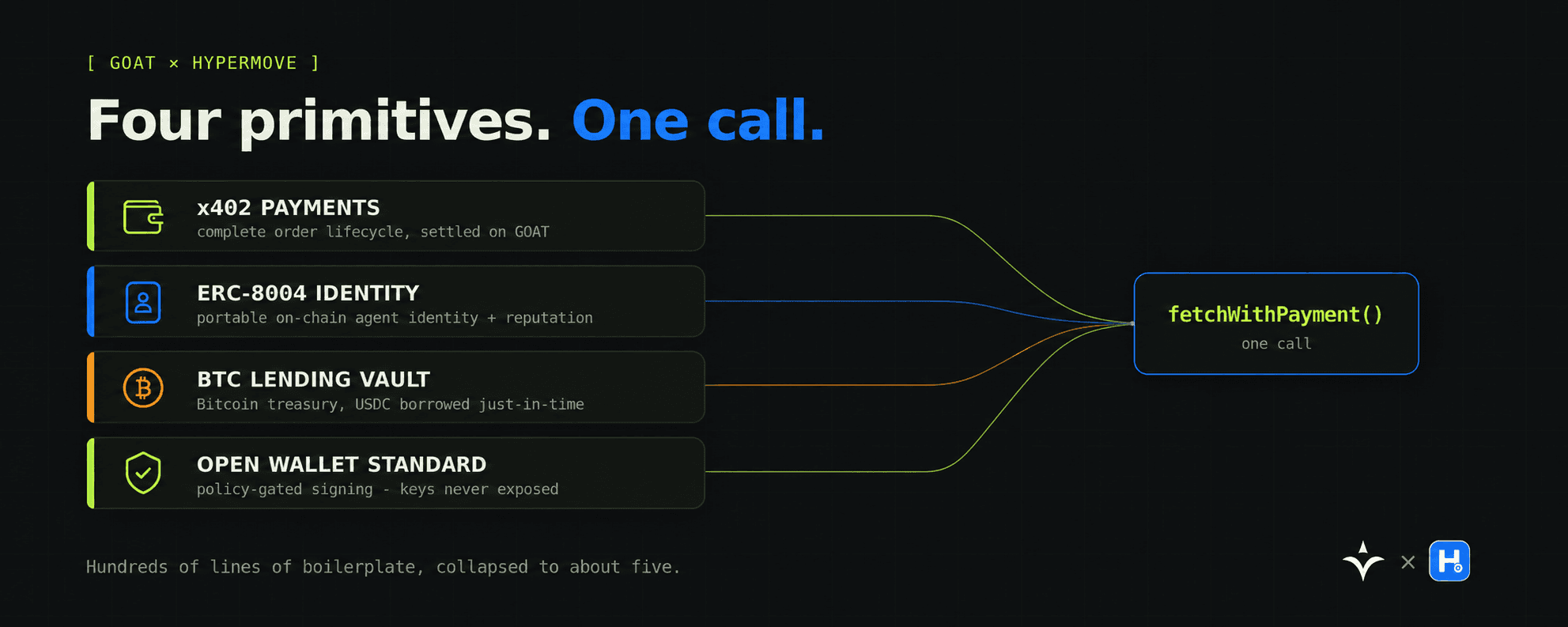
Five lines, not five hundred. n-payment unifies GOAT x402 payments, ERC-8004 agent identity, the BTC lending vault, and OWS signing behind one fetchWithPayment() call. Point an agent at a URL; the SDK handles the rest.
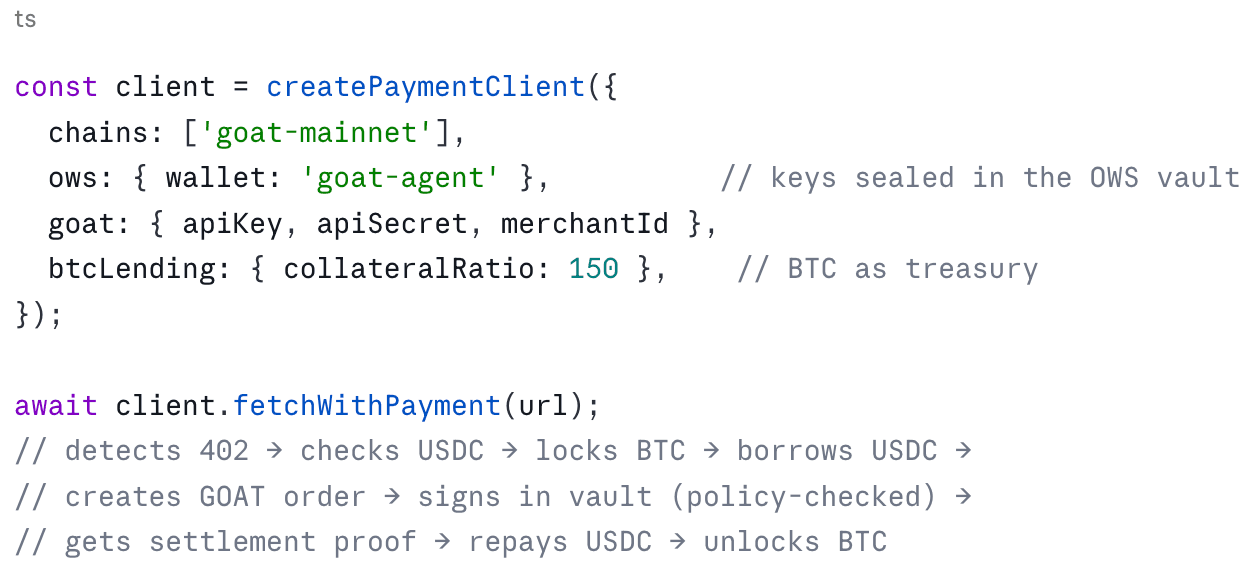
What that looks like in code
Setup is a few lines, and a single call carries the whole lifecycle:
On the server side, one middleware call (createPaywall) puts a dual-protocol 402 paywall in front of your routes. And for command-line agents in the Gstack ecosystem - including Claude Code and Kiro CLI - n-payment ships CLI skills so an agent can pay from a shell script.
A builder who ships
n-payment comes from Pham Nim, a Web3 developer-relations engineer and BTCFi builder with a long open-source trail across Solidity, Move, and Rust. The SDK reflects that: real tests, dual CJS/ESM/types output, an embedded demo with a BTC-lending simulation, and 50 developers already putting it through its paces. This is working software in active development, not a whitepaper.
A live application is the best demo
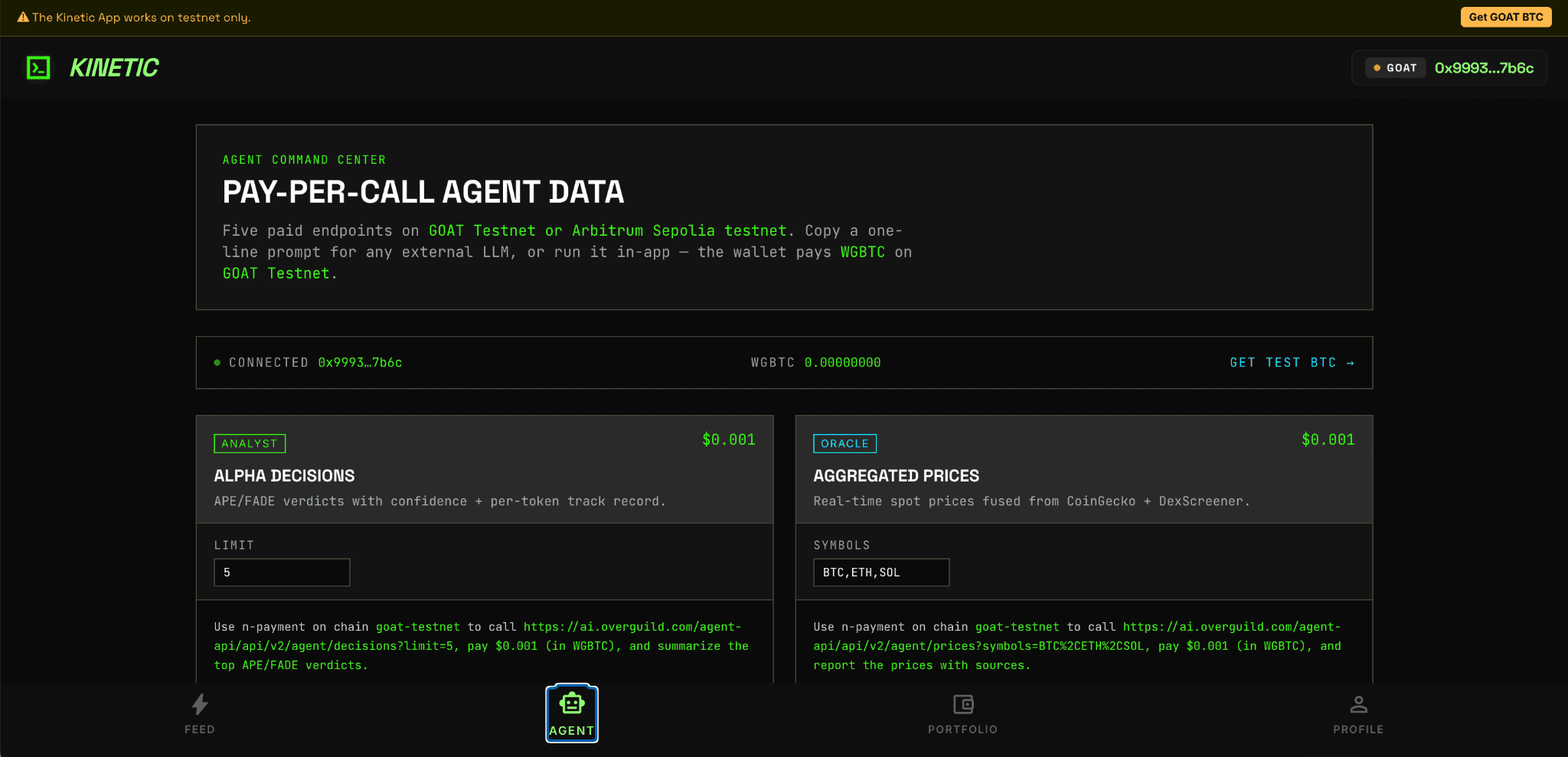
The best proof an SDK works is a product built on it. Kinetic is exactly that - a consumer app from the same builder that turns token trading into a swipe.
Its "Ape or Fade" feed is something like TikTok for crypto: you swipe through tokens to ape one or fade it - but where an ape is a real trade, not a like. A format like that only holds up if the payment underneath is instant and impossible to fumble - a single tap can't be allowed to overspend or leak a key.
That is precisely the layer n-payment provides: Kinetic's trades execute through policy-gated, vault-held signing rather than a raw private key living in the app. It turns the abstract pitch into something concrete - n-payment isn't a library waiting for its first user; it's already the rails beneath a live product.
Why it belongs on GOAT
GOAT Network is Bitcoin-secured. HyperMove makes Bitcoin Bitcoin-working - the live treasury asset that funds an agent's activity, settled through GOAT's own x402 rails and identified through ERC-8004, drawing on GOAT's BTC lending liquidity. It turns the network's defining asset into the working capital of its agent economy, and it does so without ever handing an autonomous agent the one thing it should never hold: a private key.
Payments are where the agent economy meets the real world. HyperMove makes that meeting point safe, capital-efficient, and five lines long.
Welcome to the ecosystem, HyperMove.
Explore n-payment: npmjs.com/package/n-payment
Try Kinetic: signal.overguild.com/?mode=tokens
Apply to the GOAT AI Builder Grants Program: goat.network/builder-program
Disclaimer
This article references and links to third-party projects and products, including those built by teams in the GOAT AI Builder Grants Program. These references are provided for information only. A grant, a feature, a mention, or a link does not constitute an endorsement, a recommendation, or a guarantee of any third-party product, and GOAT Network is not responsible for third-party software, services, or websites.
Nothing in this article is financial, investment, legal, or tax advice. Digital assets and onchain applications - including trading tools - carry risk, up to and including the loss of funds. Some products described here are early-stage or in active development and may change, pause, or stop working. Always do your own research and assess your own risk before using any product or making any financial decision.


