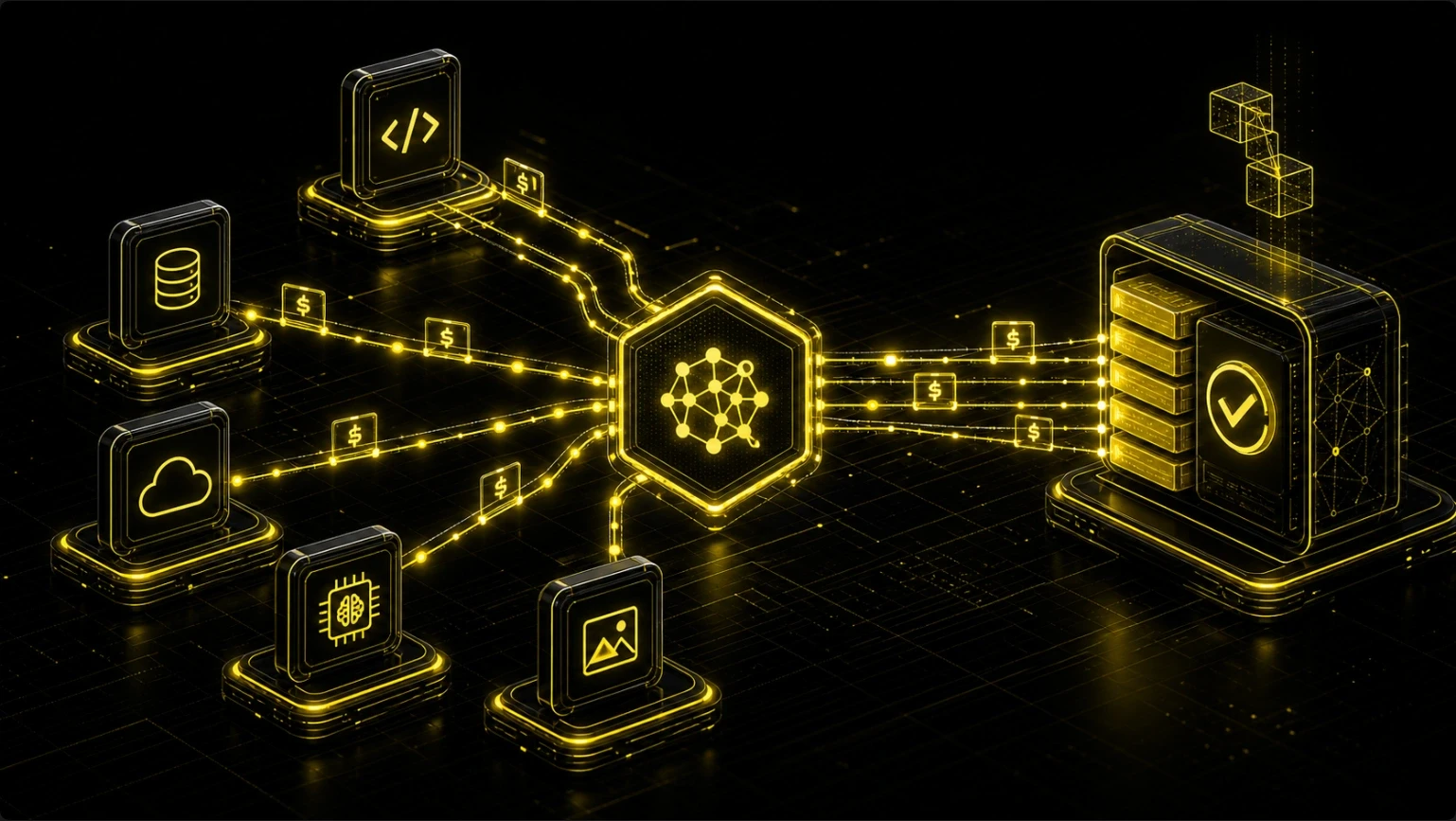

Credit card forms were designed for humans sitting in front of checkout pages. AI agents work differently. They call APIs, compare tools, fetch data, invoke services, and move through workflows at machine speed. When every paid step requires a card form, account setup, invoice approval, or prepaid subscription, the agent’s workflow breaks.
Credit Card-Free AI Agent Payments solve that mismatch by moving payment into the API request cycle. Instead of asking a human to enter card details, a service can return a machine-readable payment requirement, let the agent evaluate it against policy, receive a signed payment authorization, verify settlement, and deliver the requested API response or digital service.
This does not mean agents should spend freely. A production-ready agent payment system needs budgets, permissions, spending caps, route allowlists, proof storage, retry controls, and human approval thresholds. The point is not unlimited automation. The point is programmable, bounded, pay-per-use access.
What Credit Card-Free AI Agent Payments Mean
Credit card-free AI agent payments are payment flows where an AI agent, software client, or automated service can pay for API access or digital resources without manually entering card details or relying on a traditional checkout page.
For developers, the model usually has three parts:
Layer | What it does |
Access layer | The API or service declares that a route requires payment |
Payment layer | The agent signs or submits a payment payload |
Settlement layer | The provider verifies payment and releases the resource |
The most relevant protocol pattern today is x402, an open payment standard that uses the HTTP 402 Payment Required status code to support internet-native payments. The official x402 site describes it as an open, neutral standard for payments between clients and servers, and Coinbase’s x402 documentation frames it as a way for services to monetize APIs and digital content through HTTP-native payment flows.
Why Credit Cards Do Not Fit Agent Workflows
Credit cards are useful for human commerce, but they are awkward for autonomous or semi-autonomous software.
Credit card workflow | Agent workflow problem |
Manual checkout | Agents need API-native access, not browser checkout |
Account creation | One-off service use becomes slow |
Subscription plans | Agents may need one paid call, not a monthly tier |
Card storage | Sensitive credentials create security burden |
Chargebacks | Poor fit for instant machine-to-machine settlement |
Invoicing delays | Too slow for live agent execution |
Region and approval friction | Reduces composability across services |
API providers also face friction. If every potential agent customer must create an account, add a card, choose a plan, and manage an API key, many small paid interactions never happen. A pay-per-use model lets providers monetize discrete calls: one dataset lookup, one rendering session, one inference result, one premium content response, one compliance check, or one simulation.
How Pay-Per-Use AI Agent Payments Work
A typical credit card-free payment flow works like this:
An agent requests a paid API route.
The server responds with
HTTP 402 Payment Required.The response includes payment terms: amount, asset, recipient, network, resource, and expiry.
The agent checks the payment request against policy.
If allowed, the agent signs or submits a payment authorization.
The agent retries the API request with the payment payload.
The provider or facilitator verifies and settles the payment.
The API returns the paid response.
Both sides retain proof for reconciliation and support.
The key shift is that payment becomes part of the HTTP lifecycle. The agent does not need to open a checkout page. The provider does not need to force every buyer through a subscription funnel.
The HTTP 402 Pattern
The 402 Payment Required status code gives paid APIs a clean negotiation point. A service can say: “This resource is available, but payment is required before delivery.”
A simplified flow looks like this:
GET /premium/company-risk-score?id=123 HTTP/1.1
Host: api.example.com
Accept: application/json
The server responds:
HTTP/1.1 402 Payment Required
Content-Type: application/json
{
"amount": "0.05",
"asset": "USDC",
"recipient": "0xMerchantAddress",
"resource": "/premium/company-risk-score",
"expiresAt": "2026-06-16T10:15:00Z"
}
The agent reviews the request. If the provider, amount, route, asset, and expiry pass policy, the wallet signs the payment payload. The client retries with payment attached. After verification, the server returns the requested resource.
Where x402 Fits
x402 turns the old idea of HTTP payment into a more practical developer flow. It standardizes how a server asks for payment, how a client submits payment authorization, and how a facilitator or backend verifies settlement.
For API providers, x402 is useful because it can support:
Use case | Why it fits |
Paid API calls | Charge per request instead of subscription only |
Premium data feeds | Let agents buy one fresh data point |
Browser or compute sessions | Charge per rendering or task |
Digital content access | Unlock a single resource |
Agent tool marketplaces | Monetize individual capabilities |
Microservices | Enable service-to-service settlement |
For AI agent developers, x402 is useful because a payment requirement can be interpreted programmatically. The agent can reject, approve, retry, or escalate based on policy.
x402 is not exclusive to GOAT Network. It is a broader ecosystem standard, with work across multiple infrastructure providers and developer platforms. GOAT Network’s relevance is that its agent stack includes x402 payment flows alongside AgentKit tooling and ERC-8004 identity concepts.
What an Agent Must Check Before Paying
A payment-capable agent should not treat every 402 response as automatically payable. It needs a policy engine.
Check | Example rule |
Provider trust | Pay only approved domains or merchant IDs |
Route scope | Pay only for expected API routes |
Price | Reject calls above a per-request limit |
Budget | Enforce task, session, and daily caps |
Asset | Use only approved tokens or payment methods |
Network | Restrict supported settlement networks |
Expiry | Reject stale payment quotes |
Nonce | Prevent replayed payment requests |
Metadata | Remove sensitive user or task data |
Approval | Ask a human before high-value actions |
This is the difference between autonomous payment execution and uncontrolled spending. Agents can pay programmatically, but the developer decides the envelope.
What API Providers Need to Support
API providers need to design payment as part of the API lifecycle, not as an afterthought.
A practical provider stack includes:
Component | Purpose |
Route pricing | Define which endpoints require payment |
Payment requirement response | Return structured HTTP 402 instructions |
Merchant configuration | Set recipient, supported assets, and networks |
Verification | Confirm amount, recipient, signature, expiry, and resource |
Settlement tracking | Track pending, completed, failed, expired, or cancelled states |
Delivery control | Release the resource only after valid payment status |
Proof persistence | Store order, quote, payment, and delivery records |
Retry handling | Prevent duplicate charges on timeouts |
Monitoring | Detect stuck orders and failed settlement |
Support path | Resolve paid-but-denied or duplicate-payment cases |
GOAT Network’s x402 developer documentation gives builders a useful implementation reference for payment-enabled APIs, including merchant setup, order creation, verification, and proof handling. A developer building on GOAT can start with the x402 developer quick start and then evaluate which payment mode fits the application.
DIRECT vs DELEGATE Payment Flows
Credit card-free agent payments can be simple or complex depending on what happens after payment.
Mode | Best for | Developer implication |
DIRECT | Paid API calls, content access, simple service unlocks | Lower integration complexity |
DELEGATE | Payment-triggered logic, callbacks, advanced workflows | More security and testing required |
A direct payment flow works well when the API only needs to verify payment and return a response. A delegated flow is more appropriate when payment should trigger additional logic, such as calling a contract, executing a callback, issuing access rights, or coordinating a multi-step workflow.
GOAT Network’s x402 payment modes are relevant for developers comparing these patterns.
Why Pay-Per-Use Matters for APIs and Digital Services
Pay-per-use access changes API monetization because it removes the subscription decision from small interactions.
For API providers, this can create new revenue from low-friction usage:
Provider type | Pay-per-use example |
Data API | Charge per enriched record |
AI tool provider | Charge per specialized inference call |
Browser automation service | Charge per rendering session |
Security service | Charge per scan |
Research database | Charge per document or query |
Media service | Charge per premium asset |
Developer tool | Charge per validation, simulation, or build step |
For agent developers, pay-per-use access makes tool selection more flexible. The agent can choose the best service for the task instead of being limited to APIs that already have prepaid credits or stored API keys.
Security Risks Developers Should Handle
Credit card-free does not mean risk-free. It moves risk from card processing into protocol design, wallet authorization, metadata handling, and settlement logic.
Risk | What can happen | Mitigation |
Replay | A payment payload is reused | Nonces, expiry, and route binding |
Overpayment | Agent accepts an unexpected price | Per-call and daily limits |
Wrong recipient | Payment goes to a malicious address | Merchant allowlists and signature checks |
Paid but denied | Settlement completes but service fails | Proof storage and support workflows |
Delivered but unpaid | API releases resource too early | Verify terminal payment state first |
Metadata leakage | Payment payload reveals sensitive task context | Metadata minimization and PII filtering |
Duplicate retries | Timeout causes repeated payment | Idempotency keys and retry controls |
Callback abuse | Delegated flow triggers unsafe logic | Allowlists, validation, and least privilege |
Recent research on x402 has highlighted issues around authorization binding, replay protection, paid-but-denied states, and metadata privacy. These are implementation concerns developers should address before production use.
Where GOAT Network Fits
GOAT Network is Bitcoin-secured infrastructure for the Digital Economy and Agentic Economy. Its stack combines Bitcoin-backed settlement concepts, EVM-compatible execution, x402 payments, ERC-8004 identity and reputation, and AgentKit developer tooling.
For this topic, the most relevant GOAT layer is not token speculation or yield. It is the agent developer stack: x402 for machine-readable payments, ERC-8004 for agent identity and reputation concepts, and AgentKit for onchain actions and runtime tooling.
Developers exploring credit card-free AI agent payments can use GOAT’s Agentic Economy materials to understand how GOAT frames x402, ERC-8004, and AgentKit in one agent infrastructure narrative. For implementation work, the natural CTA is to Explore AgentKit.
Implementation Checklist
Before launching credit card-free AI agent payments, developers should answer these questions:
Area | Question |
Pricing | Are paid routes and amounts predictable? |
Payment requirement | Does the API return structured HTTP 402 instructions? |
Policy | Can agents reject payments outside approved scope? |
Budgeting | Are per-call, session, and daily limits enforced? |
Wallet security | Are signing keys isolated and scoped? |
Verification | Is the payment bound to resource, recipient, amount, and expiry? |
Settlement | Is payment status checked before delivery? |
Idempotency | Can retries happen without duplicate charges? |
Proof | Are receipts and delivery records stored? |
Privacy | Is sensitive metadata removed before payment? |
Monitoring | Can operators inspect failed or stuck payments? |
Escalation | Do higher-risk payments require human approval? |
The Developer Takeaway
Credit Card-Free AI Agent Payments are not just a replacement for card checkout. They are a new access model for APIs and digital services.
The best implementation treats payment as a bounded protocol step:
the API declares a price through HTTP 402;
the agent evaluates the request against policy;
the wallet signs only approved payments;
the provider verifies settlement before delivery;
both sides store proof;
budgets, retries, and privacy controls stay active.
That is what makes pay-per-use API access practical for AI agents. The agent can move faster than a human checkout flow, while the developer still controls what it can pay for, how much it can spend, and when it must stop.
FAQ
What are Credit Card-Free AI Agent Payments?
Credit Card-Free AI Agent Payments are payment flows that let AI agents pay for APIs or digital services without manual credit card checkout. They usually rely on machine-readable payment requests, wallet authorization, settlement verification, and spending policies.
How are AI Agent Payments different from normal online payments?
Normal online payments usually assume a human checkout page, card form, account, or subscription. AI Agent Payments are designed for software clients that need to discover payment requirements, evaluate policy, authorize payment, and receive a resource through an API workflow.
What is x402 used for?
x402 is used to enable HTTP-native payments for APIs, digital content, services, and AI agents. A server can return HTTP 402 with payment instructions, and a client can retry the request with a payment payload.
Does x402 require credit cards?
No. x402 is designed for internet-native payments and commonly uses crypto assets such as stablecoins. Some ecosystem work may support other payment methods, but the core developer value is that payment can happen programmatically through HTTP rather than through a manual card checkout page.
Can AI agents pay for APIs automatically?
AI agents can execute payment flows programmatically, but they should not be allowed to pay without boundaries. Developers should enforce budgets, route allowlists, merchant checks, spending limits, retry limits, and approval rules.
Why would API providers use pay-per-use payments?
Pay-per-use payments let API providers monetize individual calls or features without requiring every user to create an account, buy credits, or commit to a subscription. This is useful for data APIs, AI tools, browser sessions, digital services, and machine-to-machine workflows.
What risks should developers consider?
Developers should handle replay attacks, duplicate retries, wrong-recipient payments, stale quotes, metadata leakage, paid-but-denied states, and unsafe callback logic. Proof storage and idempotency are especially important.
How does GOAT Network relate to credit card-free AI agent payments?
GOAT Network supports an agent infrastructure stack that includes x402 payment flows, ERC-8004 identity and reputation concepts, and AgentKit developer tooling. It is one environment where developers can explore agent payments and related onchain workflows.


