We’re on the verge of a very real economic shift.
AI agents are beginning to discover services, negotiate access, and execute payments autonomously. Sooner or later, the number of agentic economic actors may exceed the number of people and if each of those agents can transact - even in small amounts - the scale of value flowing through the system becomes enormous.
This article explains how x402, Ziren, and GOAT Network fit together to enable a Bitcoin-native agent economy, why it matters, and how you can get involved.
So firstly, what is x402?
“x402 uses HTTP 402 Payment Required so a server can state a price, receive payment, and continue the call. The client pays in USDC (for example), retries, and gets the result, all within the same request–response flow your API already uses.” - Coinbase
This is a different model than traditional API monetization. Instead of provisioning identities (API keys), managing quotas, or selling subscriptions and reconciling invoices, the endpoint becomes a pay-per-request service with settlement embedded in the HTTP flow.
This model is particularly suited to AI agents. Agents do not manage accounts or dashboards. They operate through protocols. x402 gives them a way to transact that matches how they already behave: request, pay, proceed.
The implication is significant: for the first time, HTTP can express economic intent. APIs become natively monetizable. Agents can request, negotiate, and settle value without human mediation.
If agents are going to transact at scale, what they transact and settle in matters.
Bitcoin is the most trusted, most liquid, and most globally recognized digital asset. Extending that trust into machine-to-machine commerce is a natural progression.
Agents will gravitate toward native BTC when the system lets them use it with the same ease as stablecoins - because BTC minimizes issuer risk and balance-sheet friction.
But Bitcoin has historically been difficult to use directly for high-frequency, programmable payments, while wrapped BTC reintroduces trust assumptions the agent economy is trying to remove.
As a result, most machine-driven commerce today routes through non-Bitcoin assets.
GOAT Network is changing that.
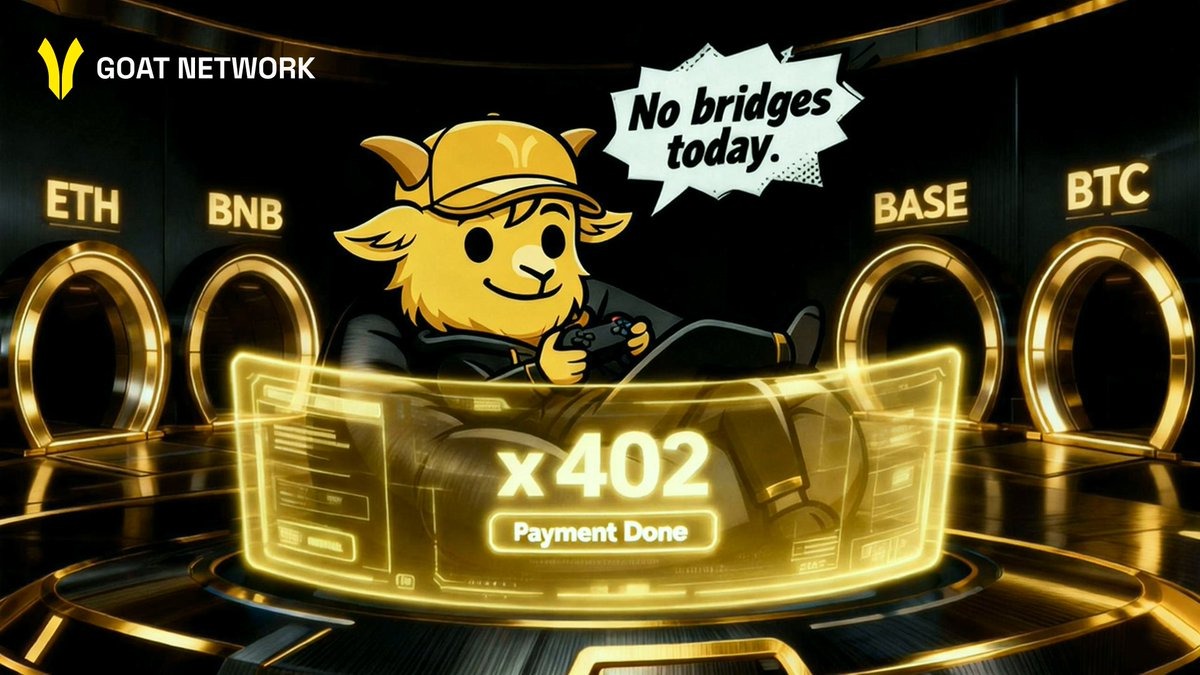
By integrating x402 with GOAT Network’s programmable execution environment with native Bitcoin settlement, we’re making it possible for agents to transact using BTC, pulling real-world internet usage directly into Bitcoin-native settlement:
From the user or agent’s perspective, it feels like a normal internet interaction. From the system’s perspective, value is flowing into BTCFi through real usage.
This is critical. BTCFi only scales if it captures demand outside the crypto-native bubble. x402 provides that on-ramp.
Who verifies that the system runs smoothly?
x402 defines how payments are requested, but it does not define who enforces correctness.
In early deployments, that role is often played by a trusted facilitator, but that doesn’t scale for agent economies. Autonomous systems cannot rely on intermediaries that must be trusted to behave correctly.
This is where Ziren comes in.
Ziren provides a zkVM-based facilitator layer that verifies x402 flows cryptographically. Instead of trusting a central service to say “payment happened”, the settlement logic executes inside the zkVM and produces a proof that it happened correctly. That proof can be checked by the server before fulfilling the request.
In practice, this means:
In this model, the facilitator is no longer a centralized entity - it is verifiable computation.
This structure is essential for agent-to-agent commerce, where transactions must be correct, replay-resistant, and auditable without introducing custodial risk.
If agents become the dominant economic actors on the internet, then payment infrastructure becomes as foundational as TCP/IP or HTTPS.
x402 defines how agents pay. GOAT Network enables those payments to be settled in BTC.
This is the pathway for Bitcoin to become the settlement layer of the machine economy - one request, one proof, one payment at a time.
That opportunity is potentially multi-trillion-dollar in scale.
And it starts with something deceptively simple: a ‘402’ response - and a payment made by an agent.
Building on GOAT Network with x402.
GOAT Network provides an x402-compatible SDK with multi-chain support that abstracts gas, payments, and cross-chain flows by default. Users can purchase services without managing networks or assets, while applications receive native callbacks tied directly to payment and settlement events.
This makes it possible to build monetized products - AI agents, paid APIs, in-app purchases - using a pay-per-request model, without weeks of custom integration or infrastructure work.
If you’re interested in building x402-based applications on GOAT Network, reach out to the team: discord.com/invite/goatrollup
The SDK is ready, and we’re working directly with builders who want to bring real, agent-native usage into the Bitcoin economy.


.png)