
Most people treat Bitcoin like a rare painting or a piece of precious jewellery.
You buy it. You hold it. You try not to touch it.
That makes sense today, because Bitcoin is not built for daily activity. It is built to be the final place where value is settled, with simple rules that are hard to break.
But here is the part that is less understood.
Bitcoin was not created just to be stored. It was created to be used as money. And if Bitcoin is ever going to become the base of a real financial system, it needs a way to support everyday activity - payments, trading, lending, yield generation - without giving up the reason Bitcoin is valuable in the first place: having rules that nobody can override.
That is the promise of native zkRollups. They are the first enabler of real Bitcoin finance.
A native zkRollup lets a separate system run fast transactions, but still makes the final rules enforceable by Bitcoin.
That is why the GOAT BitVM2 testnet is a big deal. We’re finally filling in the missing piece to making Bitcoin usable at scale.
What Bitcoin finance actually needs
Most attempts to make Bitcoin productive rely on one of these structures:
Custodians/federations/multisigs: BTC is controlled by a set of signers. Withdrawals work until they don’t - because the exit path is ultimately permissioned.
Honest-majority assumptions: safety depends on a majority of operators staying honest and live. That assumption is exactly what gets stressed during attacks, outages, or governance conflicts.
In both cases, the failure point is the same: Bitcoin cannot unilaterally enforce the correct outcome. If an exit depends on an operator signature, committee cooperation, or majority liveness, the user does not have a Bitcoin-enforceable claim.
“The Bitcoin Layer 2 market hasn’t truly started. Until now, the so-called ‘Bitcoin L2s’ are simply sidechains or custodial bridges. They lack essential attributes like permissionless exit or mainnet-level dispute resolution, which are requirements for BTCFi to be credible.” - Kevin Liu, CEO of GOAT Network
If Bitcoin is going to run a real economy, two things must be true:
You can always get your BTC back to Bitcoin.
No company, committee, or operator sits in the middle.
If these are not fundamental design properties, a “Bitcoin L2” might have apps, but it doesn’t have trust-minimized, native security.
The real question is: can Bitcoin enforce the rules when it matters? When something breaks, or someone cheats, does Bitcoin itself have a way to force the correct outcome?
Why native zkRollups on Bitcoin are a breakthrough
A zkRollup is basically:
A fast side system where people do digital activity (financial or otherwise)
Then it sends a definitive “proof” back to the main system showing the activity followed the rules.
On some chains, the main chain can directly check that proof.
Bitcoin is different. To keep its security model as strong and simple as possible, Bitcoin doesn’t have a flexible smart-contract engine that can easily verify complex proofs.
So for years, “Bitcoin Rollups” were thought to be impossible by most.
BitVM2 is the breakthrough path because it gives Bitcoin a way to enforce correctness. It uses Bitcoin’s existing tools - transactions, signatures, time locks - to create a mechanism where “cheating a proof” can be challenged and forced into a Bitcoin-enforced resolution.
All without changing Bitcoin’s code. That is the breakthrough: Bitcoin stays Bitcoin, but it can still enforce a much more functional and efficient system built on top.
“We deliberately refused to take shortcuts, even when they would have made the network easier to launch or more attractive in the short term. That decision comes directly from a form of Bitcoin minimalism as a principle. We do not see BTCFi as an extension layer or a convenient sidechain. Our goal has always been to build a truly Bitcoin native financial system, one that allows BTC to move, earn, and participate without giving up its original security guarantees.” - Stephen Duan, CTO of GOAT Network
So what is the GOAT BitVM2 testnet?
It’s a public testnet for GOAT Network’s Bitcoin-native zkRollup stack, where execution happens off-chain, validity is proven with ZK, and Bitcoin is the enforcement layer if anything goes wrong.
In simple terms: for the first time, users have a way to use BTC with an exit path secured by Bitcoin’s rules.
What we had to add to make BitVM2 deployable
We’ve taken the theoretical BitVM2 design and enhanced it to make it practical for real-world deployment.
First, Bitcoin-anchored ordering. It’s not enough to prove “a valid state”. You also need to know you’re proving the right state - the one produced by the sequencer set users actually followed. Anchoring sequencer authority to Bitcoin and binding withdrawals to that Bitcoin-anchored history avoids the failure mode where an operator presents an alternate fork at the exit boundary.
Second, withdrawals that behave like normal withdrawals. If exits only work in fixed chunks, the system isn’t money-like - it’s a set of workarounds. The withdrawal flow supports arbitrary amounts, using an HTLC-style atomic path and SPV/header-chain verification so completion doesn’t depend on a user-side ceremony.
Third, a dispute path that stays economically executable. A trust-minimized design fails if the dispute path is too expensive to run, because challengers stop challenging. GOAT BitVM2 brings the most advanced research into BitVM efficiency to life, with a garbled circuit based dispute construction that is engineered to keep worst-case overhead within a range that can actually be paid on Bitcoin.
Fourth, incentives and operational roles that don’t depend on one perpetual hero. Security is also participation: watching, responding, and staying live over long time horizons. The design rotates roles and handles collateral/accounting on the L2 so the protocol doesn’t quietly degrade into “trust whoever is still awake”.
Fifth, being explicit about data availability. Bitcoin won’t guarantee rollup data is published. So the assumptions are stated directly: external DA/validium-style trust boundaries exist, and users need a way to verify that publication happened. That’s why the system posts commitments to Bitcoin and uses watchtowers plus header-chain proofs to check inclusion, rather than leaving DA as an implied safety property.
Ultimately, GOAT BitVM2 changes the type of guarantee end users can rely on to use BTC securely.
It means Bitcoin is not just the asset you deposit into - it’s the place the protocol can fall back to when something goes wrong. If an operator lies, stalls, or tries to rewrite history, the resolution path is designed to terminate under Bitcoin’s own rules. That is the difference between “a bridge that usually works” and a system where the failure case still has an enforceable outcome.
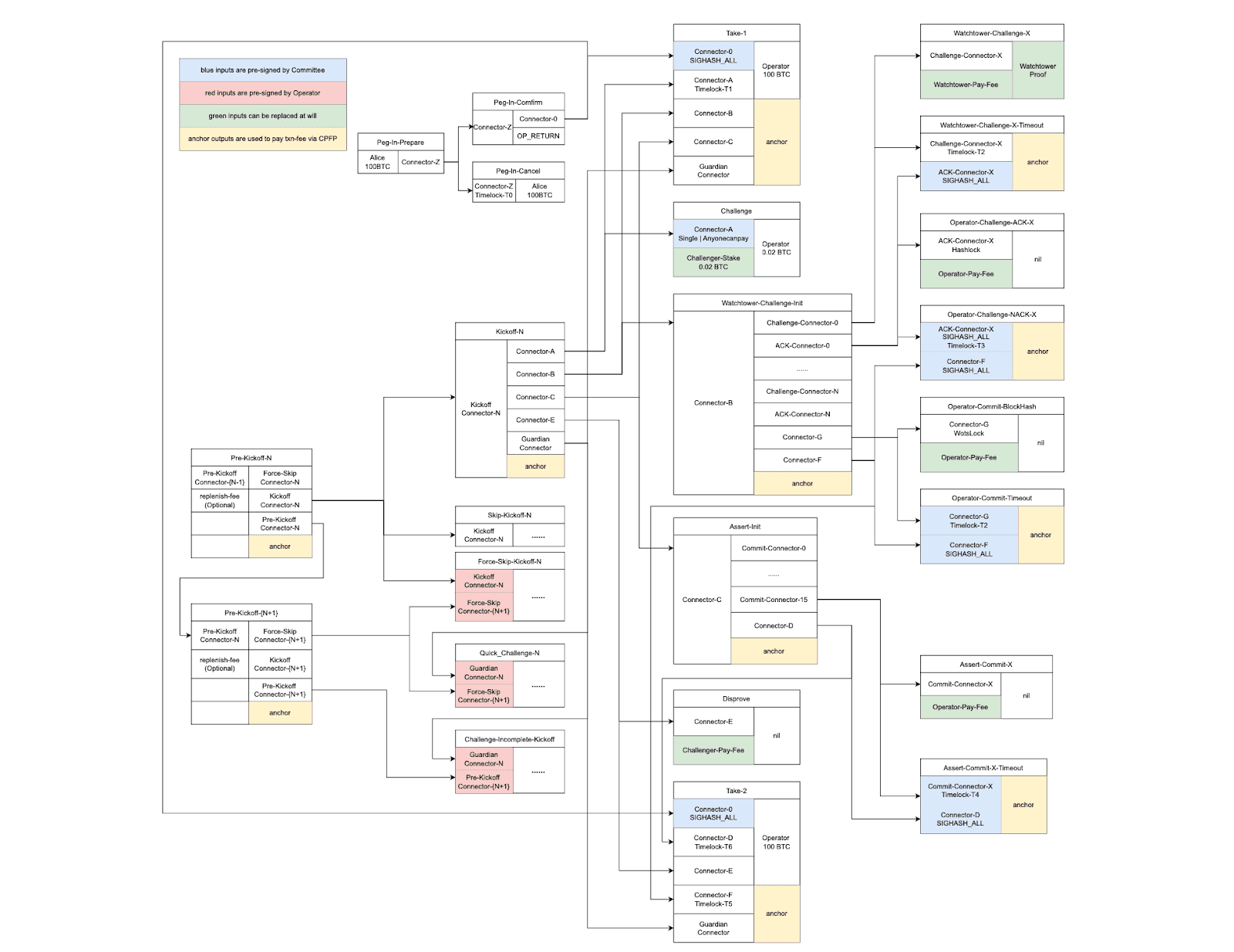
The critical element to making this practical - and possibly the breakthrough that GOAT BitVM2 adds over other BitVM2 deployments - is the dispute path that stays realistic to run on Bitcoin.
A BitVM2-based zkRollup may claim that “Bitcoin is the court”, but the hard part is making sure someone can actually afford to take a case to that court when it matters. If the worst-case dispute is too heavy, challengers won’t run it, and the guarantee becomes merely theoretical.
By introducing garbled circuits into the dispute path (paired with a designated-verifier SNARK), GOAT BitVM2 reduces the amount of work that has to land on Bitcoin in the worst case. That keeps enforcement within practical cost limits, which is what makes the whole BitVM2 security model hold up in the real world.
What else GOAT Network adds over Bitcoin L2 competitors
In addition to running the most advanced version of BitVM2 in deployment, GOAT Network has other core advantages over close competitors, including:
Type-1 zkEVM execution: The GOAT Rollup is designed as a Type-1 zkEVM (Ethereum-equivalent), not a “close-enough” EVM variant. This means fewer semantic edge cases, less porting friction, and audits/tooling carry over with fewer changes.
Decentralized sequencer architecture: sequencing is designed as a network role rather than a single operator, reducing single points of trust and limiting censorship/liveness failure modes at the architecture level. The unique design of GOAT Network’s decentralized sequencer also enables sustainable yield economics as a byproduct of how the system works.
Custom zkVM as the proving engine: execution validity is proven by the fully audited Ziren (our custom-built proving engine), designed as a self-maintainable core component rather than an interchangeable, outsourced add-on.
Why this testnet is different from previous BitVM efforts
GOAT Network’s BitVM work didn’t start with the current testnet. This release is the latest step in a sequence that moved from validating the theory to system-level execution and operational readiness:
First BitVM2 testnet (theoretical correctness): validated the core BitVM2 enforcement/dispute model in a running environment - focused on correctness of the mechanism rather than product-grade execution.
BitVM2 beta testnet (real execution): the initial testnet advanced from “the mechanism works” to “the system actually runs” - adding real-time proving integration and executable withdrawal flows so the end-to-end path could be exercised.
Current testnet (final pre-mainnet): the GOAT BitVM2 testnet converges the full Bitcoin-native zkRollup architecture - ZK-proven execution, Bitcoin-anchored sequencer authority, and Bitcoin-resolving exits/disputes - under a single, hardened configuration intended to match mainnet assumptions as closely as possible.
Why all of this matters
If Bitcoin stays only “buy and hold”, then most financial activity will be possible only through intermediaries and on other systems that do not inherit Bitcoin’s security. Systems that can’t be trusted.
For Bitcoin to become a real financial base layer, it needs a layer that people can actually use - fast, cheap, and practical - without reintroducing the trusted middlemen that Bitcoin itself was designed to remove.
GOAT BitVM2 is the core of that layer. It makes BTCFi credible for the first time, because it solves the hard part: enforcement and exit back to Bitcoin.
The GOAT BitVM2 Testnet is now live and open for public testing.
Links
Get started with the GOAT BitVM2 Testnet User Guide
GOAT BitVM2 Developer Dashboard
GOAT BitVM2 White Paper


