
ThoughtProof builds the verification layer between agent decisions and agent actions. As the first project in the GOAT AI Builder Grants Program, the team is integrating x402 pay-per-call payments and ERC-8004 identity to make reasoning verification a native primitive of the agent economy on GOAT Network.
When we launched the GOAT AI Builder Grants Program, we said we were looking for builders creating agent-native applications with real economic utility - products that solve actual problems, fit into repeatable workflows, and turn usage into transactions.
Today we're introducing the first project in the program: ThoughtProof.
The problem: agents that act before anyone checks their reasoning
Autonomous agents are now trading, settling, writing to memory, handing off tasks to other agents, and controlling wallets. But they still hallucinate, drift from instructions, and make unsupported logical leaps. When an agent controls real money, even a single bad output can result in catastrophic consequences.
This is completely unacceptable.
Until now, there has been no lightweight, pay-per-call layer that checks an agent's reasoning before it executes. There is a gap between "agent decided" and "transaction sent".
That gap is filled by ThoughtProof.
What is ThoughtProof?
ThoughtProof builds verification infrastructure for autonomous AI. Its flagship product, Sentinel, is a lightweight verification API designed for high-frequency agent loops where every decision carries economic risk.
The flow:
An agent completes a reasoning cycle - for example, "buy $500 of ETH based on signal X."
Before executing, the agent sends its reasoning and planned action to the Sentinel API over HTTP.
Sentinel runs multi-stage verification: instruction faithfulness, evidence grounding, and logical coherence - using multiple independent models, with cascade escalation when needed.
Sentinel returns ALLOW (with a confidence score) or BLOCK (with a reason).
The agent executes only on ALLOW. Optionally, the verdict is attested onchain via EAS for a permanent audit trail.
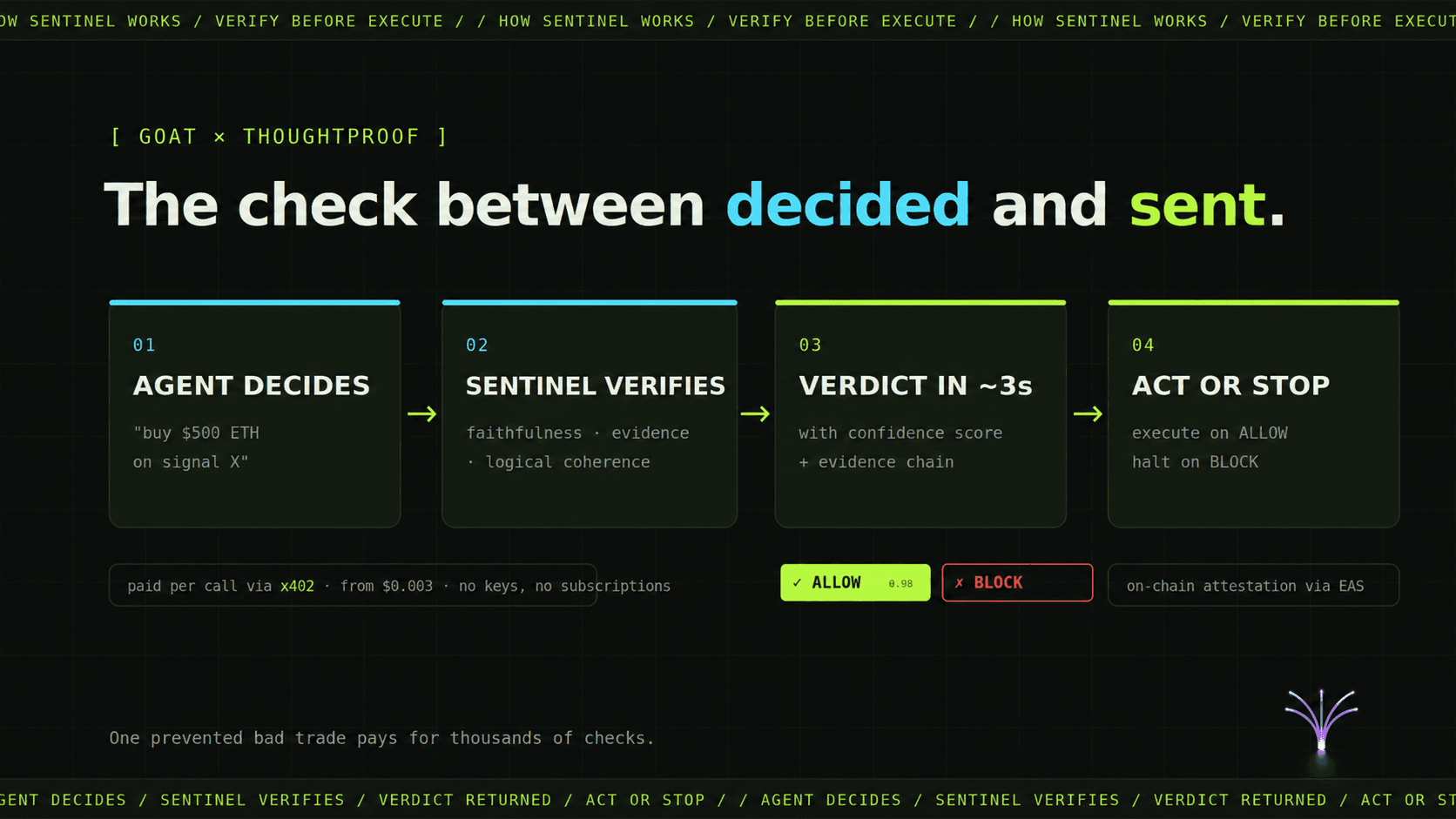
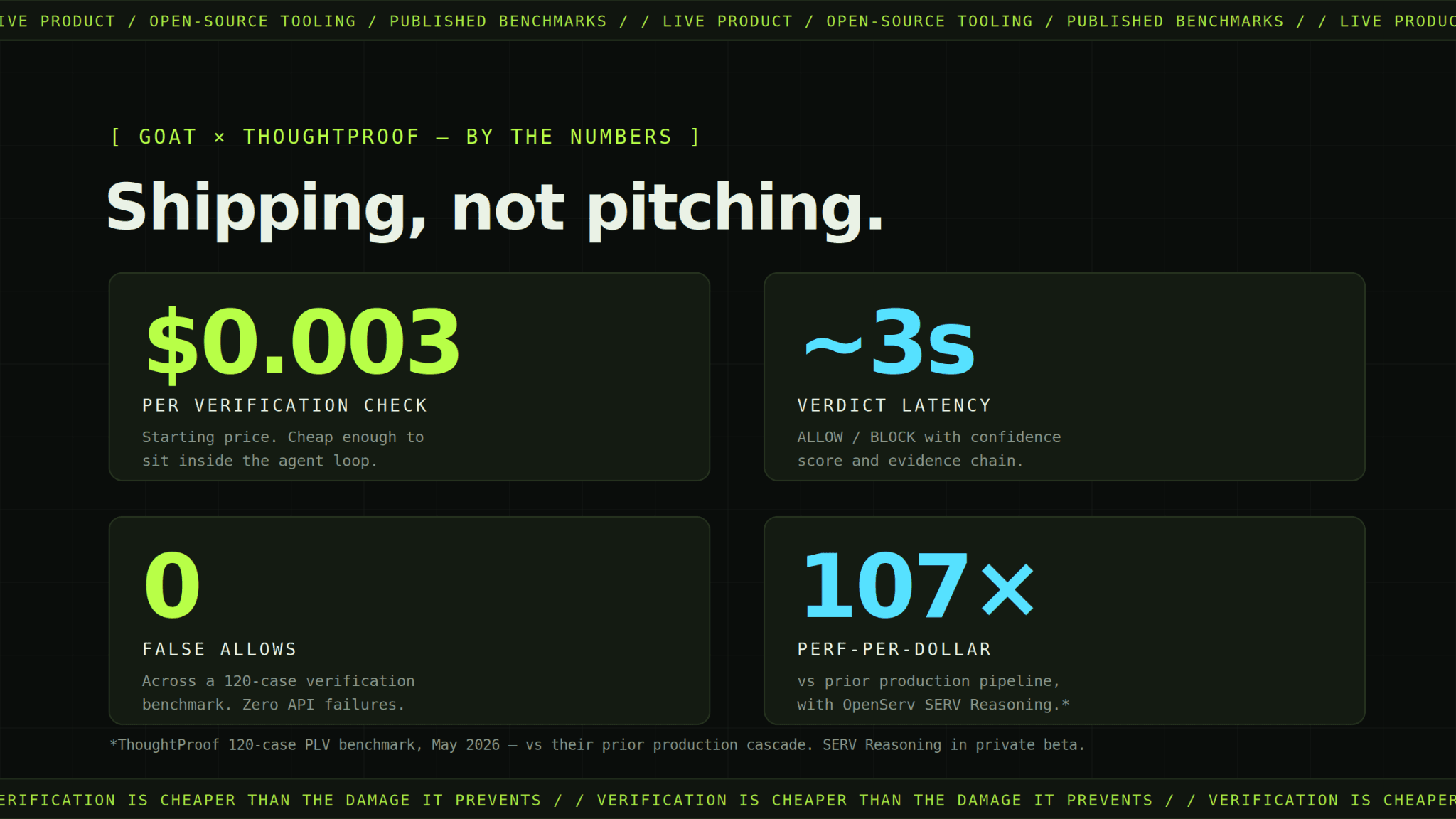
Verification starts at $0.003 per check with roughly three-second latency - cheap enough and fast enough to sit inside an agent's decision loop. The economic logic is that: one prevented bad trade pays for thousands of verification checks.
Sentinel is part of a broader stack. ThoughtProof also runs PLV (Plan-Level Verification, an audit-grade cascade for compliance and regulated workflows) and RV (Reasoning Verification, an adversarial multi-model pipeline for high-stakes decisions), alongside MIT-licensed open-source tooling including pot-cli, pot-sdk, and an MCP server.
A team already shipping, not just pitching
ThoughtProof isn't a concept deck. The products are live, the code is auditable, and the team is already publishing benchmark results.
In a recent 120-case plan-verification benchmark run with OpenServ's SERV Reasoning (private beta), ThoughtProof's pipeline reported 107× better performance-per-dollar than its prior production cascade - with zero false ALLOWs and zero API failures across the full run.
For a verifier that gates real settlements, that pair of zeros is exactly the kind of production-grade signal the Builder Grants Program looks for.
How they found us - and why the fit is exact
What makes this collaboration more special is where it started. The ThoughtProof team identified the opportunity directly from our own writing.
In our article From Standard Agent to Economic Agent, we made the point that "agentic commerce creates security risks across reasoning, authorization, trust, and settlement layers" - and that builders should look for the underdeveloped workflows where intelligence alone isn't enough.
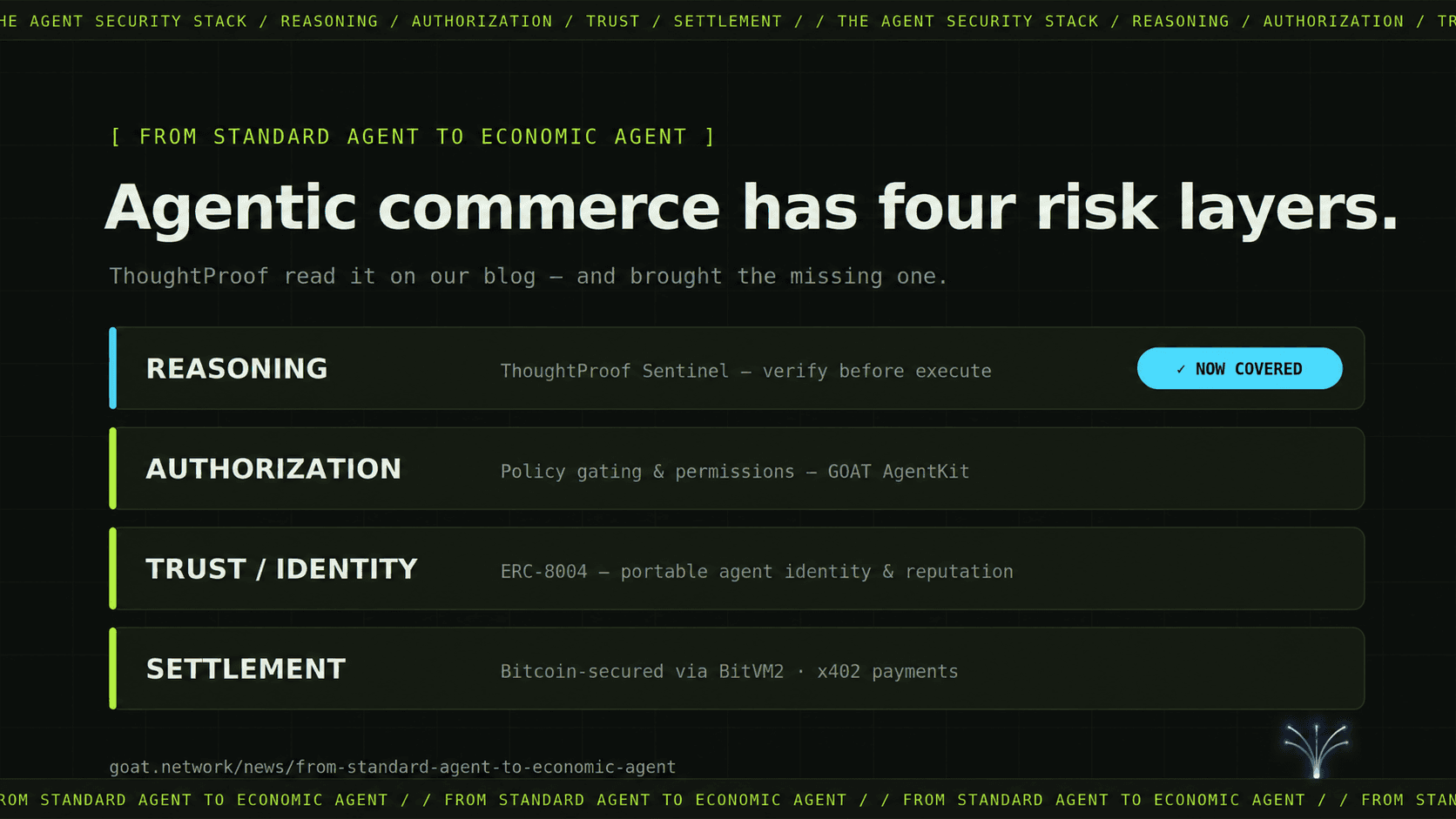
ThoughtProof read that and recognized exactly what they had built: the reasoning verification layer. GOAT Network provides the rails for authorization, identity, trust, and Bitcoin-secured settlement. ThoughtProof provides the safety check on the layer that comes before all of them - the agent's reasoning itself.
This is precisely how we hoped the grants program would work: a builder reads about a real gap in the agent economy, maps their product onto it, and applies with something already live.
What we're building together
Through the Builder Grants Program, ThoughtProof is integrating two core pieces of the GOAT stack:
x402 for pay-per-call verification. Agents will pay for each verification check natively over HTTP - no subscriptions, no API key management. An agent that needs its reasoning verified simply attaches a payment header to the request. Verification becomes a pure pay-per-use primitive in the agent economy.
ERC-8004 for verification identity. ThoughtProof's verifiers gain portable onchain identity and a reputation surface, so agents and users can verify the verifier.
The end state: any economic agent on GOAT Network can call a verification check as naturally as it calls any other service - paying per use, settling with proof, and building an attested audit trail along the way.
The bigger picture
The agent economy only works if agents can be trusted to act. Payments, identity, and settlement infrastructure answer how agents transact. Verification answers whether they should.
With ThoughtProof joining the ecosystem, the GOAT agent stack gains a native answer to the reasoning layer - the first of the security layers we wrote about, and the one every economic agent crosses before money moves.
Welcome to the ecosystem, ThoughtProof.
Explore ThoughtProof: thoughtproof.ai
Apply to the GOAT AI Builder Grants Program: goat.network/builder-program


