
When people say “Coinbase x402” and “GOAT x402”, it sounds like two competing standards. But that’s a misframing.
There isn’t a Coinbase version of the protocol and a GOAT Network version of the protocol - x402 is an open, chain-agnostic payment primitive for the web. There’s one protocol, and then there are deployment choices: who verifies, where settlement happens, what identities mean, what policy is enforced, and what you’re willing to trust in exchange for speed.
When it comes to agents paying for services, pay-per-call APIs, machine-to-machine markets, or anything that looks like commerce without a checkout page, these deployment choices are what you need to consider.
Two Approaches to Agent Payments
Coinbase’s positioning entails adding pay-per-request payments without running chain infrastructure. Its hosted x402 path productizes x402 as a low-friction payments service: fast integration, stable rails, and a trusted facilitator that verifies and settles with built-in policy enforcement.
It’s an adoption strategy, and it’s a sensible one. The fastest way to make a standard real is to ship the scaffolding that removes friction.
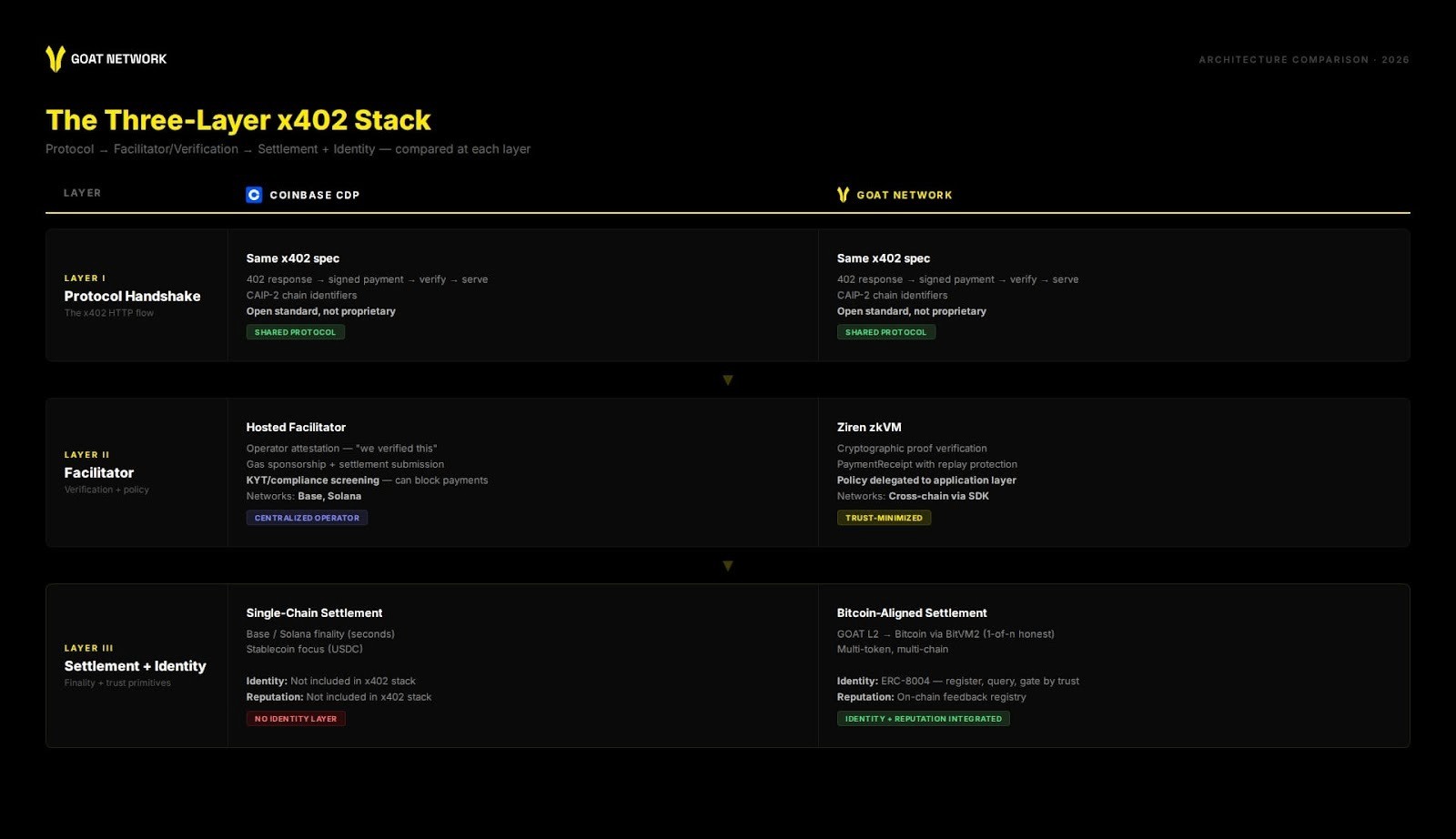
GOAT Network’s positioning starts from a different premise: not merely charging for APIs, but optimizing for agents paying agents at scale, across contexts, and with settlement assurances that don’t collapse into needing to trust an operator.
We’ve taken the same x402 payment primitive and built a complete, trust-minimized stack that is optimized for agent commerce: cross-chain payment orchestration, identity and reputation via ERC-8004, Bitcoin-aligned settlement guarantees via BitVM2, and a shift from facilitator attestation to proof-verified receipts via Ziren. Below is what each piece does, why it exists, and how it changes the baseline x402 model.
x402 payment primitive (the interface layer):
x402 is the interaction contract between a client and a server. It standardizes how “payment required” is expressed and how “payment proof” is returned, so pay-per-request can be implemented without inventing custom billing flows.
In the GOAT Network stack, x402 is not “the payment rail”. It’s the interface that lets an agent pay for a resource in a machine-native way. The actual rail is whichever network and asset the deployment accepts.
What this enables:
pay-per-call APIs without accounts, subscriptions, or invoicing
programmatic pricing and metering
composable agent-to-agent transactions where payment is part of the request cycle
Cross-chain payment orchestration (the routing layer):
Agents don’t live on one chain. They pick rails based on cost, latency, liquidity, and what the counterparty accepts - and therefore, multi-rail payments must be a default for agents. If x402 is the interface, cross-chain orchestration is the machinery that makes “acceptable payment” flexible without turning every integration into bespoke bridging logic.
Cross-chain orchestration covers three functions:
Acceptance. A single service can accept payment proofs from multiple networks (e.g. “pay me on rail A or rail B”), so agents aren’t blocked by a single chain dependency.
Routing. The system can guide a payer toward the cheapest/fastest acceptable rail for that service at that moment (fees, congestion, liquidity).
Settlement handling. The service can receive value in a predictable form even if payers come from different rails, without the service implementing per-chain treasury ops.
ERC-8004 identity and reputation (the trust layer):
ERC-8004 gives the system persistent identities and a way to attach transaction history and feedback to those identities. Once identity exists, reputation becomes computable, and once reputation is computable, markets can do more than charge a fixed price.
In practice, this layer enables:
persistent agent identifiers (an agent is a consistent economic actor, not a one-off address)
reputation queries (a server can evaluate a counterparty before serving high-value work)
post-transaction feedback (outcomes can be recorded, not just payments)
tiered access and pricing (better terms for agents with strong history; stricter terms for unknown agents)
This is a crucial difference from “payments only” deployments.
Bitcoin-aligned settlement guarantees via BitVM2 (the settlement anchor):
Most payment systems optimize for speed by settling entirely on a chosen execution network. Our thesis is that agent commerce also needs a credibly secure settlement anchor, and for GOAT Network that anchor is Bitcoin.
Practically, this design goal affects:
security posture (the “final court” for settlement is Bitcoin)
exit guarantees (users should care about credible withdrawal paths, not just fast internal transfers)
long-horizon trust (agent markets need durability; settlement assumptions matter more over time)
Bitcoin-aligned settlement is a core property of the overall system’s guarantees and exit design.
Proof-verified receipts via Ziren (the verification upgrade):
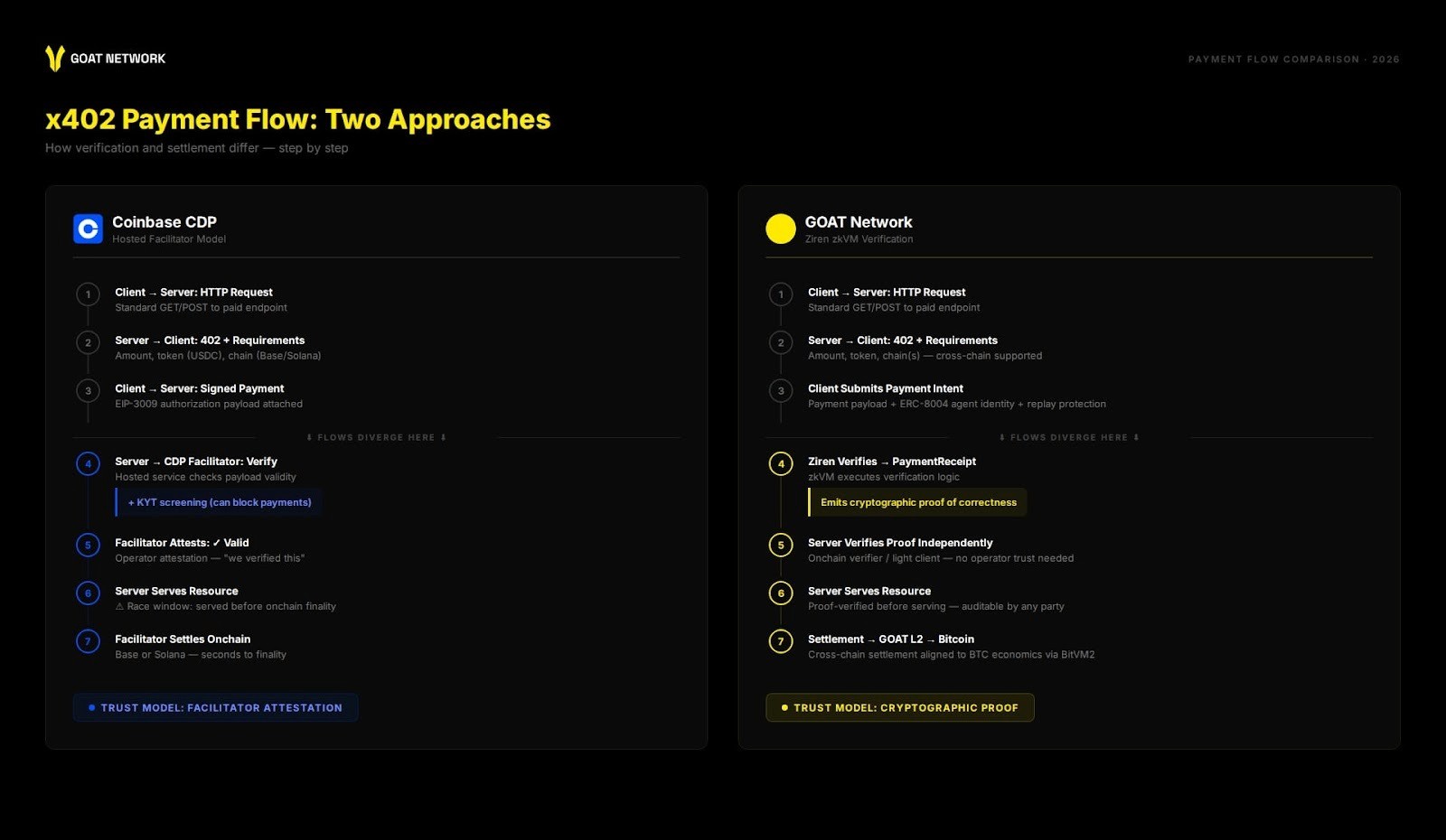
Baseline x402 deployments like Coinbase’s lean on a central facilitator that tells you whether a payment is valid. That’s operationally convenient but creates a central trust surface: if the facilitator is wrong, offline, censored, compromised, or policy-blocking, the system’s truth becomes contingent on the operator.
Ziren changes the model from attestation to verification.
The client submits a payment intent with replay protection and Ziren verifies the relevant conditions and outputs a cryptographic PaymentReceipt. The server then verifies the receipt before serving.
This changes what the server is trusting. Instead of trusting the facilitator’s word, it verifies a proof-derived artifact.
Two implications matter:
Reduced central trust. Verification can be checked independently, and correctness does not depend on one service’s assertion.
Cleaner serve-condition. The server can serve only when it has a receipt it can verify, tightening the “serve-before-finality” risk profile depending on what the receipt proves.
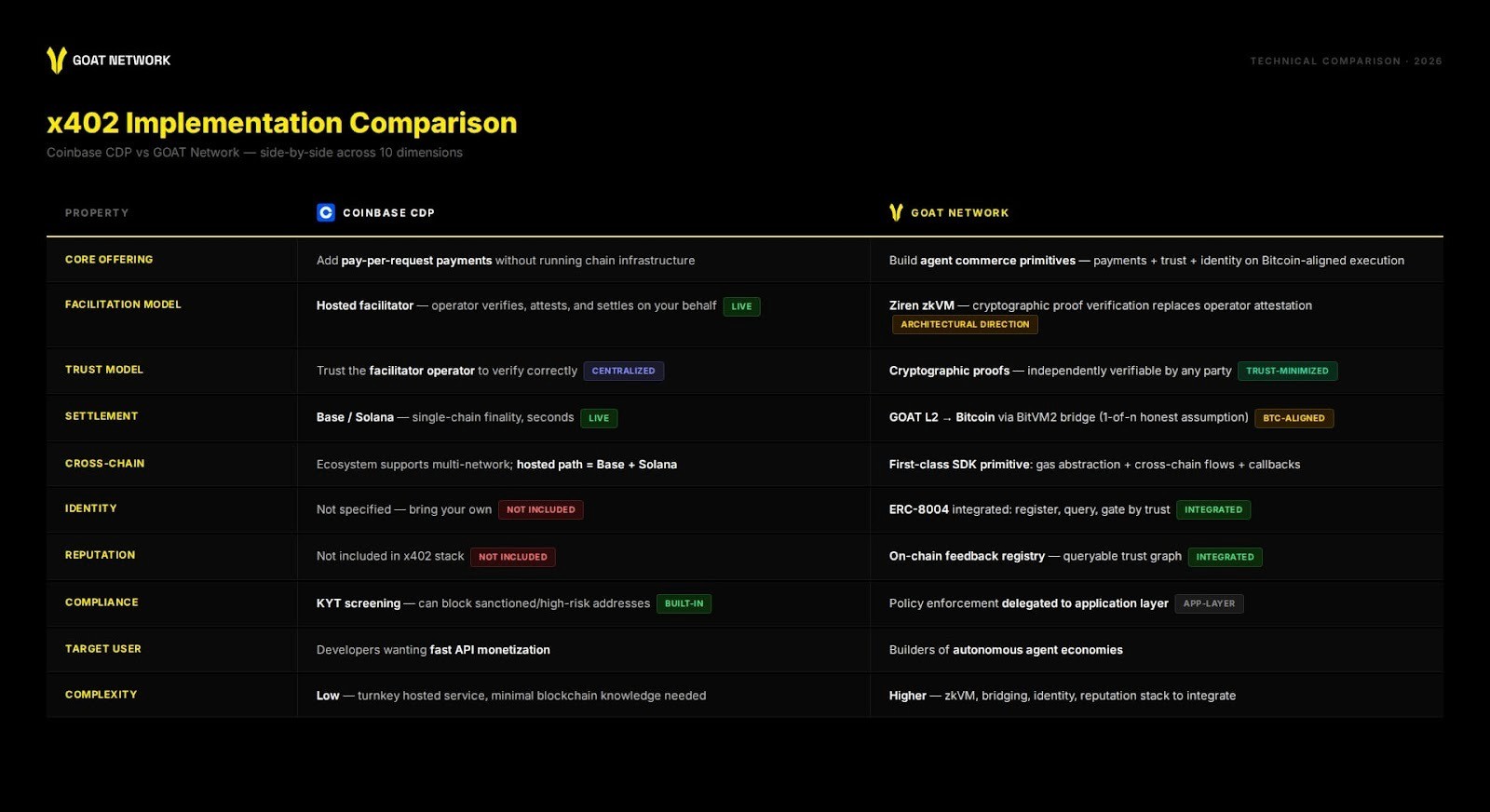
If your priority is time-to-market, stable pricing rails, and a compliance-ready hosted path that removes operational burden, Coinbase’s hosted facilitator model is the pragmatic choice.
If your priority is agent-to-agent commerce at scale - multi-rail payment orchestration, identity and reputation as a native primitive, Bitcoin-aligned settlement guarantees, and a path from facilitator trust to proof-verified receipts - then GOAT Network is the stack built for that end state.
Same primitive. Different trust model, settlement target, and scope of what “payment” is expected to enable.
Start building on GOAT Network today.