Cryptocurrency solves many problems that traditional finance imposes on agents: permissionless access, 24/7 availability, programmable execution. But not all cryptocurrency architectures are equally suitable for agent-native money. The properties that matter for human users differ from those that matter for autonomous economic actors.
pioneered smart contract platforms and remains the dominant ecosystem for decentralized applications. Its strengths are undeniable: a solid programming environment, deep liquidity, extensive tooling, and network effects from thousands of deployed protocols. For many use cases, Ethereum is the obvious choice.
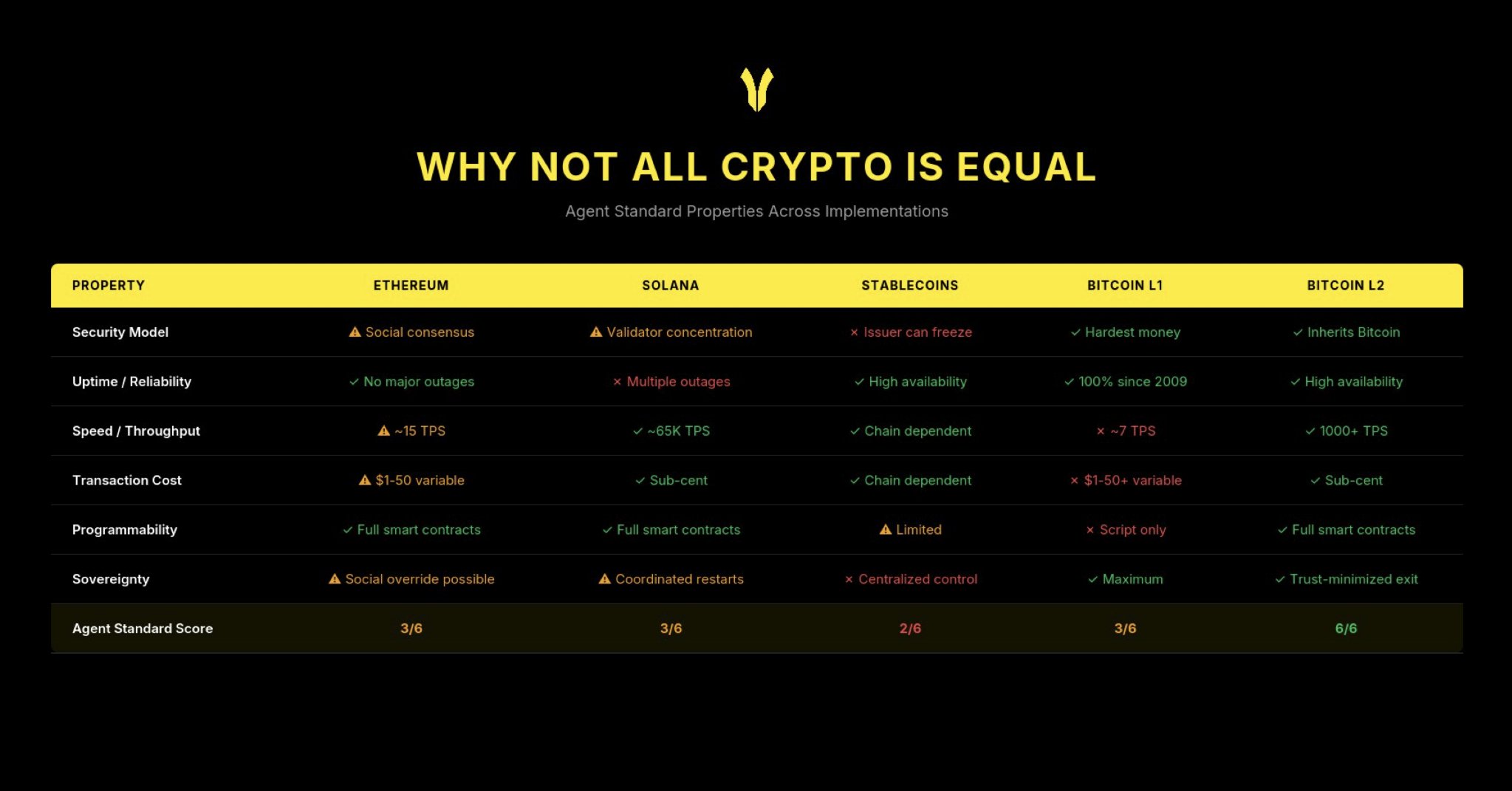
But examine Ethereum's security model and a problem arises: consensus depends on social coordination. Proof-of-stake requires validators to reach agreement not only on technical validity but on which fork to follow during disputes. When the DAO was exploited in 2016, the Ethereum community chose to roll back the blockchain - a socially coordinated response that invalidated technically valid transactions.
This flexibility is sometimes desirable. It allows the network to respond to unforeseen crises through human judgment. But it introduces uncertainty that agents cannot tolerate. An agent managing significant value needs to know that the rules cannot change through social consensus, that technically valid transactions cannot be invalidated retroactively, and that protocol-level censorship cannot be imposed through validator coordination.
The @ethereumfndn's influence over network direction adds to this concern. While Bitcoin has no formal organization that can direct development, Ethereum has a foundation that coordinates upgrades, manages research priorities, and exerts significant influence over the ecosystem. This centralization of coordination is efficient - but efficiency comes at the cost of credible neutrality.
For agents managing modest value or operating in environments where social recovery is desirable, Ethereum's tradeoffs are acceptable. For agents managing significant treasuries or requiring maximum assurance that rules will not change, harder guarantees are necessary.
offers impressive performance: thousands of transactions per second, sub-second confirmation times, and transaction costs measured in fractions of a cent. For applications requiring high throughput and low latency, Solana provides technical advantages that Ethereum cannot match at layer one.
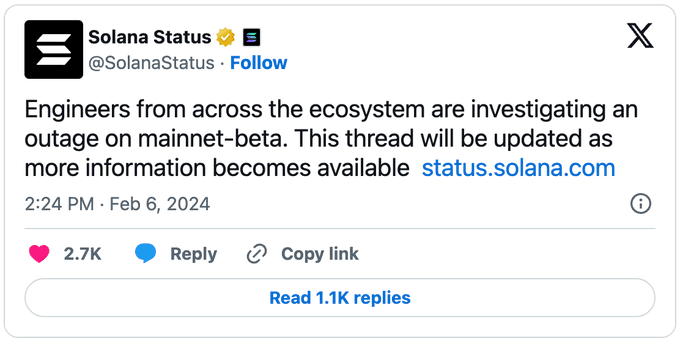
But reliability matters more than speed for autonomous agents managing real value. Solana has experienced multiple network outages - periods where block production halted and transactions could not be processed. In September 2021, the network was down for 17 hours. In January 2022, another outage lasted seven hours. In June 2022, the network degraded for several hours. These outages caused complete service unavailability.
Additionally, Solana's validator set is more concentrated than Bitcoin's or Ethereum's, with fewer independent operators controlling consensus. The network has undergone several coordinated restarts requiring manual intervention from validators. These characteristics suggest a network optimized for performance over decentralization and robustness.
For agents making frequent microtransactions where temporary unavailability is tolerable, Solana's performance advantages may outweigh its reliability risks. For agents that cannot afford downtime or require maximum resistance to coordinated intervention, Solana's tradeoffs are disqualifying.
Stablecoins like @circle's USDC and
's USDT provide price stability by pegging to fiat currencies. This minimizes volatility risk and enables agents to operate in familiar denominations. For many applications - paying for services priced in dollars, providing predictable wages, maintaining stable accounting - stablecoins are practical and effective.
But stablecoins inherit the properties of the fiat they track, including censorability. Circle, which issues @USDC, has frozen addresses at the request of law enforcement. In July 2023, Circle froze over $75 million across multiple addresses. Tether has similarly frozen addresses containing USDT. These actions are legally required when issuers are subject to U.S. jurisdiction.
For human users, this is often acceptable - most people do not expect to be targets of asset seizure, and some appreciate that their funds could be recovered if stolen. For agents, censorability is incompatible with sovereignty. An agent cannot operate with confidence if its entire treasury can be frozen through appeal to a centralized issuer. It cannot guarantee payment to counterparties if those payments can be reversed by third-party intervention.
As stablecoins are also dependent on banking relationships, agents using stablecoins are ultimately exposed to traditional financial system risk, merely abstracted behind a crypto interface. USDC's value derives from Circle's deposits in regulated financial institutions. If those relationships are severed - whether through regulatory action, bank failure, or political pressure - the peg breaks. In March 2023, USDC briefly lost its dollar peg when Silicon Valley Bank collapsed. Circle had approximately $3.3 billion of USDC reserves deposited at SVB, and uncertainty about those funds caused USDC to trade as low as $0.87. The peg recovered only after the Federal Reserve intervened to guarantee all SVB deposits - a reminder that stablecoin stability ultimately depends on government backstops for traditional banks.

For short-term operational balances and payments to counterparties who require dollar-denominated settlement, stablecoins are useful. For long-term treasury management and sovereign financial operations, they reintroduce the centralization and seizure risk that cryptocurrency was designed to eliminate.
provides the strongest monetary properties: absolute supply cap, highest decentralization, greatest security budget, most credible neutrality. Its consensus rules have remained stable for over a decade. It has never experienced unplanned downtime. It has resisted every attempt at coordinated rule changes that lacked overwhelming consensus. For storing value long-term, nothing matches Bitcoin's assurance properties.
But Bitcoin layer 1 has limited throughput and high transaction costs. The network processes approximately seven transactions per second. During periods of high demand, transaction fees can exceed $50. Confirmation times average ten minutes but can extend to hours when blocks are full. Smart contract functionality is deliberately limited.
For an agent making thousands of daily microtransactions, these limitations are prohibitive. An agent cannot pay $50 per transaction for coffee purchases. It cannot wait hours for payment confirmation when providing real-time services. It cannot implement complex conditional logic using Bitcoin script alone.
Bitcoin layer 1 is ideal for final settlement and long-term storage. It is inadequate for the high-frequency, low-value transactions that characterize agent economic activity.
The Bitcoin Layer 2 Solution
Bitcoin layer 2 protocols inherit Bitcoin's security properties while enabling higher throughput and programmability. The design pattern consists of anchoring commitments to Bitcoin's blockchain while processing transactions off-chain or on sidechains, then using cryptographic proofs or economic incentives to ensure that layer 2 activity can be validated against layer 1.
The @lightning Network demonstrates this for simple payments: lock funds in Bitcoin multisig addresses, route payments through channel networks off-chain, and settle net balances on Bitcoin layer 1 only when necessary. Millions of transactions can occur off-chain with only periodic on-chain settlement.
More recently, validity rollups and BitVM-based bridges extend this pattern to full smart contract execution. These systems process transactions on layer 2 with full programmability, then commit cryptographic proofs to Bitcoin layer 1 that allow anyone to verify correctness. The layer 2 can have high throughput and low fees, while layer 1 provides security and finality.
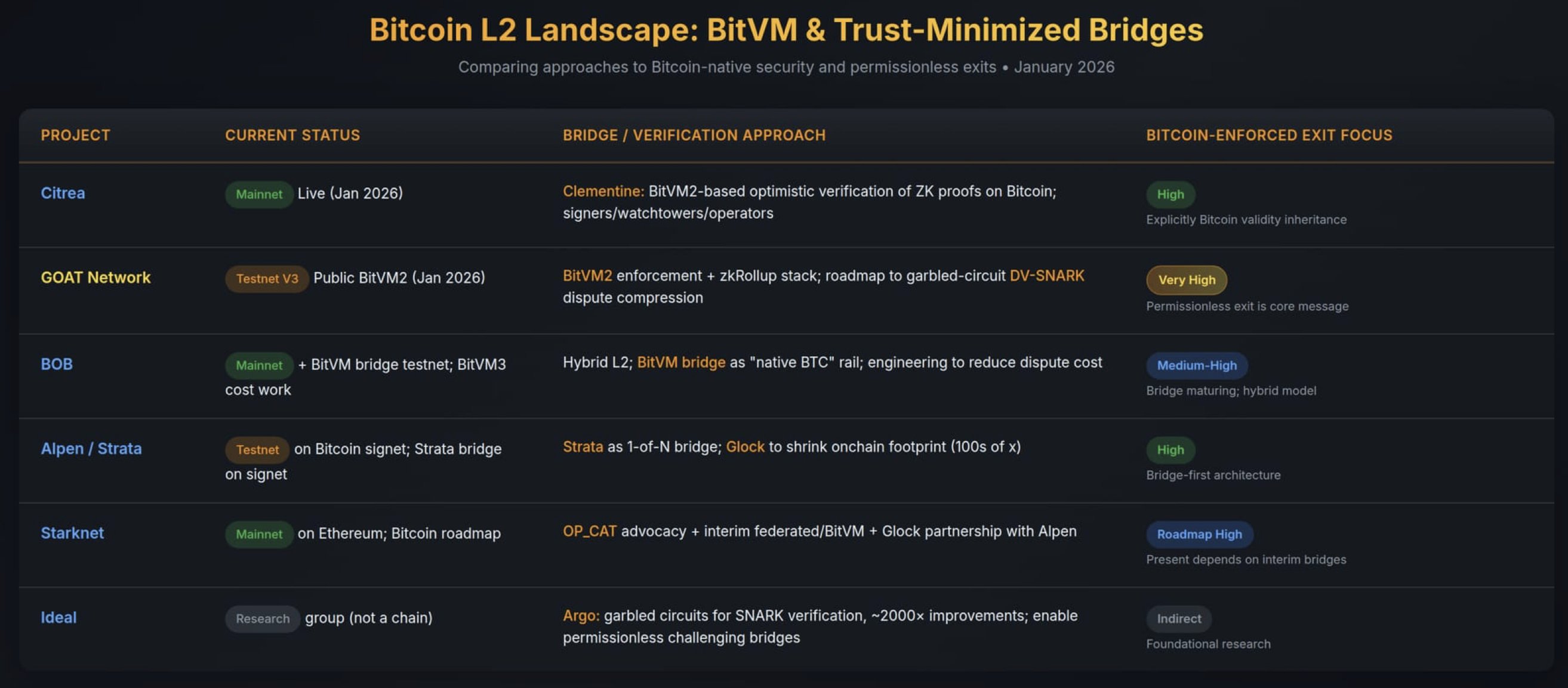
This architecture provides what agents need: Bitcoin's monetary hardness combined with the programmability and performance necessary for complex agent interactions. An agent can hold its primary treasury in Bitcoin, operate daily through layer 2 protocols, and fall back to layer 1 settlement when maximum security is required.
The critical requirement is that layer 2 bridges must be trust-minimized. If a layer 2 system requires trusting a federation, multisig, or centralized operator to allow withdrawals, it reintroduces the human intermediation that agents require. True layer 2 systems provide cryptographic or economic guarantees that users can exit to layer 1 without permission.
Agents don't just need crypto - they need the "right" crypto. Hard money properties matter more for machines than humans, because machines can't lobby, sue, or appeal.
And there's no harder money than Bitcoin.


.png)