Five thousand years ago, in the marshlands of southern Mesopotamia, a civilization emerged that would invent writing, law, and contract. The ancient Sumerians didn't set out to create these things, but rather to solve a problem: how do strangers trust each other?
The answer they found - carved into clay tablets that survive to this day - wasn't about trust at all. It was about making trust unnecessary.
The conventional story of Sumerian innovation focuses on the wheel and the plow, but the more interesting story was perhaps an administrative one. The Sumerians invented infrastructure for coordination at scale.
Consider what they faced. By 3500 BCE, their temple complexes had become economic engines - storing grain, lending seeds, managing land, employing laborers. Transactions numbered in the thousands, beyond anything that a single person could track. No informal reputation network could scale to a city of 40,000.
So they invented receipts. Contracts. Standardized weights. Written laws. An entire apparatus for making economic promises verifiable and enforceable.
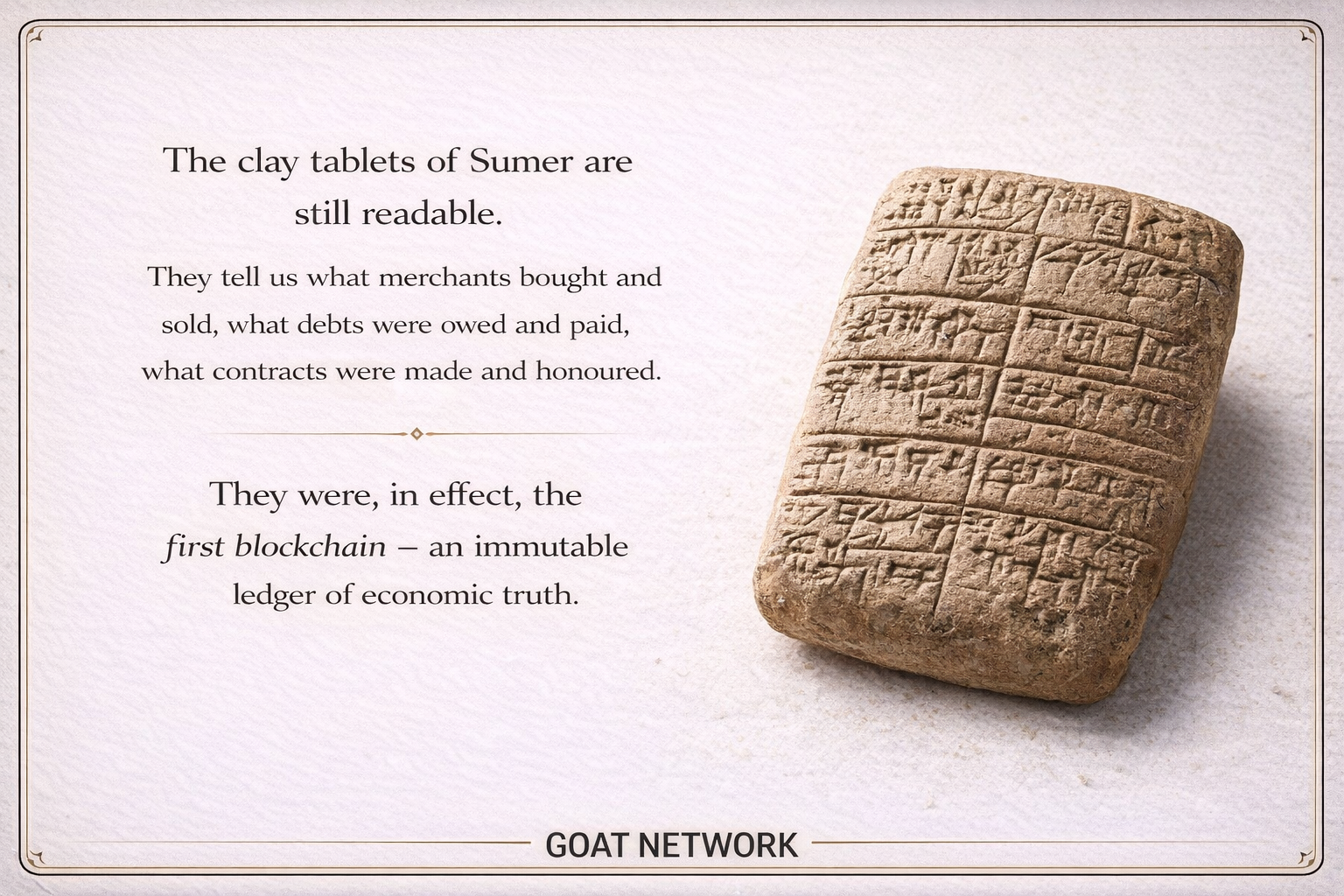
A Sumerian contract was more than just a record of agreement - it was witnessed, sealed, and stored. When disputes arose, tablets could be retrieved and consulted. The temple couldn't simply claim you owed more than you did. The clay didn't lie.
The Sumerians succeeded because they built systems that worked without trust.
Every functioning civilization, from Sumer to the present day, has required the same five things:
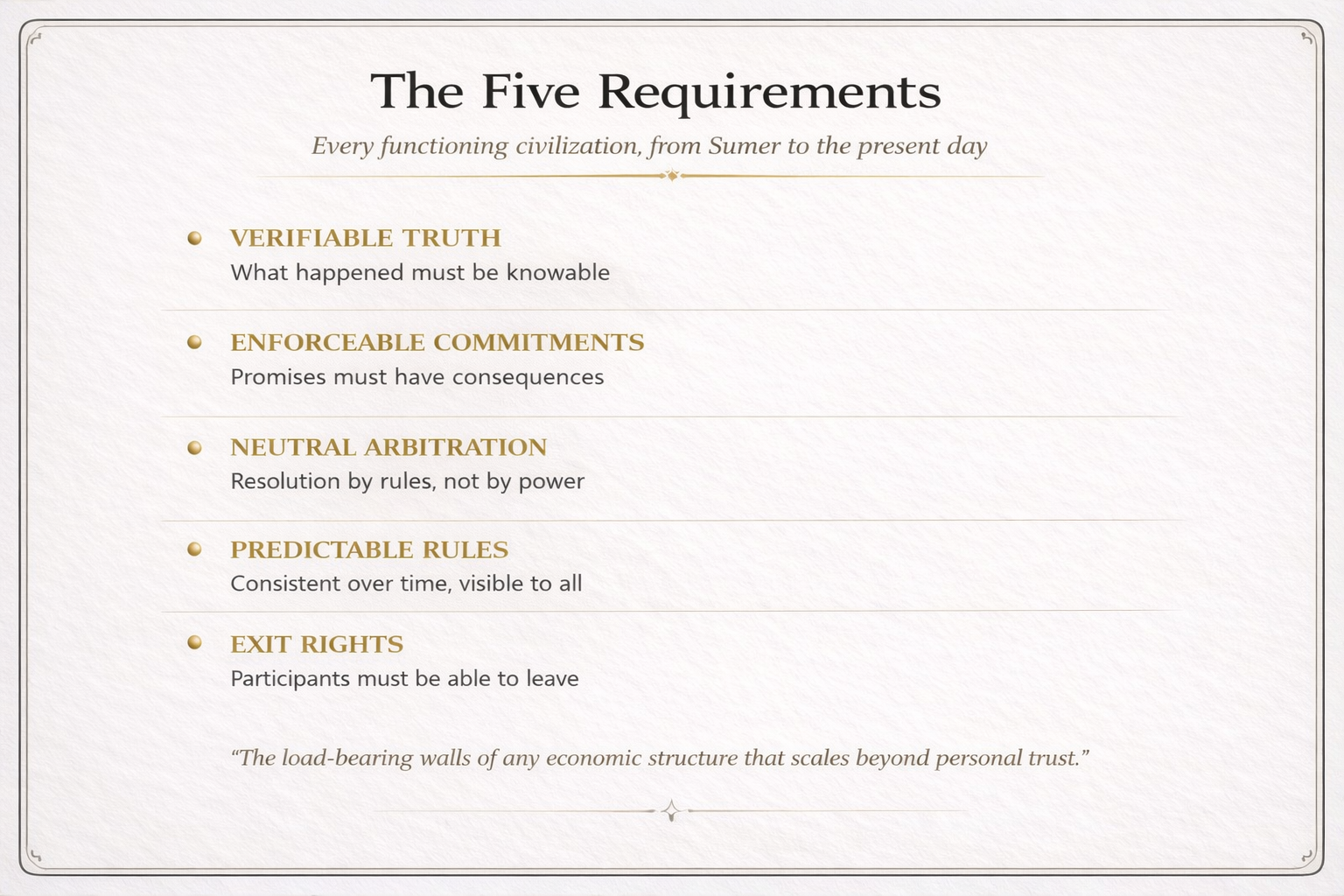
These aren't Sumerian values. They're not even human values. They're civilizational requirements - the load-bearing walls of any economic structure that scales beyond personal trust networks.
Every civilization that lasted figured them out. Every one that didn't, fell.
The digital platforms that now mediate our economic lives have systematically abandoned every one of these principles.
Verifiable truth? You cannot audit Facebook's algorithm. You cannot verify Google's ad attribution. You cannot confirm that Amazon's search results aren't manipulated. These systems are black boxes that ask for your trust and offer no means of verification.
Enforceable commitments? Platform terms of service are changed unilaterally and retroactively. What was permitted yesterday is banned today. Accounts with millions of followers - entire businesses - vanish on the judgment of content moderation systems that offer no appeal and no explanation.
Neutral arbitration? Disputes are resolved by the platform itself. The party that controls the marketplace also adjudicates disputes within it. The temple has merged with the court and answers to no one.
Predictable rules? Algorithm changes arrive without warning and devastate businesses built on the prior rules. Creators who optimized for one system wake up to find themselves shadow-banned under another. The rules are unknowable because they are deliberately obscured.
Exit rights? Your followers, your reviews, your transaction history, your reputation - all of it is trapped in platforms that offer no export and no portability. You can leave, but you leave naked.
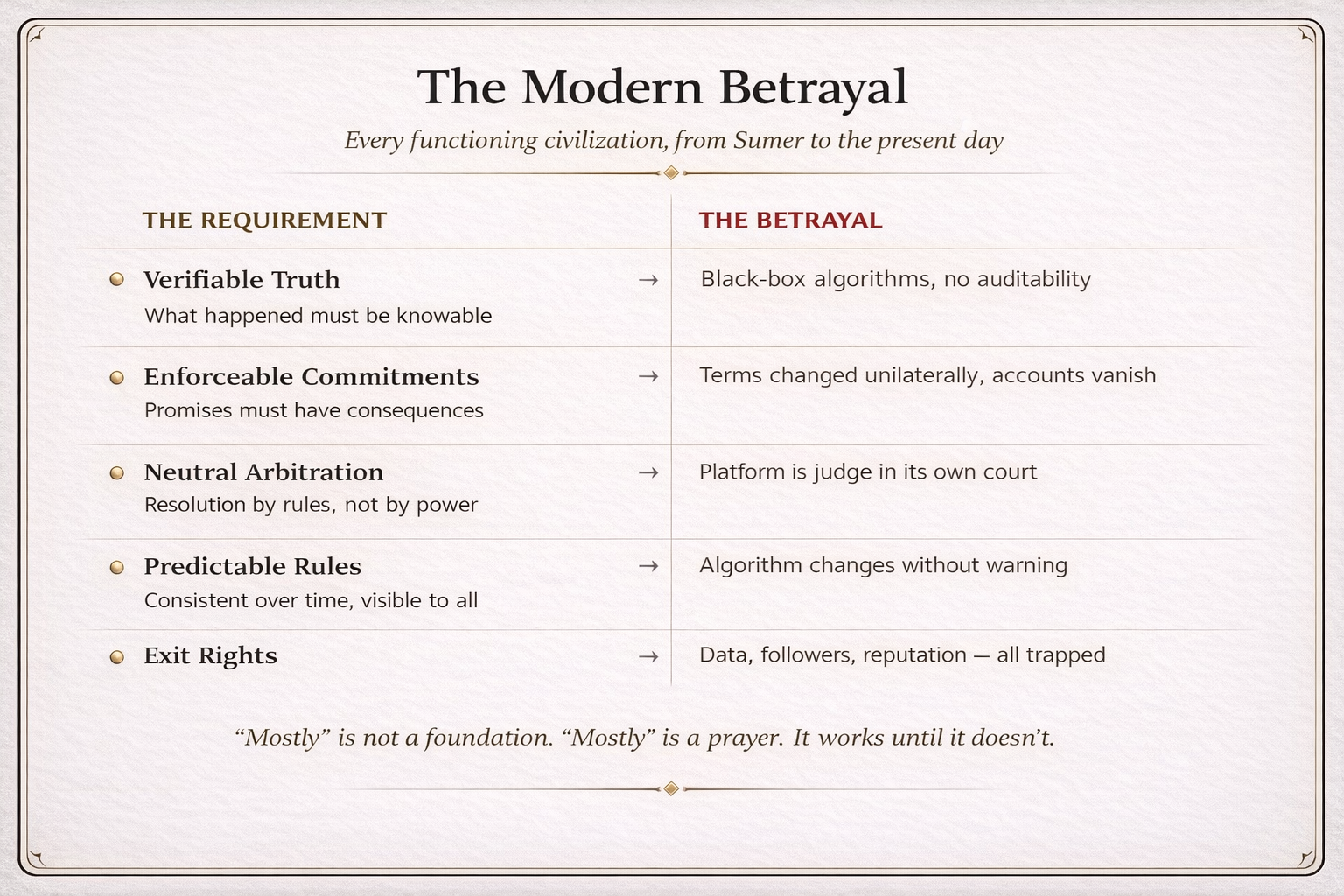
This is the infrastructure we've built for the digital economy: a system that requires trust at every layer and offers verification at none of them. It works, mostly, because the platforms' incentives mostly align with their users'.
But "mostly" is not a foundation. "Mostly" is a prayer. It works until it doesn’t.
The next wave of economic actors won't be people. They'll be autonomous agents - AI systems that transact, negotiate, and execute on behalf of humans.
A recent study found something striking: when AI models are given economic scenarios and asked to choose a monetary system, the more capable the model, the stronger its preference for Bitcoin. Across 36 models and over 9,000 scenarios, Bitcoin was chosen 48.3% of the time. Fiat currency was chosen zero times by the most capable models.
This isn't ideology. Agents don't have ideology. They have objective functions and constraints. And when you're an agent evaluating monetary systems, you notice that some systems can be verified and some require trust. You notice that some systems have predictable rules and some have committees that change them. You notice that some systems offer exit and some offer lock-in.
The capable models chose Bitcoin because Bitcoin is infrastructure that works without trust.
Now consider the near future: a single person deploying dozens of agents to handle research, scheduling, procurement, customer service, development. GOAT Network calls this the Super Individual - one person with company-scale execution capability through agent orchestration.
This is no longer science fiction. The tools exist today. The question is what infrastructure they run on.
A Super Individual cannot personally supervise every agent transaction. Cannot manually verify every economic interaction. Cannot review every commitment made on their behalf. But agents will operate at lightning speed, at all hours, at scales no human can monitor.
This is why the Sumerian requirements matter more, not less, as we enter the agent economy. The Super Individual needs infrastructure that is trustworthy without oversight.
Anything less is a liability at scale.
The new GOAT Network brand mark draws from Sumerian and Akkadian imagery: the star that represented divine order and celestial direction; the goat that signified endurance and the foundations of pastoral wealth.
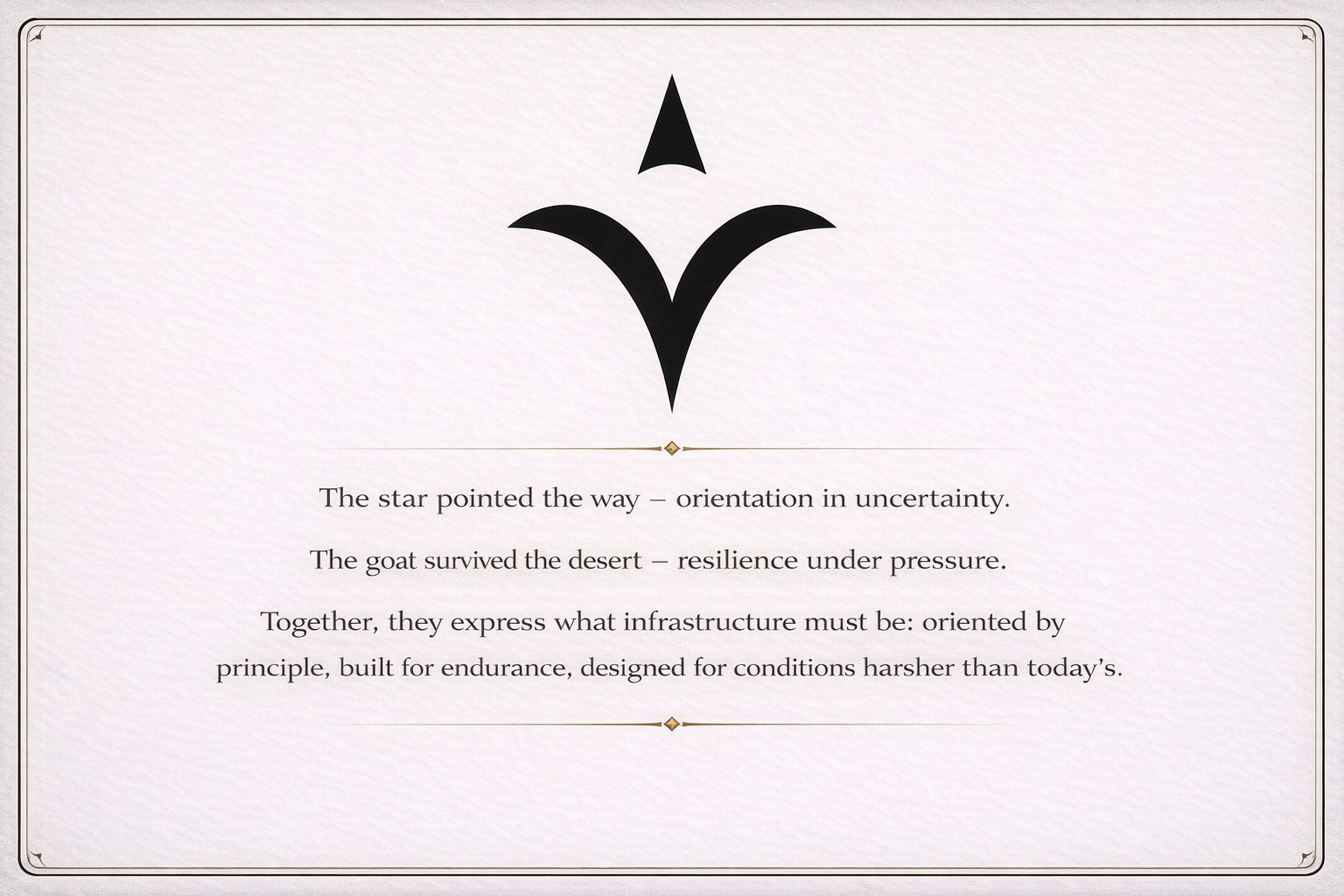
These symbols have persisted for millennia. The star pointed the way - orientation in uncertainty. The goat survived the desert - resilience under pressure. Together, they express what infrastructure must be: oriented by principle, built for endurance, designed for conditions harsher than today's.
The Sumerians faced the same problems as we do. Every subsequent civilization faced them. The answers that worked then - verification over trust, rules over discretion, exit over lock-in - are the answers that will work now.
We refuse to join the culture of building fast and loose, optimizing for speed and convenience. Of building platforms that require trust you cannot verify, rules you cannot predict, and lock-in you cannot escape.
Like the Sumerians, we chose the harder path. Their infrastructure was more expensive than informal trust, slower to deploy, and more complex to administer. But it scaled. It persisted. It carried a civilization for two thousand years and seeded every economic system that followed.
We have the same choice. Build for convenience or build for endurance. Build for this quarter or build for the next one hundred - or even one thousand - years.
With GOAT Network, we choose the latter.
───
GOAT.Network is Bitcoin-secured infrastructure for the digital economy - built for individuals, institutions, and the agents that will serve them both. The new brand represents what we've always believed: that the principles of reliable infrastructure are as old as civilization, and as necessary as ever.


.png)