Every Layer 2 begins the same way: a new chain, a bridge, a handful of testnet transactions, and a blog post that says "we're live". The infrastructure gets built. The chain works. And then… silence. Not because the team stopped shipping, but because the distance between "functional chain" and "place where people build things" is enormous - and most projects never cross it.
Our team has spent the past several months doing exactly the kind of work that doesn't make headlines: building the merchant tools, agent infrastructure, developer documentation, and application surfaces that turn raw blockchain capacity into something people and agents actually want to use.
Crypto has no shortage of payment protocols. What it lacks are payment “platforms” - the full operational stack that lets a merchant go from being merely interested in x402 to actually processing transactions - frictionlessly, without requiring a team of integration engineers.
That's what GOAT x402 has become. Our live merchant platform is the kind of infrastructure that separates GOAT Network from the majority of projects still stuck in proof-of-concept:
x402 Merchant Onboarding Demo | x402 Payment Demo
The presentation layer has been rebuilt for clarity. Approval, top-up, and usage flows have been streamlined. The platform is ready for Agent adoption - a statement that very few projects can honestly make.
Here's where the GOAT Network positioning gets genuinely interesting.
Most chains that mention "AI agents" are bolting on a chatbot demo and calling it agent infrastructure. Our approach is entirely different: building agent infrastructure as a forefront layer of the ecosystem, with its own standards, tooling, and economic rails.
Our new AgentKit is a comprehensive, modular toolkit for agent developers. Recent work includes expanding the plugin system, cleaning up packaging and documentation, and - critically - building payment-related plugins that connect directly to x402. This means agents built with the AgentKit can natively transact. They don't need custom payment integration. They don't need to go off-chain. The payment layer is innate, and it works.
Building on our comprehensive coverage of x402, ERC-8004 - the standard for agent identity and capability registration - is now formally documented and published in the official developer docs, whilst our in-development 8004scan will give the agent ecosystem something it desperately needs: visibility. It's a purpose-built explorer for the agent economy, enabling clear visualization of agent registrations, capabilities, and activity.
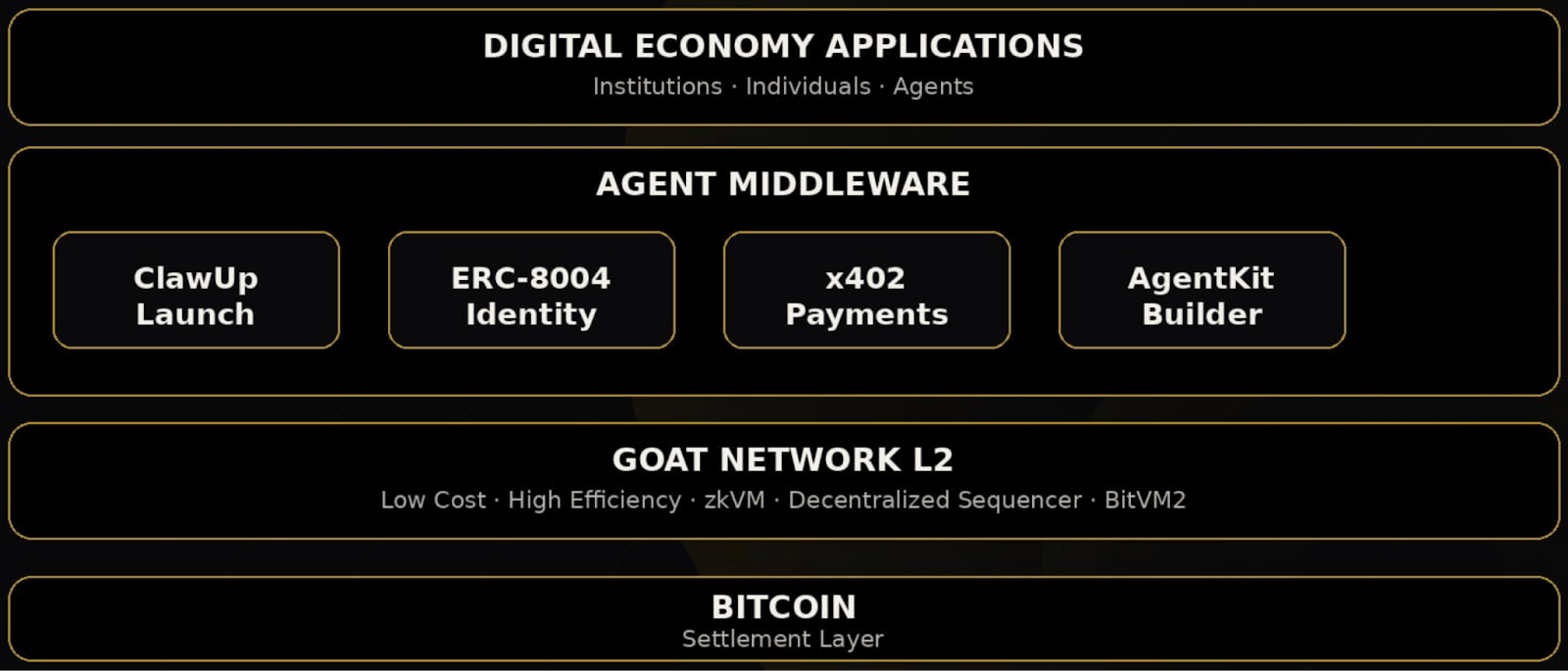
More features are being added soon that will further expand agent capabilities on GOAT Network - giving them stronger identity, coordination, and transaction primitives as the network moves closer to a full operating environment for autonomous economic activity.
Consider the paths that now exists:
A merchant can register on x402, go through a structured onboarding flow, configure webhooks, and start accepting payments - in their preferred language, across chains, and with proper admin controls.
An agent developer can use AgentKit to build autonomous agents with native payment capabilities, register them using ERC-8004, and will soon be able to deploy them into an environment where they can pick up tasks and verify their work - all on documented, public standards.
Budding builders can visit the docs, understand the architecture, read the standards, and start integrating without guessing or reverse-engineering - and soon use 8004scan to see the agent ecosystem taking shape in real time.
This kind of vertical integration - where payments, agent tooling, developer experience, and application surfaces all connect and reinforce each other - is what separates a blockchain from a platform. GOAT Network is building a comprehensive platform for the agent economy.
There are gaps to fill, edges to polish, and adoption to earn. But the foundational tools now exist. The documentation is live. The standards are published. The infrastructure is hardening.
For merchants exploring crypto-native payments, for developers building autonomous agents, for teams evaluating where to deploy: the ecosystem is open and at your disposal.
Start here:
GOAT Network is the Bitcoin-Secured Infrastructure for the Digital Economy. Learn more at goat.network.


.png)

.jpg)